



Summary
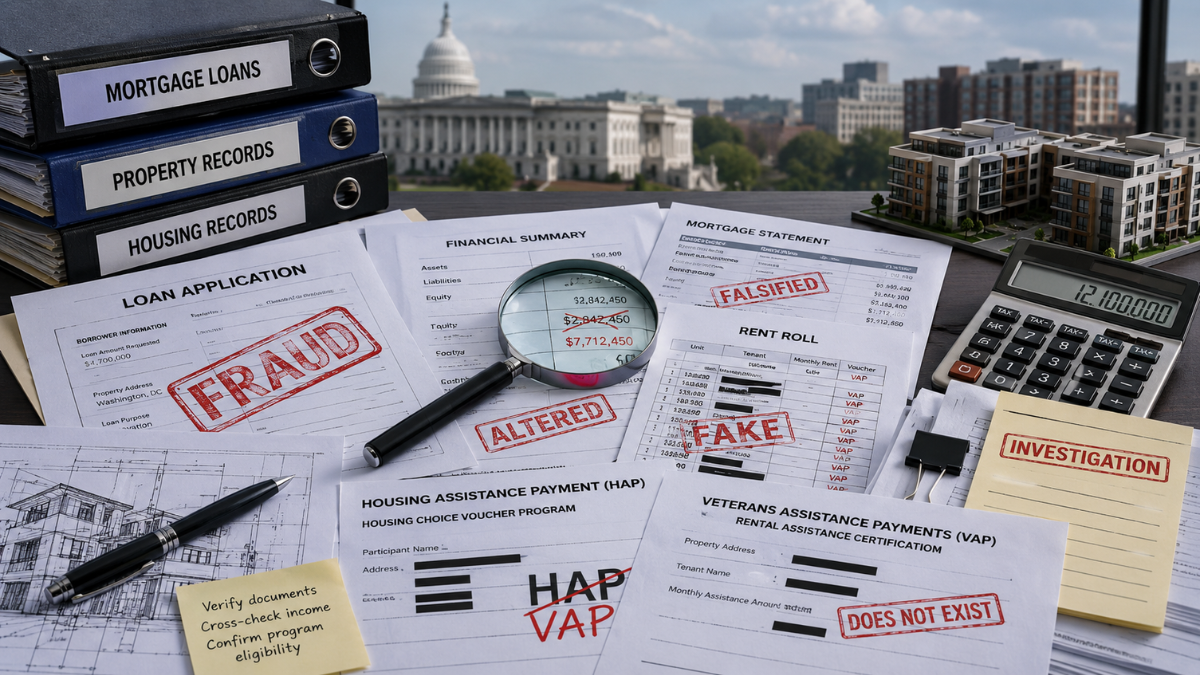
Richard Cunningham, a former D.C. Housing Authority employee and Washington, D.C.-based real estate developer, has pleaded guilty in a federal mortgage fraud case involving nearly $15 million in loan applications. Federal authorities alleged that the scheme involved falsified mortgage statements, forged signatures, and altered housing assistance documents submitted to private lenders between August 2020 and May 2024. Investigators said Cunningham sought approximately $14.9 million in financing and obtained about $12.1 million through the fraudulent applications.
Key Facts
- Defendant: Richard Cunningham
- Former Employer: D.C. Housing Authority
- Amount Sought: Approximately $14.9 Million
- Amount Obtained: Approximately $12.1 Million
- Timeframe: August 2020 – May 2024
- Investigating Agencies: FBI Washington Field Office and HUD-OIG
- Sentencing Date: December 4, 2026
Former D.C. Housing Authority Employee Admits Mortgage Fraud
Richard Cunningham pleaded guilty before U.S. District Judge Trevor N. McFadden to making false statements to a mortgage lending business. The case was announced by U.S. Attorney Jeanine Ferris Pirro for the District of Columbia.
According to court documents, the mortgage fraud scheme took place over nearly four years and involved several multifamily residential properties in Washington, D.C. that were owned or controlled by Cunningham.
Federal prosecutors alleged that false information and fabricated documents were submitted to private mortgage lenders in an effort to secure millions of dollars in renovation financing.
Romanian national pleads guilty in fraud scheme involving shell companies and fake identities
First Phase Involved Falsified Mortgage Statements
The first phase of the scheme focused on obtaining renovation loans from a Virginia-based private mortgage company.
Court records show that Cunningham applied for six secondary renovation loans. To qualify for the financing, the lender required sufficient equity in the properties being offered as collateral.
Authorities alleged that Cunningham knew the available equity was not enough to meet the lender’s requirements. Investigators said he submitted falsified mortgage statements that significantly understated the balances owed on primary mortgages attached to the properties.
By showing lower mortgage balances, the properties appeared to have more equity than they actually did.
Based on the information provided in the applications, the lender approved and funded all six loans. The total value of those loans was approximately $7.4 million.
Alleged Fake Veterans Housing Documents Used for Additional Financing
The second phase of the mortgage fraud scheme involved loan applications submitted to an Oregon-based private mortgage company.
Federal authorities said Cunningham sought renovation financing for two additional Washington, D.C. properties. To support the applications, investigators alleged that documents were created to make the properties appear to generate reliable rental income through a federal housing assistance program.
The applications referenced a program called Veterans Assistance Payments, or VAP. However, authorities stated that no such program exists within the U.S. Department of Housing and Urban Development (HUD).
According to court filings, genuine Housing Assistance Program documents from HUD’s Housing Choice Voucher Program were allegedly altered. Investigators said references to HAP were changed to VAP throughout the paperwork.
Authorities also alleged that forged entries and signatures were added to create the appearance that veterans were already living in the properties under a federal voucher program.
In addition, fabricated rent rolls were allegedly submitted to the lender. Those records falsely indicated that all tenants were receiving vouchers from the Department of Veterans Affairs.
One of the loan applications was approved, resulting in approximately $4.7 million in financing. A second application was ultimately rejected.
Nearly $15 Million in Financing Was Sought
Federal prosecutors stated that Cunningham sought approximately $14.9 million in total financing from the two private lenders involved in the case.
Authorities alleged that approximately $12.1 million was successfully obtained through the use of false statements and fraudulent supporting documents.
The lenders relied on the submitted information when evaluating the loan applications and making funding decisions, according to court records.
The charges stem from the alleged use of falsified financial records, altered housing assistance documents, forged signatures, and fabricated rental information during the application process.
FBI and HUD-OIG Conducted the Investigation
The investigation was led by the FBI Washington Field Office and the Office of Inspector General for the U.S. Department of Housing and Urban Development, commonly known as HUD-OIG.
Investigators reviewed loan applications, mortgage statements, lease agreements, rent rolls, and other records connected to the financing requests.
The case was prosecuted by HUD-OIG Special Assistant U.S. Attorney Samantha R. Miller on behalf of the U.S. Attorney’s Office for the District of Columbia.
Guilty Plea and Sentencing Details
Cunningham pleaded guilty to charges involving false statements made to a mortgage lending business.
Federal law provides a maximum statutory penalty of 30 years in prison and a fine of up to $1 million for the offense.
Sentencing has been scheduled for December 4, 2026.
The Department of Justice announcement also noted the recent creation of the National Fraud Enforcement Division. The division supports federal efforts to investigate and prosecute fraud involving taxpayer dollars and federal benefit programs.
The announcement further referenced the Task Force to Eliminate Fraud, a government-wide initiative chaired by Vice President J.D. Vance and focused on addressing fraud, waste, and abuse within federal programs.