
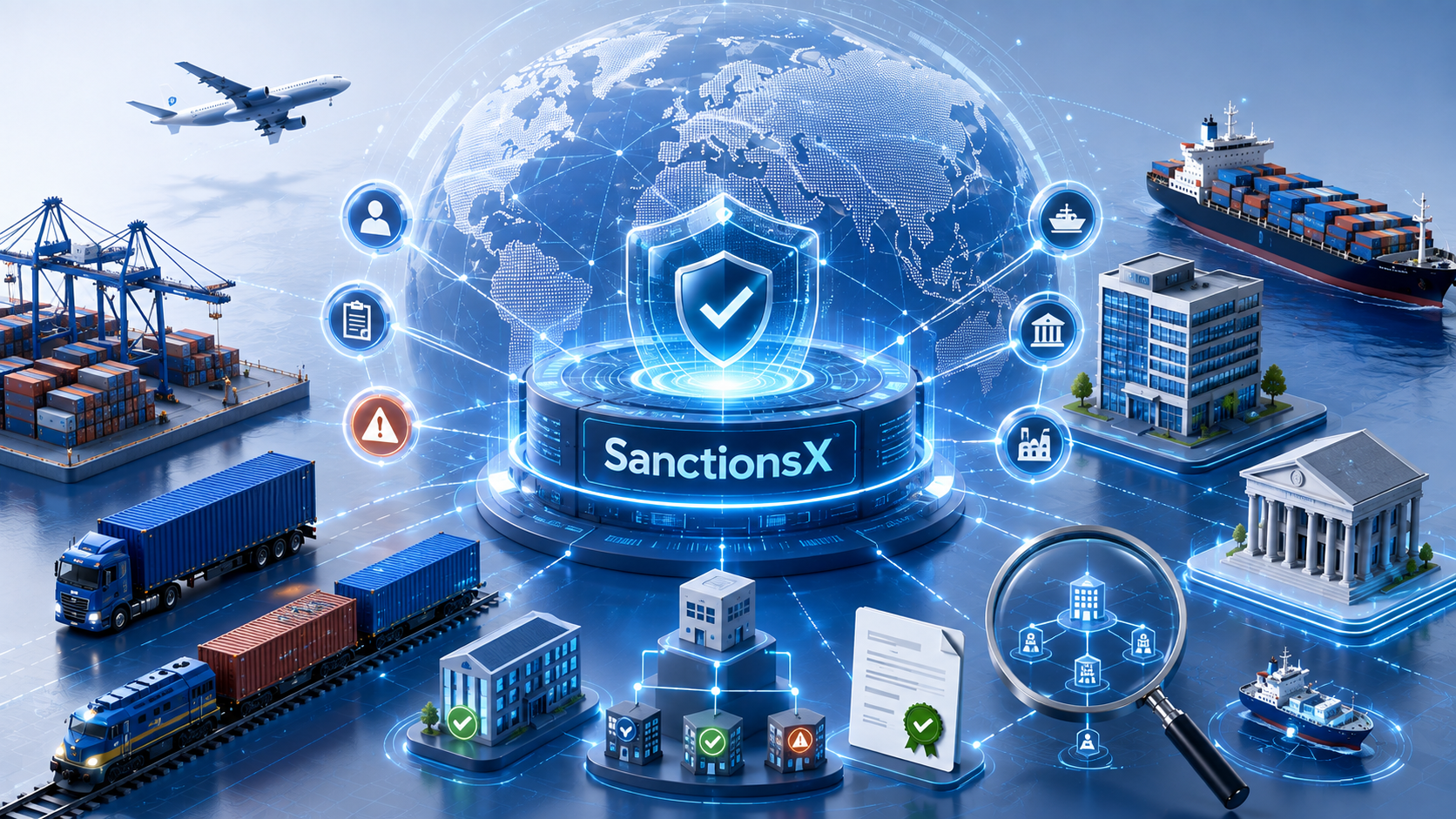


SanctionsX is a sanctions and export control screening platform built by Riskpro Technology that helps exporters, banks, freight forwarders, trading houses, and compliance teams check counterparties, vessels, and beneficial owners against global sanctions, denied-party, and watchlist databases before a deal closes — not after a regulator asks questions. It screens names and entities across sanctions lists (OFAC, UN, EU, UK, and jurisdiction-specific registries), politically exposed persons (PEP) databases, export control and denied-party lists, and maritime detention and vessel-risk registries, then turns the results into a documented, audit-ready compliance report.
In short: SanctionsX answers the question “Is it safe to do business with this person, company, or ship?” — and it answers it with evidence, not guesswork.
The Problem SanctionsX Solves
Global trade compliance has become one of the highest-risk, lowest-visibility parts of running an export, shipping, or trade finance business. Sanctions regimes change frequently, ownership structures are deliberately layered to obscure who actually controls a company, and a single missed match against a denied-party list can result in frozen shipments, blocked payments, regulatory penalties, and reputational damage that outlasts the transaction itself.
This is not a theoretical risk. According to CA Mayur Joshi, Director of Riskpro, “Reputational damage is the biggest risk involved in the violations of Sanctions in India. Sanctions may not affect many businesses directly. We have seen some companies doing business with Yemen but as there is no financial implications, businesses avoid the banking system and work with counterparties in high risk jurisdictions.” Joshi is the founder of Riskpro Management Consulting, established in 2008, and has personally investigated frauds worth over ₹40,000 crore across 700+ corporate cases — the kind of hands-on caseload behind the screening logic SanctionsX is built on.
Most mid-size exporters and trading companies do not have an in-house compliance department with access to enterprise-grade screening tools. They rely on manual Google searches, outdated spreadsheets, or nothing at all. Larger organizations that do have compliance tooling often find it slow, disconnected from their actual deal workflow, or too expensive to extend to every counterparty on every transaction. SanctionsX was built to close that gap: enterprise-grade screening depth, delivered as a fast, deal-embedded workflow that any exporter, bank, or logistics company can actually use.
You may like to Access our free resources on Sanctions Screening
How SanctionsX Works ?
At its core, SanctionsX combines a multi-jurisdiction sanctions database with a structured deal workspace:
- Screening. A name — an individual, a company, or a vessel — is checked against active sanctions, denied-party, PEP, and export control sources. The matching engine looks for exact name matches, partial and token-based matches (to catch name-order or spelling variations), and alias hits, and scores every result by confidence and risk severity.
- Deal workspace. Every transaction (a shipment, a trade finance deal, a new counterparty relationship) becomes a “deal” with its own counterparties, vessel information, and export classification. Each counterparty is screened, matches are reviewed by an analyst, and false positives are formally dispositioned rather than just dismissed.
- Beneficial ownership analysis. SanctionsX doesn’t stop at the named counterparty. It traces beneficial ownership chains — who actually owns and controls the company — and screens those owners too, since sanctioned individuals frequently hide behind layers of corporate structure rather than transacting under their own name.
- Vessel and maritime screening. For shipments, SanctionsX screens the vessel itself: ownership history, flag changes, and whether it appears on detention lists (Tokyo MoU, Paris MoU) or maritime sanctions registries associated with sanctions evasion.
- Reporting. Once screening is complete, SanctionsX generates a structured, documented compliance report — the artifact a bank, auditor, or regulator will actually want to see.
- Maker-checker workflow. Screening results and reports go through a review and approval process, so no single analyst’s judgment is the only thing standing between a transaction and a sanctions violation. Every review, disposition, and approval is logged with a timestamp and reviewer identity, creating a defensible audit trail.
Did you read the Sanctions Screening Book ?
Who SanctionsX Helps ?
Built in 2025, SanctionsX is for anyone who has to answer the question “have we checked this counterparty?” and needs a real answer, not a shrug. That includes:
Exporters and international trading companies, who need to verify every buyer, intermediary, and end-user before goods and payment change hands — especially in industries like chemicals, electronics, machinery, and dual-use goods where export control classification matters as much as sanctions screening.
Banks and trade finance institutions, who are legally required to screen parties to letters of credit, documentary collections, and trade finance facilities, and who face direct regulatory liability if a sanctioned party slips through.
Freight forwarders and shipping/logistics companies, who need to know whether a vessel carrying their cargo — or the company chartering it — carries sanctions or detention risk, since carriers can be held liable for facilitating a sanctioned shipment even if they didn’t originate the deal.
Compliance and legal teams, who need a repeatable, documented screening process they can point to during an audit or regulatory inquiry, rather than reconstructing what was checked after the fact.
Law firms and advisory practices, who screen counterparties as part of client due diligence, M&A transactions, or cross-border deal structuring.
Benefits for Exporters, Specifically
Exporters sit at the sharp end of sanctions risk: they are the party physically shipping goods, and in most jurisdictions, “I didn’t know” is not a defense against a sanctions violation. SanctionsX addresses the exporter’s specific pain points directly.
Speed without cutting corners. Quick Search lets an exporter run an instant name check on a new buyer or intermediary before a deal is even confirmed, without waiting for a full compliance review cycle. If the initial check raises a flag, a full Enhanced Due Diligence report can be ordered on that same result.
Coverage that matches how trade actually works. A single export transaction can involve a buyer, a consignee, an end-user, a freight forwarder, a bank, and a vessel — and sanctions risk can sit with any one of them. SanctionsX screens every party in the transaction, not just the immediate counterparty, and layers in export control classification (HSN/commodity code screening) so an exporter can catch both “who am I selling to” and “am I allowed to sell this to them” in the same workflow.
Documented proof of due diligence. If a shipment is ever questioned by a bank, a customs authority, or a regulator, an exporter using SanctionsX can produce a dated, evidence-backed report showing exactly what was checked, what was found, and who reviewed it — turning “we did check, trust us” into a document that stands on its own.
Lower cost of getting it right. Because SanctionsX offers tiered reports (see below), an exporter isn’t forced to pay for a full deep-dive investigation on every single counterparty. Routine checks stay fast and inexpensive; only counterparties that actually warrant deeper scrutiny get the full enhanced treatment.
Protection of banking and payment relationships. Trade finance banks increasingly push sanctions screening obligations down to their exporter clients. Being able to show a bank a structured SanctionsX report — rather than an informal assurance — can be the difference between a smooth letter-of-credit process and a stalled one.
The Different Types of Reports
SanctionsX offers two distinct report tiers, deliberately structured so the depth of the check matches the actual risk of the transaction, rather than forcing every counterparty through the same expensive process.
- Simplified Due Diligence (SDD) is a fast, focused check: does this exact name appear on any sanctions or watchlist database, yes or no. SDD searches the name as given — it does not expand into known aliases, ownership structures, vessel data, or export analysis. It’s designed for high-volume, lower-risk screening: a first-pass check on a new contact, a routine periodic refresh, or a low-value transaction where a simple match/no-match answer is sufficient.
- Enhanced Due Diligence (EDD) is the full compliance opinion. EDD searches the name and all known aliases, traces beneficial ownership through corporate layers, screens associated vessels and export/cargo data, evaluates jurisdiction risk, and produces a complete narrative risk opinion with a documented conclusion. EDD is the report a bank, auditor, or legal team will actually rely on for a higher-value or higher-risk transaction — a new counterparty in a high-risk jurisdiction, a deal involving dual-use goods, or any relationship where a simple name match isn’t enough assurance.
- Beyond SDD and EDD, SanctionsX also produces a Know Your Vessel (KYV) report for maritime-specific screening (detailed below), and structured exports (Word, PDF, and JSON) of every report, so results can be filed, shared with a bank, or fed into an organization’s own compliance record-keeping system.
Because both SDD and EDD are built on the same underlying screening engine and matching logic, an exporter can start with a fast SDD check and, if something warrants a closer look, upgrade straight to a full EDD report on that same result — without starting the process over.
Why Knowing Your Vessel Is Important
Sanctions evasion in maritime trade has become one of the most sophisticated and consequential compliance risks in global shipping — and it’s a risk that has almost nothing to do with who signs the sales contract. A perfectly legitimate buyer and a perfectly legitimate exporter can still end up on the wrong side of a sanctions violation if the vessel carrying the cargo is itself sanctioned, has a history of falsifying its location (spoofing AIS/GPS data), has undergone suspicious flag changes, or has been involved in ship-to-ship transfers designed to disguise a cargo’s true origin or destination.
This is exactly why vessel screening — Know Your Vessel — has to be a distinct, first-class part of any serious compliance program, not an afterthought bolted onto counterparty screening:
Vessels change identity more easily than companies do. A ship can change its flag state, its registered owner, and even its name multiple times in a single year, specifically to shed a sanctions designation or detention history. Screening a vessel once at the start of a relationship isn’t enough — it needs to be checked at the time of each shipment.
Ownership is often deliberately opaque. Many vessels associated with sanctions evasion are owned through shell companies, single-vessel entities, or nominee owners specifically to separate the sanctioned party from the ship on paper. Effective vessel screening has to trace ownership the same way beneficial ownership screening does for corporate counterparties.
Detention history is a leading risk indicator. Vessels flagged under Port State Control regimes like the Tokyo MoU or Paris MoU for safety or documentation violations are statistically more likely to also carry sanctions or dark-fleet risk. Cross-referencing detention data alongside sanctions data gives a much fuller risk picture than either source alone.
Liability doesn’t require intent. Carriers, charterers, and even cargo owners can face liability or reputational damage for using a sanctioned vessel, regardless of whether they knew about its status — which means the burden is on the party arranging the shipment to actually check, and to be able to show they checked.
SanctionsX’s KYV screening pulls vessel ownership, flag history, and detention records into the same workflow as counterparty and beneficial ownership screening, so an exporter or freight forwarder gets one consolidated risk picture for the entire shipment — the buyer, the company behind the buyer, and the vessel carrying the goods — instead of three disconnected checks run through three different tools.
Getting Started with SanctionsX
SanctionsX is designed to fit into how compliance and trade teams actually work, not to force a new process on top of an existing one. New users can start with a no-commitment Quick Search trial to run instant name checks and see match results firsthand, then move to a full account with deal workspaces, task assignment, and complete SDD/EDD reporting once they’re ready to build compliance screening into their regular transaction workflow.
Frequently Asked Questions
What is the difference between SDD and EDD reports? SDD is a fast match/no-match check on the name provided. EDD adds alias screening, beneficial ownership analysis, vessel and export data, and a full documented risk opinion.
Does SanctionsX screen vessels as well as companies and individuals? Yes. Know Your Vessel (KYV) screening checks vessel ownership, flag history, and Port State Control detention records alongside standard sanctions and denied-party screening.
Who typically uses SanctionsX? Exporters, trade finance banks, freight forwarders and shipping companies, compliance and legal teams, and advisory firms conducting counterparty due diligence.
Can SanctionsX produce documentation for a bank or auditor? Yes. Every report can be exported as a structured Word, PDF, or JSON document, with a full audit trail of who reviewed and approved each finding.
Why does vessel screening matter if the buyer and seller are both legitimate? Because sanctions evasion increasingly happens at the shipping level — through flag changes, disguised ownership, and ship-to-ship transfers — independent of whether the underlying sale contract itself is legitimate.