

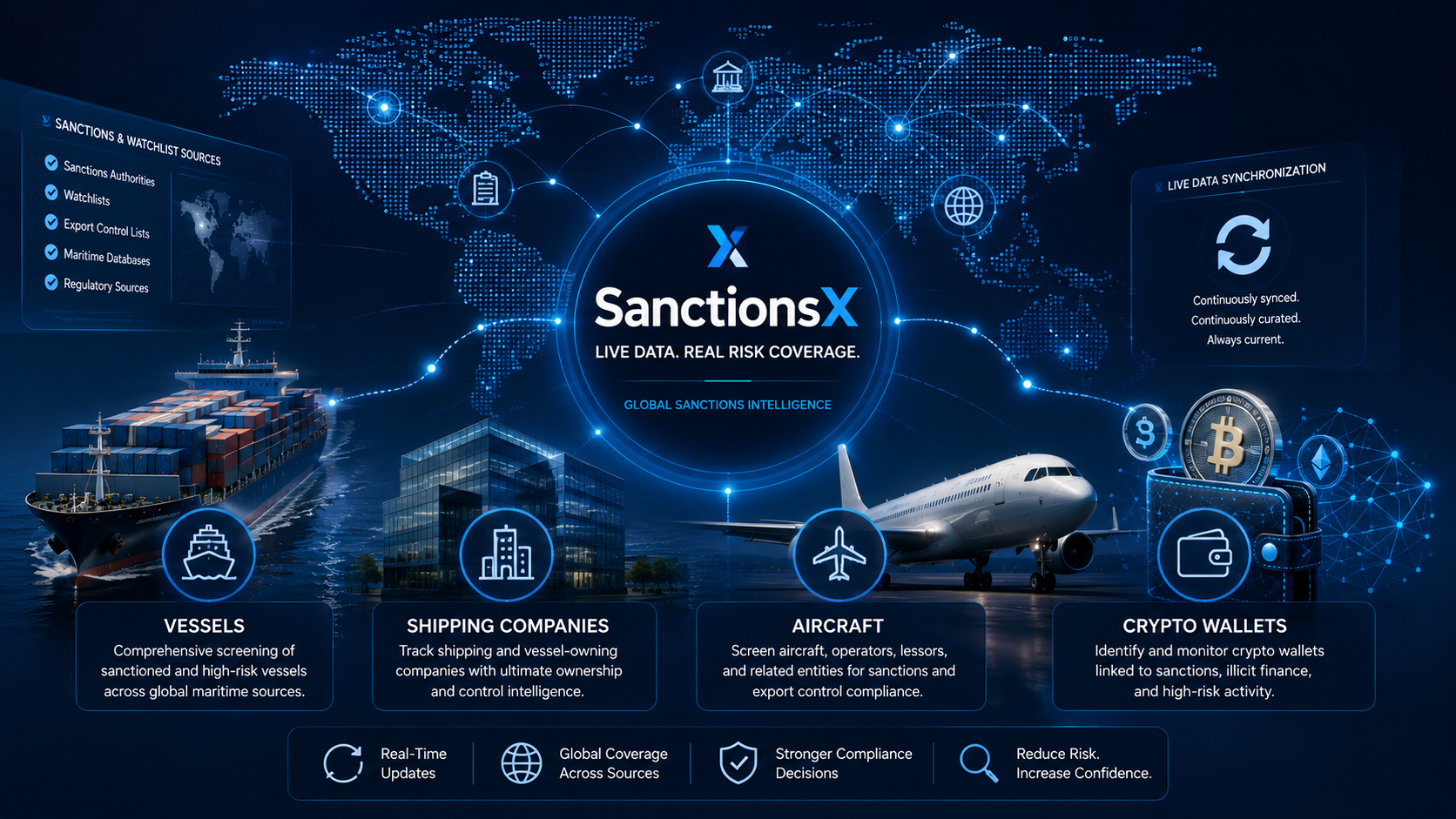


Figures update automatically as SanctionsX's underlying database changes. Last refreshed August 26, 2026.
The numbers above are not a snapshot from last quarter’s report. They are pulled live from SanctionsX’s own screening database every time this page loads, refreshed automatically as new sanctions data is synced, new vessels and companies are curated, and new watchlist entries are added. As of publication, SanctionsX is tracking 30,899 vessels, 8,430 shipping and vessel-owning companies, 346 aircraft, and 1,754 cryptocurrency wallets across 214 active sanctions and watchlist sources — for a combined total of 515,223 screened records.
Those figures will be different the next time you load this page, and that is the point. Sanctions lists change constantly — new designations are added, vessels change ownership and flags, wallets tied to illicit finance are identified — and a compliance resource that quotes a fixed number is out of date the moment it’s published. This page is built so the underlying content never has to be rewritten when the data changes; only the live figures update.
Why Real-Time Sanctions Data Matters
A static PDF or a once-a-quarter report tells you what was true when it was written. In global trade, shipping, and financial compliance, that gap between “when it was written” and “right now” is exactly where risk lives. A vessel that was clean six months ago can change ownership, change its flag, or turn up on a Port State Control detention list next week. A cryptocurrency wallet can be added to a sanctions designation the same day it processes a transaction. A shipping company can restructure specifically to distance a sanctioned individual from a vessel on paper.
According to CA Mayur Joshi, Director of Riskpro and author of the practitioner reference Sanctions Screening: A Key Element of AML and Financial Crime Prevention (2022), “the landscape of Sanctions screening is fast changing in India. Traditional tools are no more helpful. They are triggering more false positives. Artificial Intelligence could be the way forward.” That fast-changing landscape is exactly why SanctionsX is built around continuously synced, live-queried data rather than a periodically refreshed static list — the screening engine, and now this public data page, both read directly from the same current database, not a cached export from weeks ago.
Vessels: Why Ship-Level Screening Cannot Be Static
SanctionsX currently tracks 30,899 vessels across sanctions, export control, and maritime detention sources — including designated vessels under sanctions programs, ships flagged under Port State Control regimes like the Tokyo MoU and Paris MoU, and vessels linked to sanctions evasion patterns such as disguised ship-to-ship transfers or falsified location data.
Vessel data is one of the fastest-moving categories in sanctions compliance, for a structural reason: a ship’s identity is far easier to alter than a company’s or a person’s. A vessel can change its registered flag state, its name, and its ownership record multiple times within a single year, often specifically to shed a prior sanctions designation or detention history. A vessel screening resource that isn’t updated continuously will simply miss these changes — which is why the count on this page reflects the current state of the database, not a fixed figure decided at publication time.
Shipping and Vessel-Owning Companies: Tracing Who Actually Controls the Fleet
Beyond individual vessels, SanctionsX tracks 8,430 shipping and vessel-owning companies — the corporate entities that actually control the ships in the database, rolled up and cross-referenced across every vessel each one owns. This matters because sanctions evasion at sea is rarely about a single ship acting alone; it typically involves a company (often a single-vessel or shell entity) structured specifically to separate a sanctioned party from the vessel on paper.
By tracking ownership at the company level — not just the vessel level — SanctionsX can surface patterns a vessel-only search would miss: a company quietly accumulating a fleet of previously flagged ships, or a single owner behind multiple vessels registered under different names. As new vessel ownership data is curated and cross-checked, this company count updates along with it.
Aircraft: Export Control and Sanctions Risk Above the Water
SanctionsX tracks 346 aircraft as part of its export control and sanctions screening coverage. Aircraft face many of the same sanctions evasion dynamics as vessels — leasing structures, ownership layering, and jurisdiction shopping are all used to obscure who actually controls or benefits from an aircraft’s use — and they carry additional export control significance, since aircraft, aircraft parts, and related technology are frequently subject to dual-use export restrictions on top of standard sanctions designations.
For exporters, financiers, and leasing companies, aircraft screening answers a question that’s easy to overlook until it becomes a problem: is this specific airframe, or the company that holds title to it, actually clear to transact with under current sanctions and export control rules.
Cryptocurrency Wallets: Sanctions Compliance in a Non-Traditional Asset Class
SanctionsX tracks 1,754 cryptocurrency wallets identified in connection with sanctions designations, illicit finance, and watchlist activity. Crypto wallet screening has become a necessary extension of traditional sanctions compliance as designated individuals and entities have increasingly used digital assets to move value outside conventional banking channels — and because a wallet address, unlike a company name, can be created and abandoned in seconds, this is arguably the fastest-moving data category on this page.
Financial institutions, exchanges, and any business accepting cryptocurrency payments from counterparties face the same underlying obligation as a bank processing a wire transfer: know whether the party on the other end of the transaction is sanctioned. A wallet-address list that isn’t continuously updated is close to useless for this purpose, since the whole risk pattern depends on catching new designations quickly.
How SanctionsX Keeps This Data Current
The figures on this page are not manually updated by a person editing a webpage. They come directly from SanctionsX’s own screening database, which is maintained through several parallel processes:
Scheduled source synchronization. Sanctions, export control, and watchlist sources are synced on a recurring schedule, pulling in new designations, updates, and delistings as issuing authorities publish them.
Curated cross-plugin data flow. For maritime and vessel-owner data specifically, curated ownership and identification details are reviewed by an analyst and pushed into the live database through a secure, authenticated data pipeline between Riskpro’s compliance tools — meaning vessel ownership records aren’t just imported once, but actively maintained and enriched over time.
Rolled-up aggregation. Company-level data, like the Shipping Companies figure above, is computed by aggregating across every underlying vessel record tied to that owner, so the count reflects the current state of ownership data rather than a fixed snapshot.
Live, cached queries. This page itself queries the database directly (behind a short cache to keep the page fast for visitors), rather than displaying numbers that were hardcoded into the page content at the time it was written. That is what makes it possible to publish this page once and have the figures stay accurate indefinitely, without a content team needing to revisit and edit it every time the underlying data changes.
Who Relies on This Kind of Live Coverage
Exporters and trading companies use current vessel and company data to verify a shipment’s carrier and the entity behind it before cargo moves, not after.
Banks and trade finance institutions rely on up-to-date sanctions coverage — across vessels, companies, aircraft, and increasingly crypto wallets — to meet screening obligations on trade finance facilities and correspondent relationships.
Freight forwarders and logistics companies need current vessel and ownership data specifically because a ship’s risk profile can change between the time a booking is made and the time it sails.
Compliance and legal teams need a documented, current data source they can point to, rather than relying on a resource that was accurate when it was first published but has since drifted out of date.
Frequently Asked Questions
Are the numbers on this page updated in real time? The figures are queried directly from SanctionsX’s live database and refreshed on a short cache cycle, so they reflect the current state of the data rather than a fixed number set at publication.
Why does SanctionsX track shipping companies separately from vessels? Because sanctions evasion at sea is usually structured around who owns and controls a vessel, not just the vessel’s own identity — tracking ownership at the company level surfaces patterns that vessel-only screening would miss.
Why include cryptocurrency wallets in a sanctions screening database? Because sanctioned individuals and entities increasingly use digital assets to move value outside traditional banking channels, and wallet addresses can be created far faster than a company or vessel identity can change.
How often is vessel ownership data updated? Vessel ownership and identification details are curated by analysts and pushed into the live database on an ongoing basis, rather than imported once and left static.
Does this page require a login to view? No. This live data view is public — the figures are aggregate counts only, with no underlying names, ownership details, or match data exposed, so it’s freely accessible to visitors, researchers, and search engines alike.