



1. Introduction
Making the right business decision requires more than trust or intuition. Whether a company is acquiring another business, investing in a startup, entering a joint venture, selecting a key supplier, or forming a long-term partnership, it must first understand exactly who it is dealing with. This is where corporate due diligence plays a vital role.
Corporate due diligence is a systematic process of gathering, verifying, and analysing information about a company before making an important business decision. It helps organizations confirm that the information provided by the other party is accurate, identify hidden risks, and assess whether the proposed transaction or relationship is likely to achieve its intended objectives. Rather than relying solely on claims made by the target company, due diligence converts assumptions into verified facts and enables informed decision-making.
The importance of due diligence has grown significantly in today’s business environment. Companies face increasing risks from financial fraud, regulatory violations, cyber threats, sanctions, corruption, environmental issues, and reputational damage. A single overlooked issue can lead to financial losses, legal disputes, regulatory penalties, or even the failure of a major transaction. Studies have shown that 70% to 90% of mergers and acquisitions fail to achieve their expected value, with inadequate due diligence being one of the most frequently cited reasons.
However, corporate due diligence is not only about identifying risks. It also helps organizations discover opportunities, negotiate better deal terms, validate business assumptions, and prepare for successful integration after a transaction. In many cases, effective due diligence can be the difference between creating long-term value and making a costly business mistake.
This article explains the purpose of corporate due diligence, the company assessment process, the key areas that should be reviewed, common challenges, emerging trends such as artificial intelligence (AI) and ESG due diligence, and practical best practices for conducting effective company assessments.
2. What is Corporate Due Diligence?
Corporate due diligence is a structured and systematic investigation carried out before making an important business decision. It involves collecting, verifying, and analysing information about a company to understand its financial condition, legal standing, ownership structure, operations, reputation, and overall risk profile. The objective is to ensure that decision-makers have accurate and reliable information before entering into a transaction or business relationship.
In simple terms, corporate due diligence answers one fundamental question:
“Do we really know the company we are about to do business with?”
To answer this question, organizations examine not only the information provided by the company itself but also verify it using independent sources such as public records, regulatory filings, media reports, litigation databases, sanctions lists, and industry information. This independent verification helps identify risks that may not be immediately visible.
When is Corporate Due Diligence Performed?
Corporate due diligence is conducted before several important business decisions, including:
- Mergers and acquisitions (M&A) to evaluate the target company’s strengths, weaknesses, and potential liabilities.
- Investments by private equity firms, venture capital investors, or financial institutions.
- Joint ventures and strategic partnerships to understand the capabilities and risks of potential partners.
- Vendor, supplier, or distributor onboarding as part of third-party risk management.
- Large commercial contracts where organizations need confidence in the financial stability and integrity of the other party.
Although the depth of the review varies depending on the transaction, the objective remains the same—to make well-informed business decisions based on verified facts rather than assumptions.
Corporate Due Diligence is More Than a Background Check
Many people think due diligence is simply checking whether a company exists or whether it has any legal cases against it. In reality, modern corporate due diligence is far more comprehensive.
A thorough due diligence exercise may include:
- Reviewing financial statements and business performance.
- Examining corporate records and ownership structures.
- Identifying the ultimate beneficial owners (UBOs).
- Assessing pending litigation and regulatory actions.
- Screening the company and its key individuals against sanctions and watchlists.
- Reviewing adverse media and reputational issues.
- Evaluating operational capabilities, technology, and cybersecurity.
- Assessing environmental, social, and governance (ESG) risks where relevant.
Instead of looking at just one aspect of a business, due diligence provides a 360-degree view of the company, allowing decision-makers to understand both its risks and its opportunities.
A Tool for Better Decision-Making
The outcome of a due diligence exercise is not simply a checklist or a collection of documents. Rather, it provides management with a clear assessment of the company’s strengths, weaknesses, potential risks, and future opportunities.
Based on the findings, an organization may decide to:
- Proceed with the transaction as planned.
- Renegotiate the purchase price or commercial terms.
- Seek contractual protections such as warranties or indemnities.
- Request additional information or corrective actions.
- Delay or even terminate the proposed transaction if the risks are considered too significant.
In this way, corporate due diligence serves as a strategic decision-making tool. It reduces uncertainty, improves transparency, and enables organizations to make confident business decisions based on verified information rather than incomplete or self-reported data.
3. Purpose and Strategic Importance of Company Assessment
The primary purpose of corporate due diligence is to help organizations make well-informed business decisions. Every major business transaction involves some level of uncertainty, and without proper investigation, companies may unknowingly acquire hidden liabilities, enter into high-risk partnerships, or overpay for a business. Due diligence reduces this uncertainty by verifying information, identifying risks, and providing decision-makers with a clear understanding of the company they intend to engage with.
Today, corporate due diligence is no longer viewed as just a legal or compliance requirement. Instead, it is a strategic business tool that helps organizations protect their investments, negotiate better deals, and create long-term value.
3.1 Identifying Hidden Risks
One of the most important objectives of due diligence is to uncover risks that may not be visible during initial discussions or negotiations. While a company may present itself as financially stable and well-managed, a detailed assessment can reveal issues that could significantly affect the success of the transaction.
Some common risks identified during due diligence include:
- Financial irregularities or weak cash flows.
- Outstanding litigation or regulatory investigations.
- Tax liabilities and compliance issues.
- Complex ownership structures or hidden beneficial owners.
- Exposure to sanctions or politically exposed persons (PEPs).
- Operational weaknesses or supply chain disruptions.
- Cybersecurity vulnerabilities and data privacy concerns.
- Negative media coverage or reputational issues.
Identifying these risks early allows organizations to take appropriate action before committing significant financial or strategic resources.
3.2 Verifying Information
Business decisions should never rely solely on information provided by the target company. Financial statements, customer lists, growth projections, and operational claims must all be independently verified.
For example, a company may claim that it has a diversified customer base. However, due diligence may reveal that more than half of its revenue comes from a single customer. If that customer decides to terminate the relationship after the acquisition, the company’s financial performance could be severely affected.
Similarly, management may project rapid future growth, but a review of historical financial statements and market conditions may suggest that these projections are overly optimistic.
By independently verifying key information, organizations gain confidence that their decisions are based on facts rather than assumptions.
3.3 Supporting Accurate Valuation
The value of a business depends on much more than its reported profits. Factors such as pending lawsuits, debt obligations, customer concentration, intellectual property rights, regulatory compliance, and operational efficiency all influence the true value of a company.
Due diligence helps buyers determine whether the proposed purchase price accurately reflects the company’s actual condition. If significant risks are identified, the buyer may:
- Negotiate a lower purchase price.
- Request warranties and indemnities from the seller.
- Retain part of the purchase price in an escrow account.
- Structure the deal using earn-out arrangements linked to future performance.
In this way, due diligence not only protects the buyer but also helps ensure that the transaction is fairly valued.
3.4 Supporting Better Business Decisions
Not every due diligence exercise results in an acquisition or investment. In many cases, the findings help management decide whether to:
- Proceed with the transaction.
- Renegotiate the commercial terms.
- Delay the transaction until certain issues are resolved.
- Walk away entirely if the risks outweigh the expected benefits.
Sometimes, deciding not to proceed with a transaction is the best outcome of a successful due diligence exercise. Avoiding a poor investment can save an organization millions of dollars and prevent long-term operational or reputational damage.
3.5 Preparing for Post-Transaction Success
The value of due diligence extends beyond signing the agreement. The findings often serve as the foundation for post-transaction planning and integration.
For example, due diligence may identify:
- Key employees who should be retained.
- Systems that need to be integrated.
- Contracts that require renegotiation.
- Operational improvements that should be implemented.
- Compliance weaknesses that need immediate attention.
This allows organizations to prepare a structured integration plan and realize the expected benefits of the transaction more quickly.
3.6 Demonstrating Regulatory Compliance
Corporate due diligence also plays an important role in meeting legal and regulatory obligations. Organizations are increasingly expected to understand who they do business with and to identify potential risks related to sanctions, anti-money laundering (AML), anti-bribery and corruption (ABC), fraud, and environmental, social, and governance (ESG) issues.
Maintaining proper due diligence records demonstrates that an organization has taken reasonable steps to assess and manage these risks. This can be particularly important during regulatory inspections, audits, or legal proceedings, where documented evidence of the due diligence process may help demonstrate compliance with applicable laws and internal policies.
Why Due Diligence is Essential
The importance of corporate due diligence is reflected in the success—or failure—of business transactions. Research covering thousands of mergers and acquisitions over several decades indicates that 70% to 90% of acquisitions fail to achieve their expected value. While many factors contribute to these outcomes, inadequate due diligence is consistently identified as one of the leading causes. Hidden liabilities, unrealistic financial projections, cultural incompatibility, customer concentration, and integration challenges are just some of the issues that could have been identified earlier through a thorough company assessment.
In short, corporate due diligence is much more than a risk management exercise. It enables organizations to make informed decisions, negotiate from a position of strength, protect shareholder value, and build successful long-term business relationships.
4. The Corporate Due Diligence Process
Corporate due diligence is not a single activity but a structured process involving multiple teams, information sources, and areas of expertise. The exact scope depends on the size and complexity of the transaction, but the overall objective remains the same—to gather reliable information, verify its accuracy, identify potential risks, and support informed decision-making.
In mergers and acquisitions (M&A), the due diligence process generally begins after the parties sign a Letter of Intent (LOI) and usually takes 4 to 12 weeks, although larger or more complex transactions may require additional time. For supplier onboarding or strategic partnerships, the process is often scaled according to the level of risk involved.
A typical corporate due diligence process consists of the following stages.
4.1 Scoping and Planning
Every due diligence exercise begins with defining its objectives and scope. At this stage, the buyer or investor determines what information needs to be reviewed, the level of investigation required, and the specialists who should be involved.
The due diligence team may include professionals from different functions such as:
- Finance
- Legal
- Tax
- Compliance
- Commercial operations
- Information technology
- Cybersecurity
- Human resources
- Environmental and ESG specialists
The scope of the review is generally risk-based. For example, acquiring a multinational manufacturing company requires a much broader review than onboarding a local vendor. Defining the scope early helps the organization focus its resources on the most significant risks and opportunities.
4.2 Information Gathering
Once the scope has been defined, the next step is to collect relevant information from both internal and external sources.
Most modern transactions use a Virtual Data Room (VDR), where the target company uploads documents for review. Typical documents include:
- Certificate of incorporation and constitutional documents
- Financial statements
- Tax records
- Material contracts
- Customer and supplier information
- Employment agreements
- Regulatory licences and permits
- Litigation records
- Intellectual property documents
- Corporate policies and procedures
In addition to document review, the due diligence team may also conduct:
- Management interviews
- Site visits
- Customer or supplier discussions (where appropriate)
- Public record searches
- Media and internet research
- Sanctions and watchlist screening
- Regulatory database searches
Collecting information from multiple independent sources helps validate the accuracy of the information provided by the target company.
4.3 Detailed Analysis
After gathering the necessary information, specialists begin analysing the data within their respective areas of expertise. Rather than working independently, the different workstreams often share findings because an issue identified in one area may have implications for another.
For example:
- A legal dispute may create a financial liability.
- Weak cybersecurity controls may expose the company to regulatory penalties.
- Customer concentration may affect future revenue forecasts.
- Poor corporate governance may increase compliance risks.
Looking at the business from multiple perspectives allows the due diligence team to develop a complete understanding of the company’s strengths, weaknesses, and overall risk profile.
4.4 Identifying Red Flags
One of the most important outcomes of due diligence is the identification of red flags. A red flag is any issue that could materially affect the value of the business, increase risk, or influence the decision to proceed with the transaction.
Examples of common red flags include:
- Undisclosed debt or financial liabilities.
- Pending litigation or regulatory investigations.
- Weak internal controls.
- Dependence on a small number of customers or suppliers.
- Sanctions or anti-bribery concerns.
- Ownership structures that lack transparency.
- Intellectual property disputes.
- Significant cybersecurity weaknesses.
Not every red flag leads to the cancellation of a transaction. Some risks can be managed through contractual protections, price adjustments, or post-acquisition remediation plans. However, identifying these issues early enables better negotiation and more informed decision-making.
4.5 Reporting and Decision Support
After completing the analysis, the due diligence team prepares a report summarizing its findings. Rather than simply listing problems, the report explains:
- Key risks identified.
- Potential business opportunities.
- The financial and operational impact of each issue.
- Recommended mitigation measures.
- Issues requiring further investigation.
- The overall risk assessment.
Senior management and investors use this report to decide whether to proceed with the transaction, renegotiate the commercial terms, request additional protections, or withdraw from the deal altogether.
4.6 Documentation and Post-Transaction Planning
The final stage involves documenting the due diligence process and preserving supporting evidence. Proper documentation demonstrates that the organization followed a structured assessment process and can be valuable during audits, regulatory reviews, or future disputes.
The findings also support post-transaction integration planning. Information gathered during due diligence helps management prioritize operational improvements, integrate systems, retain key employees, strengthen compliance controls, and address identified risks after the transaction is completed. In this way, due diligence creates value not only before a deal closes but also during the integration and long-term management of the business relationship.
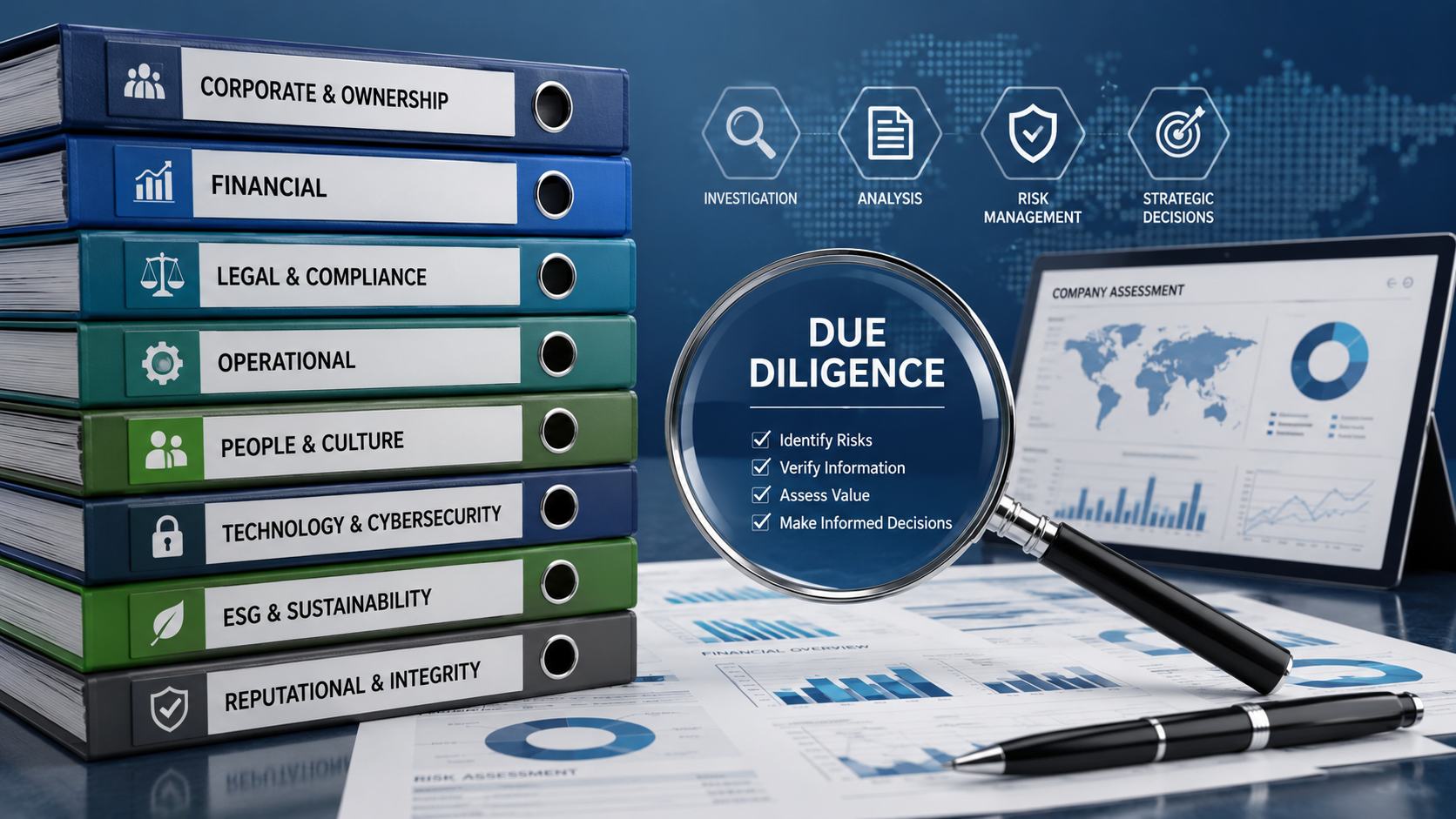
5. Key Areas of Company Assessment
A successful corporate due diligence exercise looks at a company from multiple perspectives. Financial performance is certainly important, but it is only one part of the overall picture. A company may appear profitable while hiding legal disputes, operational weaknesses, cybersecurity issues, or compliance failures that could significantly affect its future.
For this reason, corporate due diligence is generally divided into several workstreams. Each workstream focuses on a different aspect of the business, allowing the due diligence team to develop a complete understanding of the company’s strengths, weaknesses, risks, and opportunities. The depth of each review depends on the size of the transaction, the industry, and the level of risk involved.
5.1 Corporate and Ownership Assessment
The first step is to confirm that the company legally exists and has the authority to conduct business. This involves reviewing incorporation documents, constitutional documents, licences, and records maintained by the relevant corporate registry.
An equally important objective is understanding who actually owns and controls the company. Ownership structures can sometimes be complex, involving multiple holding companies, trusts, or nominee shareholders. Therefore, due diligence seeks to identify the Ultimate Beneficial Owners (UBOs) and understand the control structure of the business.
The assessment generally includes:
- Legal existence and good standing of the company.
- Certificate of incorporation and constitutional documents.
- Shareholding pattern and capitalization table.
- Ultimate Beneficial Ownership (UBO).
- Directors, senior management, and key shareholders.
- Screening directors and owners against sanctions lists, watchlists, and Politically Exposed Person (PEP) databases.
A clear understanding of ownership is essential because hidden ownership structures may expose an organization to sanctions risks, regulatory violations, or reputational damage.
5.2 Financial Assessment
Financial due diligence evaluates whether the company’s financial position accurately reflects its actual business performance. Rather than relying only on reported profits, analysts examine the quality and sustainability of earnings.
Typical areas reviewed include:
- Audited financial statements for the previous three to five years.
- Revenue growth and profitability.
- Cash flow and working capital.
- Outstanding loans and debt obligations.
- Tax compliance and tax liabilities.
- Customer concentration.
- Related-party transactions.
- Future financial projections.
For example, a company may report strong revenues, but if most of those revenues come from one customer, the business could face significant risk if that customer leaves. Similarly, hidden debt or aggressive accounting practices may reduce the true value of the company. Financial due diligence helps buyers understand these risks before completing the transaction.
5.3 Legal and Compliance Assessment
Legal due diligence focuses on identifying legal obligations and regulatory risks that could affect the transaction or future business operations.
The review typically covers:
- Material customer and supplier contracts.
- Pending or threatened litigation.
- Regulatory investigations and enforcement actions.
- Business licences and permits.
- Intellectual property ownership.
- Compliance with applicable laws and regulations.
- Exposure to sanctions, export controls, anti-money laundering (AML), and anti-bribery laws.
Particular attention is paid to contract clauses such as change-of-control provisions, which may allow customers or suppliers to terminate agreements if ownership of the company changes after an acquisition. Identifying such clauses early helps prevent unexpected business disruptions after the transaction closes.
5.4 Commercial and Operational Assessment
Even financially healthy businesses may struggle if their operations are inefficient or their business model is unsustainable. Commercial due diligence therefore evaluates how the company generates revenue and whether its business can continue to grow.
This assessment generally includes:
- Business model and competitive position.
- Market size and growth opportunities.
- Customer relationships and retention.
- Supplier dependency.
- Manufacturing or service delivery capabilities.
- Operational processes and internal controls.
- Supply chain resilience.
The objective is to determine whether the company’s operational performance supports its future growth expectations and whether any operational weaknesses could affect long-term profitability.
5.5 People and Cultural Assessment
One of the most overlooked aspects of due diligence is evaluating the people behind the business. A successful company often depends on experienced leadership, skilled employees, and a strong organizational culture.
The assessment focuses on:
- Experience and stability of senior management.
- Key employee retention risks.
- Organizational structure.
- Employee relations.
- Compensation and incentive programs.
- Succession planning.
- Corporate culture and values.
Many mergers fail not because of financial problems, but because employees leave, management teams cannot work together, or organizational cultures are incompatible. Assessing these factors helps organizations prepare effective integration strategies after the transaction.
5.6 Technology, Cybersecurity, and Data Assessment
Technology has become one of the most valuable assets of modern businesses. As a result, technology due diligence is now an essential part of many transactions.
Typical review areas include:
- Information technology infrastructure.
- Business-critical software and applications.
- Cybersecurity controls.
- Data privacy compliance.
- Software licensing.
- Intellectual property relating to technology.
- Artificial Intelligence (AI) systems and associated risks.
A cybersecurity breach or outdated IT infrastructure can significantly reduce the value of a business. Understanding these risks before completing a transaction allows buyers to estimate future investment requirements and strengthen cyber resilience after acquisition.
5.7 ESG and Sustainability Assessment
Environmental, Social, and Governance (ESG) considerations have become an increasingly important part of corporate due diligence. Investors, regulators, and customers now expect companies to operate responsibly and sustainably.
An ESG assessment may include:
- Environmental liabilities and climate-related risks.
- Resource efficiency and environmental compliance.
- Labour practices and employee welfare.
- Human rights risks within the supply chain.
- Diversity and inclusion initiatives.
- Governance structure and ethical business practices.
Strong ESG performance can enhance a company’s reputation and long-term value, while poor ESG practices may expose it to regulatory penalties, litigation, and reputational damage.
5.8 Reputational and Integrity Assessment
Finally, organizations assess whether the company has any reputational or integrity concerns that could affect future business relationships.
This review typically includes:
- Adverse media searches.
- Regulatory enforcement actions.
- Criminal investigations.
- Fraud allegations.
- Sanctions and watchlist screening.
- Public perception and stakeholder concerns.
Although reputational risks may not appear in financial statements, they can have a significant impact on customer confidence, investor trust, and brand value. Therefore, organizations increasingly treat integrity due diligence as an essential part of the overall company assessment process.
Together, these workstreams provide a comprehensive view of the target company. Rather than evaluating only its financial performance, corporate due diligence assesses every critical aspect of the business, enabling organizations to make informed decisions, negotiate effectively, and manage risks throughout the transaction lifecycle.
6. Why Corporate Due Diligence Matters: Statistics, Evidence, and Common Pitfalls
Corporate due diligence requires significant time, effort, and resources. It involves reviewing large volumes of documents, interviewing management teams, analysing financial information, and verifying data from multiple independent sources. Given this investment, an important question arises—is it really worth it?
The answer is yes. Research consistently shows that organizations that perform thorough due diligence are better positioned to identify risks, negotiate favourable terms, and make informed business decisions. On the other hand, inadequate or rushed due diligence has been linked to failed acquisitions, financial losses, legal disputes, and integration challenges.
What Do the Numbers Tell Us?
Several studies conducted over the past few decades have found that 70% to 90% of mergers and acquisitions (M&A) fail to achieve their expected value or strategic objectives. While every unsuccessful transaction has its own reasons, poor due diligence is repeatedly identified as one of the major contributing factors.
In many cases, buyers discover serious problems only after completing the acquisition, such as:
- Hidden financial liabilities.
- Overstated revenues or unrealistic growth projections.
- Pending litigation or regulatory investigations.
- Dependence on a small number of customers.
- Weak internal controls.
- Cultural conflicts between management teams.
- Difficulties integrating systems and operations.
By the time these issues become apparent, reversing the transaction is often impossible or extremely costly.
Research also indicates that approximately one-third of signed Letters of Intent (LOIs) never progress to a completed transaction, with due diligence findings being one of the most common reasons. Although terminating a deal may appear disappointing, it is often a sign that the due diligence process has successfully prevented a poor investment.
Another frequently overlooked factor is organizational culture. Studies suggest that people and cultural issues contribute significantly to post-acquisition integration failures, particularly when the acquiring and target companies have different leadership styles, workplace cultures, or management practices. This explains why modern due diligence increasingly examines not only financial and legal matters but also leadership capability, employee retention, and organizational culture.
In recent years, Environmental, Social, and Governance (ESG) considerations have also become an important part of due diligence. Many investors now expect ESG risks to be assessed alongside traditional financial and legal reviews before making investment decisions.
Common Pitfalls in Corporate Due Diligence
Although organizations recognize the importance of due diligence, the process is not always carried out effectively. Several common mistakes can reduce its value and leave important risks undiscovered.
1. Relying Only on Information Provided by the Target Company
One of the biggest mistakes is accepting the target company’s information without independent verification. Financial statements, customer contracts, ownership details, and regulatory disclosures should always be verified through reliable external sources wherever possible.
2. Treating Due Diligence as a Checklist Exercise
Some organizations focus on completing standard checklists rather than understanding the bigger picture. Simply collecting documents is not enough. The findings from different workstreams must be connected to identify broader business risks.
For example, a legal dispute may also create financial liabilities, affect customer confidence, and damage the company’s reputation. Looking at each issue in isolation may result in important risks being overlooked.
3. Rushing the Process
Competitive bidding situations often create pressure to complete transactions quickly. In such circumstances, organizations may shorten the due diligence process or postpone certain reviews until after the acquisition.
While this approach may save time initially, it can expose the buyer to significant financial and operational risks that become much more expensive to address later.
4. Ignoring “Soft” Risks
Traditional due diligence focused mainly on financial statements and legal documents. However, many failed transactions are caused by issues that cannot be identified through financial analysis alone.
Examples include:
- Poor leadership.
- Employee dissatisfaction.
- Cultural incompatibility.
- Weak governance.
- Lack of succession planning.
Ignoring these “soft” risks can make post-acquisition integration much more difficult.
5. Inadequate Ownership and Compliance Checks
Cross-border transactions often involve complex ownership structures that make it difficult to identify the ultimate beneficial owners (UBOs). Without proper ownership mapping, organizations may unknowingly enter into relationships with sanctioned individuals, politically exposed persons (PEPs), or companies involved in financial crime.
Similarly, insufficient sanctions screening or anti-bribery due diligence may expose organizations to significant regulatory and reputational risks.
6. Confirmation Bias
Another common pitfall is confirmation bias—the tendency to look only for information that supports the decision to proceed with the transaction while overlooking evidence that suggests otherwise.
An effective due diligence team should remain objective throughout the assessment. Its role is not to justify the transaction but to identify both risks and opportunities, allowing management to make informed decisions based on facts rather than expectations.
Due Diligence Should Be an Investigation, Not a Formality
The most successful organizations treat corporate due diligence as an independent fact-finding exercise rather than a compliance formality. The objective is not to confirm that a transaction should proceed but to understand the business as accurately as possible.
When performed thoroughly, due diligence may reveal that a transaction is an excellent opportunity. In other cases, it may identify risks that justify renegotiating the purchase price, requesting stronger contractual protections, or walking away entirely. In every case, the process supports better decision-making and reduces the likelihood of costly surprises after the transaction has been completed.
7. How Technology, AI, and ESG are Changing Corporate Due Diligence
Corporate due diligence has changed significantly over the past decade. Traditionally, due diligence involved reviewing large volumes of paper documents, conducting manual interviews, and verifying information through public records. While these activities remain important, advances in technology and changing regulatory expectations have transformed how organizations assess companies today.
Modern due diligence is no longer limited to checking financial statements and legal documents. Organizations now use Artificial Intelligence (AI), data analytics, automation, cybersecurity assessments, and Environmental, Social, and Governance (ESG) evaluations to gain deeper insights into potential risks and opportunities. These developments have made due diligence faster, more accurate, and more comprehensive than ever before.
7.1 Artificial Intelligence (AI) in Due Diligence
Artificial Intelligence has become one of the most valuable tools in modern due diligence. Instead of manually reviewing thousands of documents, AI-powered software can quickly analyse large volumes of information, identify unusual patterns, and highlight potential risks for further investigation.
Some common applications of AI include:
- Reviewing contracts to identify unusual clauses or legal obligations.
- Analysing financial records to detect inconsistencies or anomalies.
- Screening sanctions lists, watchlists, and adverse media.
- Identifying relationships between companies and beneficial owners.
- Detecting duplicate or inconsistent information across multiple documents.
By automating repetitive tasks, AI allows due diligence professionals to spend more time analysing risks and making informed decisions rather than collecting and organizing information.
7.2 The Rise of Generative AI
More recently, Generative AI has begun transforming the due diligence process even further. Unlike traditional AI, which focuses on analysing structured data, Generative AI can understand and summarize large amounts of unstructured information.
For example, Generative AI can:
- Summarize lengthy legal agreements.
- Extract key risks from financial reports.
- Compare multiple versions of contracts.
- Generate due diligence reports and executive summaries.
- Assist investigators in identifying areas requiring deeper review.
While these capabilities can significantly improve efficiency, organizations should not rely solely on AI-generated outputs. Human expertise remains essential to validate findings, interpret complex issues, and exercise professional judgment. AI should therefore be viewed as a tool that supports decision-making rather than replacing experienced professionals.
7.3 Continuous Due Diligence
Traditionally, due diligence was conducted only once—before completing an acquisition, investment, or business partnership. However, business risks do not remain static. Companies may experience changes in ownership, financial condition, regulatory status, or reputation long after a transaction has been completed.
As a result, many organizations are moving towards continuous due diligence, where key third parties, suppliers, distributors, and business partners are monitored on an ongoing basis.
Continuous monitoring may include:
- Monitoring adverse media.
- Tracking sanctions and watchlist updates.
- Identifying changes in beneficial ownership.
- Reviewing new litigation or regulatory actions.
- Monitoring financial health and credit ratings.
- Identifying significant corporate changes.
This approach enables organizations to identify emerging risks early rather than waiting until the next periodic review.
7.4 ESG Due Diligence is Becoming a Business Priority
Environmental, Social, and Governance (ESG) factors have become an increasingly important part of corporate due diligence. Investors, regulators, lenders, and customers now expect organizations to understand not only a company’s financial performance but also how responsibly it operates.
Modern ESG due diligence may assess:
- Environmental compliance and climate-related risks.
- Carbon emissions and sustainability initiatives.
- Labour practices and employee welfare.
- Human rights risks across the supply chain.
- Diversity, equity, and inclusion initiatives.
- Corporate governance and ethical business practices.
Poor ESG performance can expose organizations to regulatory action, litigation, reputational damage, and reduced investor confidence. Conversely, companies with strong ESG practices are often viewed as better positioned for sustainable long-term growth.
7.5 Greater Focus on Cybersecurity and Data Privacy
As businesses become increasingly digital, cybersecurity has become a critical area of due diligence. A company may have strong financial performance, but weak cybersecurity controls could expose it to data breaches, regulatory penalties, operational disruptions, and reputational damage.
Technology due diligence now commonly includes reviewing:
- Information security policies.
- Cybersecurity controls.
- Data privacy compliance.
- Cloud infrastructure.
- Incident response capabilities.
- Historical cyber incidents.
- Business continuity and disaster recovery plans.
Understanding these risks helps buyers estimate future investment requirements and identify areas where improvements may be needed after the transaction.
7.6 Increased Transparency in Beneficial Ownership
Governments around the world are introducing stricter requirements for identifying Ultimate Beneficial Owners (UBOs). Greater ownership transparency helps organizations detect hidden control structures, shell companies, sanctions risks, corruption, and money laundering.
As a result, beneficial ownership verification has become a standard part of modern due diligence, particularly in cross-border transactions and high-risk industries.
The Future of Corporate Due Diligence
Corporate due diligence continues to evolve alongside changes in technology, regulation, and global business risks. Organizations are increasingly combining traditional investigative techniques with AI-powered analytics, automated screening, ESG assessments, and continuous monitoring to build more effective due diligence programs.
However, despite these technological advances, the fundamental objective of due diligence remains unchanged—to understand the company thoroughly before making an important business decision. Technology can improve efficiency and provide valuable insights, but experienced professionals remain essential for interpreting findings, assessing risks, and making informed judgments.
The future of corporate due diligence is therefore likely to be a combination of advanced technology and human expertise, enabling organizations to make faster, smarter, and more confident business decisions while effectively managing evolving risks.
8. Best Practices for Effective Company Assessment
A successful due diligence exercise is not determined by the number of documents reviewed but by the quality of the analysis and the decisions that follow. Organizations that follow a structured and risk-based approach are better equipped to identify hidden risks, negotiate favourable terms, and avoid costly surprises after a transaction is completed.
The following best practices can help organizations conduct more effective corporate due diligence.
1. Define the Scope Early
Every transaction is different. The depth of due diligence should depend on the size, complexity, value, and risk of the proposed transaction.
For example, acquiring a multinational company requires a much more detailed assessment than onboarding a local supplier. Defining the scope at the beginning ensures that time and resources are focused on the areas that matter most.
2. Adopt a Risk-Based Approach
Not every risk has the same impact. Organizations should prioritize areas that are most likely to affect the success of the transaction.
Factors that may increase the level of due diligence include:
- High-value transactions.
- Cross-border operations.
- Operations in high-risk jurisdictions.
- Regulated industries.
- Complex ownership structures.
- Significant cybersecurity or ESG risks.
A risk-based approach helps organizations allocate resources more efficiently while ensuring that critical risks receive appropriate attention.
3. Verify Information Using Independent Sources
Organizations should never rely solely on information provided by the target company. Financial statements, ownership details, licences, litigation history, and regulatory compliance should be verified using reliable independent sources wherever possible.
Examples of external verification sources include:
- Corporate registries.
- Regulatory authorities.
- Court records.
- Public financial filings.
- Sanctions and watchlists.
- Adverse media databases.
- Credit reports.
- Industry publications.
Independent verification increases confidence in the findings and helps identify discrepancies that may otherwise go unnoticed.
4. Involve the Right Specialists
Corporate due diligence is a multidisciplinary exercise. Depending on the nature of the transaction, organizations should involve professionals from different functions, including:
- Finance
- Legal
- Tax
- Compliance
- Information Technology
- Cybersecurity
- Human Resources
- Operations
- Environmental and ESG
Each specialist contributes expertise that helps build a complete understanding of the target company.
5. Use Technology to Improve Efficiency
Modern due diligence increasingly relies on technology to improve speed, accuracy, and consistency.
Organizations can use technology to:
- Organize documents through Virtual Data Rooms (VDRs).
- Automate document reviews.
- Screen sanctions and adverse media.
- Analyse contracts using Artificial Intelligence (AI).
- Identify ownership structures.
- Monitor emerging risks continuously.
While technology can significantly improve efficiency, important decisions should still be reviewed by experienced professionals.
6. Document Every Finding
A well-documented due diligence process provides evidence that the organization conducted a reasonable and systematic assessment before making its decision.
Documentation should include:
- Information reviewed.
- Sources used for verification.
- Risks identified.
- Discussions with management.
- Assumptions made.
- Recommendations provided.
- Final conclusions.
Good documentation supports transparency and can be valuable during audits, regulatory inspections, or future legal proceedings.
7. Plan Beyond the Transaction
Due diligence should not end once the agreement is signed. The findings should be used to prepare for post-transaction integration and ongoing risk management.
Organizations should develop action plans to:
- Address identified weaknesses.
- Strengthen compliance controls.
- Integrate technology and business processes.
- Retain key employees.
- Monitor unresolved risks after closing.
This helps ensure that the expected benefits of the transaction are realized over the long term.
8. Treat Due Diligence as a Continuous Process
Business risks continue to evolve after an acquisition, investment, or partnership begins. New regulations, ownership changes, financial difficulties, cybersecurity incidents, or reputational issues may arise at any time.
For this reason, many organizations are moving from one-time due diligence to continuous due diligence, where key third parties, business partners, and investments are monitored on an ongoing basis. Regular monitoring allows organizations to identify new risks early and respond before they become significant problems.
Building a Strong Due Diligence Culture
Ultimately, effective due diligence is not about completing a checklist—it is about making informed business decisions. Organizations that invest in structured assessment processes, involve the right expertise, use reliable data sources, and embrace modern technology are better positioned to manage risk and create long-term value.
A strong due diligence culture encourages decision-makers to ask the right questions, verify critical information, and base important business decisions on evidence rather than assumptions. This approach not only reduces the likelihood of costly mistakes but also builds greater confidence among investors, regulators, customers, and other stakeholders.
9. Conclusion
Corporate due diligence has become an essential part of modern business decision-making. Whether an organization is acquiring another company, making an investment, entering into a joint venture, or onboarding a new supplier, conducting a thorough assessment helps ensure that important decisions are based on verified information rather than assumptions.
As discussed throughout this article, corporate due diligence is much more than a financial review. It is a structured process that examines multiple aspects of a business, including its ownership, financial health, legal and regulatory compliance, operations, technology, cybersecurity, reputation, and ESG performance. Looking at these areas together provides a complete picture of the company’s strengths, weaknesses, opportunities, and potential risks.
The business environment is also changing rapidly. Companies today face new challenges such as cyber threats, complex global supply chains, stricter regulatory requirements, sanctions compliance, ESG expectations, and increased transparency around beneficial ownership. As a result, organizations are moving beyond traditional one-time assessments and adopting technology-driven, risk-based, and continuous due diligence practices to monitor business relationships throughout their lifecycle.
At the same time, technology is making the due diligence process faster and more efficient. Artificial Intelligence (AI), data analytics, automation, and digital collaboration tools enable organizations to review large volumes of information more quickly and identify potential risks that might otherwise be overlooked. However, technology should support—not replace—professional judgment. Experienced legal, financial, compliance, and operational experts remain essential for interpreting findings and making informed business decisions.
Ultimately, the objective of corporate due diligence is not simply to identify problems. It is to provide decision-makers with a clear understanding of the business they intend to work with. A well-executed due diligence process helps organizations:
- Identify financial, legal, operational, and reputational risks.
- Verify critical information using independent sources.
- Negotiate better commercial terms.
- Meet regulatory and compliance requirements.
- Prepare for successful post-transaction integration.
- Protect shareholder value and business reputation.
In today’s increasingly complex business environment, organizations can no longer afford to treat due diligence as a routine checklist exercise. Instead, it should be viewed as a strategic investment that supports informed decision-making, reduces uncertainty, and contributes to long-term business success.
Disclaimer: This article is based on publicly available research and industry practices available as of August 2026. The scope and methodology of corporate due diligence may vary depending on the type of transaction, industry, jurisdiction, and applicable legal or regulatory requirements. Organizations should tailor their due diligence processes to their specific business objectives and seek professional advice where appropriate.