

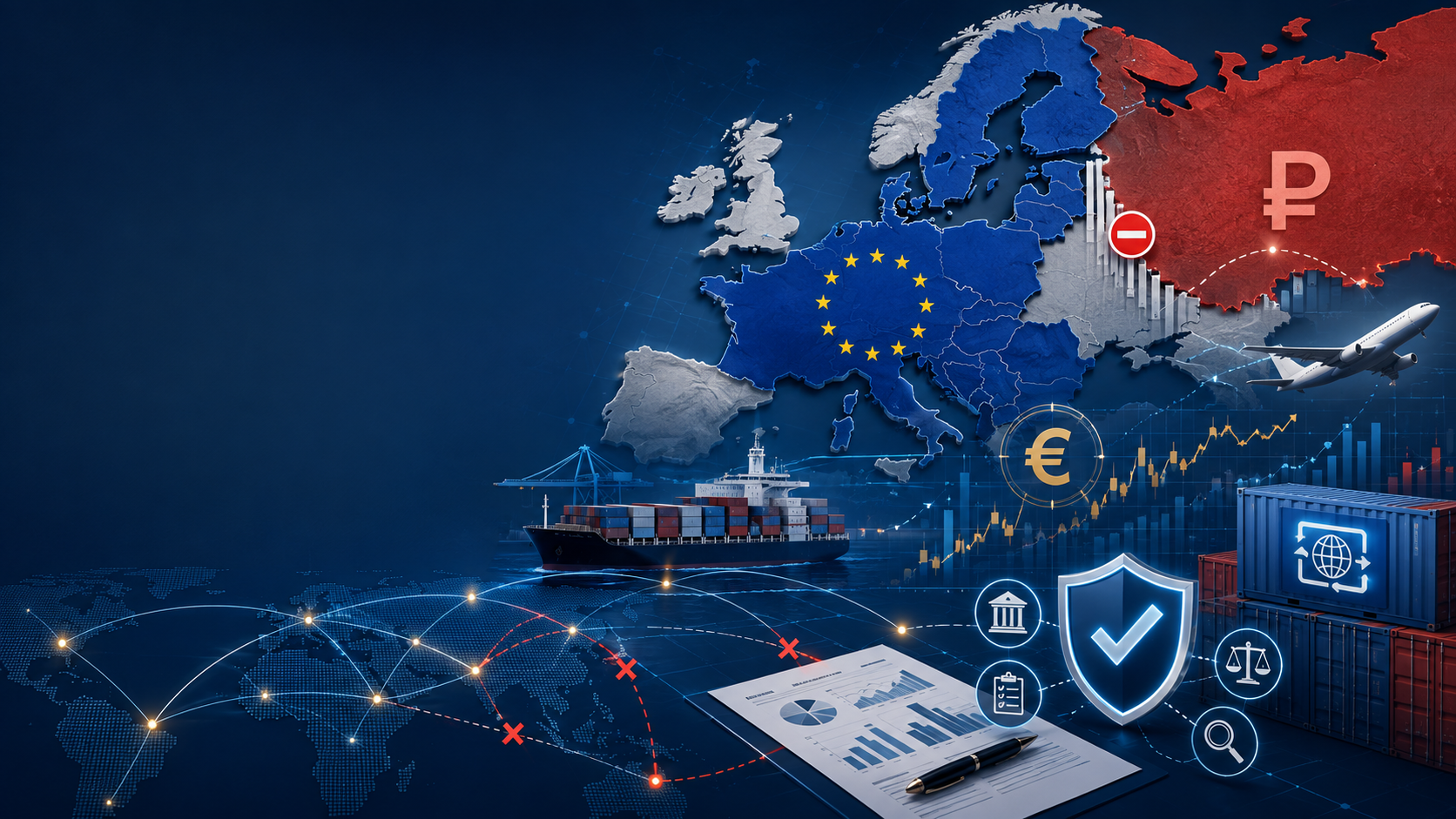


The European Union (EU) sanctions on Russia have become one of the most comprehensive and closely watched sanctions regimes in the world. Since Russia’s annexation of Crimea in 2014 and, more significantly, its full-scale invasion of Ukraine in February 2022, the EU has introduced a series of restrictive measures aimed at limiting Russia’s economic, financial, and military capabilities.
Today, these sanctions extend far beyond political statements or diplomatic pressure. They affect banks, manufacturers, exporters, shipping companies, insurers, technology firms, and multinational corporations across the globe. Even businesses with no direct operations in Russia can be impacted through supply chains, financing arrangements, or commercial relationships involving EU counterparties.
For compliance professionals, understanding the EU sanctions regime is no longer optional. It has become an essential part of managing regulatory risk, particularly for organizations involved in international trade, financial services, logistics, and technology.
This article explains why the EU imposed sanctions on Russia, how the sanctions framework operates, the key restrictions currently in place, and what businesses need to consider to remain compliant.
Key Takeaways
| Area | What it means |
| Purpose | The EU sanctions aim to reduce Russia’s ability to finance military activities, access critical technologies, and generate revenue from strategic sectors. |
| Main measures | Financial restrictions, trade and export controls, energy and transport measures, and sanctions on individuals and entities. |
| Business impact | Companies must assess customers, suppliers, products, payments, and supply chains for sanctions risks. |
| Compliance focus | Effective compliance requires sanctions screening, due diligence, export control checks, and monitoring for sanctions circumvention. |
Why Has the EU Sanctioned Russia?
The EU first imposed sanctions on Russia in 2014 after the annexation of Crimea and the city of Sevastopol. Viewing the annexation as a violation of international law and Ukraine’s territorial integrity, the EU responded with targeted measures against individuals, businesses, and sectors linked to Russia’s actions.
For several years, these sanctions remained focused on financial restrictions, travel bans, and sector-specific measures. However, the situation changed dramatically in February 2022 when Russia launched a full-scale invasion of Ukraine.
Russia sends second post-sanctions LNG cargo from Portovaya to China
In response, the EU adopted multiple sanctions packages that significantly expanded the scope of existing restrictions. These measures targeted major Russian banks, state-owned enterprises, energy exports, advanced technologies, transportation, media organizations, and thousands of designated individuals and entities.
The objective is not to punish ordinary citizens but to increase the economic and political cost of Russia’s actions. By restricting access to international finance, limiting exports of strategic goods, reducing revenue from key industries, and targeting those linked to the Russian state, the EU seeks to weaken Russia’s ability to sustain its military and industrial capabilities.
Since 2022, the sanctions framework has continued to evolve. Rather than introducing only new restrictions, the EU has increasingly focused on closing loopholes, strengthening enforcement, and preventing sanctions from being circumvented through third countries or complex corporate structures.
How the EU Sanctions Framework Works
EU sanctions are adopted under the European Union’s Common Foreign and Security Policy (CFSP). In simple terms, the political decision to impose sanctions is made by the Council of the European Union, while the legal obligations are implemented through directly applicable EU regulations.
This ensures that the same sanctions rules apply across all EU member states, although national authorities remain responsible for licensing, supervision, investigations, and penalties for non-compliance.
The measures generally fall into four broad categories:
- Financial restrictions, such as asset freezes, banking measures, and investment prohibitions.
- Trade and export controls, which restrict the movement of certain goods, technologies, and software.
- Sectoral restrictions, targeting industries such as energy, transportation, and defence.
- Individual and entity sanctions, including travel bans and asset freezes.
Although each measure serves a different purpose, they work together to limit Russia’s access to financial resources, strategic technologies, and international markets.
The Main EU Sanctions Against Russia
Financial Restrictions
Financial sanctions are the foundation of the EU’s restrictive measures against Russia. Their primary objective is to reduce Russia’s access to international capital and financial markets while limiting the ability of designated individuals and organizations to use assets held within the European Union.
One of the most significant measures is the asset freeze. When an individual or company is designated under EU sanctions, any funds or economic resources they own, hold, or control within the EU must be frozen. The assets are not confiscated, but they generally cannot be accessed, transferred, sold, or used without authorization. EU persons are also prohibited from making funds or economic resources available, directly or indirectly, to sanctioned parties.
The sanctions also target Russia’s banking sector. Several Russian financial institutions have faced restrictions on accessing EU financial markets, raising capital, and conducting certain transactions with European counterparties. These measures are designed to reduce Russia’s ability to obtain financing and support international business operations.
Another major step was the restriction on the Russian Central Bank’s access to a significant portion of its foreign reserves held within EU jurisdictions. Central banks rely on such reserves to support their national currency and maintain financial stability. Limiting access to these assets reduced Russia’s financial flexibility following the invasion of Ukraine.
The EU also introduced investment restrictions affecting certain Russian state-owned enterprises and strategic sectors. These measures limit new investments and financial support, reducing long-term access to European capital.
Trade and Export Controls
Alongside financial sanctions, the EU has imposed extensive trade restrictions designed to limit Russia’s access to strategic goods, advanced technology, and industrial equipment.
Rather than banning all trade, the EU focuses on products that could strengthen Russia’s economy or military capabilities. Export restrictions cover a wide range of items, including advanced semiconductors, electronics, telecommunications equipment, aerospace components, industrial machinery, navigation systems, and specialized software.
A key feature of these controls is the regulation of dual-use goods—products that have legitimate civilian applications but can also be used for military or strategic purposes. Examples include precision machine tools, high-performance computer processors, encryption software, industrial lasers, and certain telecommunications technologies. Because these products could contribute to military production or defence capabilities, their export is either prohibited or subject to strict licensing requirements.
Uncertainty grows over US waiver on Russian oil sanctions ahead of April 11 expiry
The EU has also imposed import restrictions on several Russian-origin products, including coal, crude oil (subject to specific rules and exemptions), petroleum products, gold, iron and steel products, timber, and selected industrial commodities. These measures aim to reduce revenue generated from exports that play an important role in Russia’s economy.
For businesses, compliance with trade restrictions goes beyond checking whether a customer appears on a sanctions list. Companies must classify products correctly, understand export control requirements, verify the end user and intended use of their goods, and maintain records demonstrating compliance with applicable regulations.
Energy and Transport Measures
Energy has long been one of Russia’s largest sources of revenue, making it a central focus of the EU’s sanctions strategy. Before 2022, several EU member states depended heavily on Russian oil, natural gas, and coal. Since then, the EU has introduced measures to reduce that dependence while limiting the financial resources available to Russia.
One of the most significant steps was the ban on imports of seaborne Russian crude oil into the EU, accompanied by restrictions on certain petroleum products and limitations on investments in Russia’s energy sector. The EU has also prohibited the export of equipment and technology used in oil refining, making it more difficult for Russia to modernize parts of its energy infrastructure.
Alongside these measures, the EU and its G7 partners introduced a price cap on Russian seaborne crude oil. Rather than banning all exports of Russian oil to third countries, the price cap limits the provision of services such as shipping, insurance, financing, and brokering when the oil is sold above the agreed price threshold. The objective is to reduce Russia’s oil revenues while helping maintain stability in global energy markets.
Transport restrictions complement these measures. Russian aircraft are generally prohibited from entering EU airspace, while EU companies face restrictions on supplying aircraft, spare parts, maintenance services, and technical support to Russian operators. Similar measures apply to maritime transport, with many Russian vessels restricted from accessing EU ports and certain shipping-related services subject to sanctions. Restrictions on Russian road transport operators further reduce access to European logistics networks.
Together, these measures make it more difficult for Russia to move goods, generate revenue from strategic industries, and access the services needed to support international trade.
Individual and Entity Sanctions
While sectoral measures target the broader economy, the EU also imposes sanctions on specific individuals and organizations considered responsible for, involved in, or benefiting from Russia’s actions in Ukraine.
The list of designated persons includes senior government officials, members of parliament, military leaders, business executives, and other individuals linked to the Russian state or defence sector. Thousands of companies, financial institutions, state-owned enterprises, and organizations have also been sanctioned.
The two most common measures are asset freezes and travel bans. Asset freezes prevent designated persons or entities from accessing funds or economic resources within the EU, while travel bans generally prohibit them from entering or transiting through EU member states.
Hungary and Russia agree on a 12-point plan to expand cooperation in energy, trade, and education
For businesses, these sanctions create a clear obligation: they must not make funds or economic resources available to designated persons or entities, either directly or indirectly. This means companies need to screen not only their customers but also suppliers, intermediaries, beneficial owners, and business partners to ensure they are not dealing with sanctioned parties.
Preventing Sanctions Circumvention
As sanctions expanded, so did attempts to bypass them. In response, the EU has placed increasing emphasis on preventing sanctions circumvention.
Circumvention occurs when a person or company seeks to avoid sanctions through indirect means—for example, by routing restricted goods through a third country, concealing the involvement of a sanctioned individual, or using intermediary companies to mask the final destination of products.
This has shifted the focus of compliance from simple sanctions screening to a broader assessment of supply chain and transaction risks. Businesses are expected to understand who ultimately owns their customers, where goods are likely to end up, and whether a transaction presents any indicators of sanctions evasion.
Common warning signs include unusual shipping routes, complex ownership structures with no clear commercial purpose, reluctance to disclose the end user, or transactions that are inconsistent with a customer’s normal business activities. While these indicators do not necessarily mean sanctions are being circumvented, they should prompt additional due diligence before proceeding.
A key development in this area is the “No Russia Clause.” For certain sensitive exports, EU exporters are required to include contractual provisions prohibiting buyers in third countries from re-exporting those goods to Russia or for use in Russia. This contractual safeguard helps reduce the risk of controlled goods being diverted through intermediary countries.
What Businesses Need to Do
The breadth of the EU sanctions regime means compliance is no longer the responsibility of legal or compliance teams alone. Finance, procurement, logistics, sales, and senior management all play a role in ensuring that business activities do not breach sanctions.
An effective sanctions compliance programme begins with a risk assessment. Companies should evaluate where sanctions risks arise within their operations by considering their customers, suppliers, products, payment flows, and geographic exposure.
Customer due diligence is equally important. Before entering into a business relationship, organizations should verify the identity of their counterparties, understand their ownership structure, and assess whether they operate in sectors or regions that present elevated sanctions risks. In higher-risk situations, enhanced due diligence may be appropriate.
Sanctions screening remains a core control. Businesses should regularly screen customers, suppliers, beneficial owners, financial institutions, and other relevant parties against applicable sanctions lists. Because sanctions lists change frequently, screening should be an ongoing process rather than a one-time check during onboarding.
Russia VPN restrictions linked to payment system disruptions, claims telegram founder
For exporters, export control compliance is essential. Companies should determine whether their products, software, or technologies are subject to EU export restrictions, confirm the intended end use, and obtain any required authorizations before shipment.
Maintaining clear records of due diligence, screening results, export classifications, and internal approvals is equally important. Good documentation not only supports compliance but also helps demonstrate that reasonable steps were taken if regulators review a transaction.
Finally, businesses should invest in employee training and establish clear internal policies. Employees involved in sales, logistics, procurement, finance, and customer onboarding are often the first to identify potential sanctions risks. Regular training helps ensure that issues are recognised and escalated before they result in compliance failures.
Conclusion
Over the past decade, the European Union’s sanctions against Russia have evolved into one of the world’s most comprehensive sanctions regimes. What began as targeted measures in response to the annexation of Crimea has expanded into a broad framework covering financial services, international trade, technology, energy, transportation, and thousands of designated individuals and entities.
For businesses, the implications extend far beyond checking names against a sanctions list. Effective compliance now requires understanding export controls, assessing beneficial ownership, monitoring supply chains, and identifying potential attempts to circumvent restrictions. Organizations that adopt a risk-based approach—supported by strong due diligence, ongoing screening, and clear internal controls—are better equipped to navigate these challenges while reducing legal, financial, and reputational risks.
As geopolitical developments continue to shape international trade, the EU sanctions regime will continue to evolve. Staying informed and adapting compliance programmes accordingly is no longer just a regulatory expectation; it has become an essential part of doing business in the global economy.