

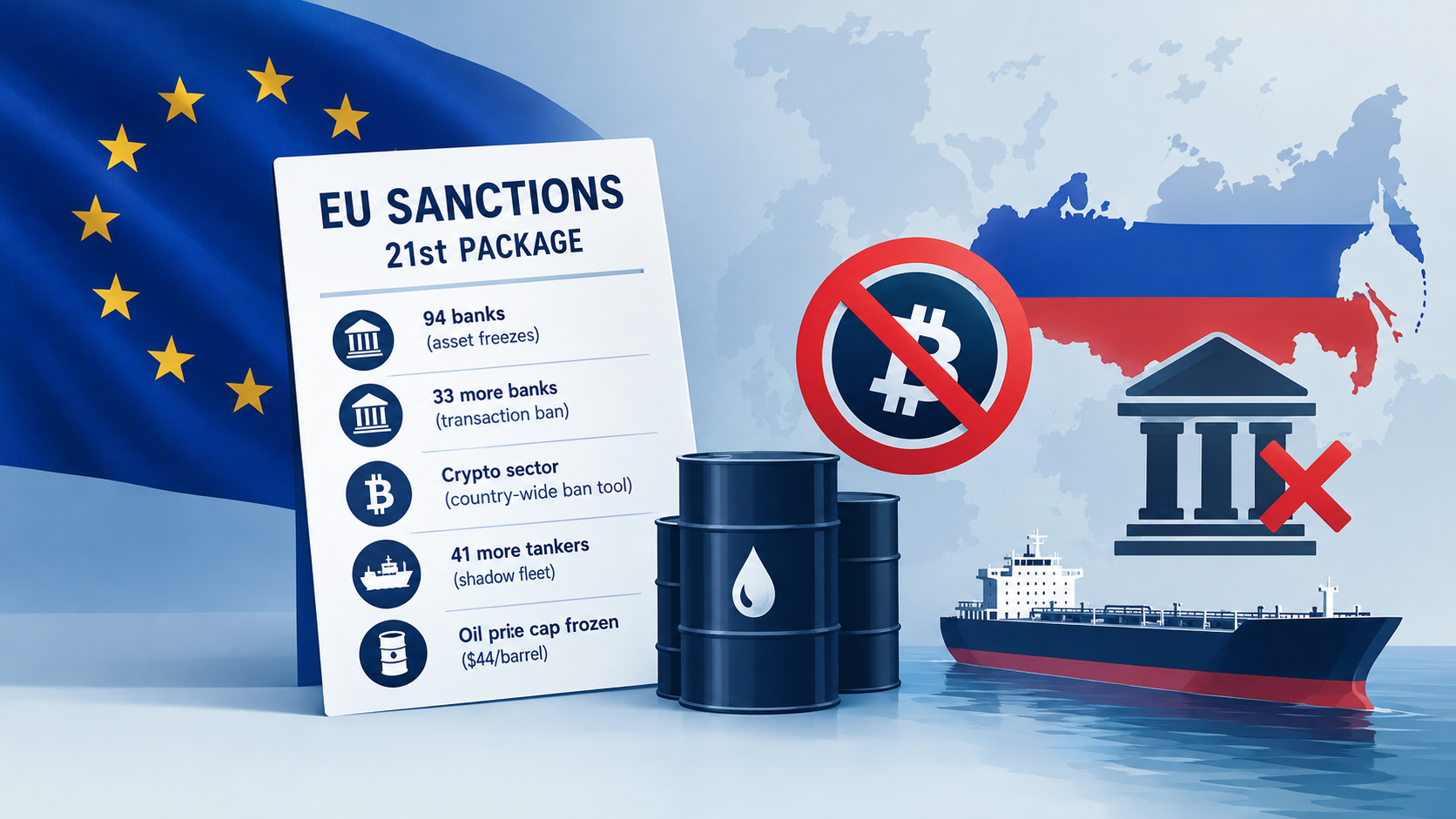


Ninety-four banks frozen out. Thirty-three more added to the transaction ban. And for the first time, Brussels can now shut a country’s crypto sector out of the EU entirely if it keeps helping Russia dodge sanctions.
Key takeaways
- The EU adopted its 21st sanctions package against Russia on 23 July 2026, its largest batch of individual listings in four years, with 218 names in total.
- 33 additional Russian banks joined the EU’s transaction ban starting 13 August 2026, on top of 94 banks already hit with asset freezes.
- For the first time, the EU can impose a full third-country ban on crypto-asset services if a country hosts platforms that help Russia dodge sanctions.
- The oil price cap is frozen at $44 a barrel for a year, and 41 more shadow-fleet tankers were added to the blacklist.
- Firms with any Russia-adjacent banking, crypto, shipping, or trading exposure have compliance deadlines running from August 2026 through March 2028.
What actually happened
On 23 July, the Council of the EU signed off on its 21st package of sanctions against Russia. It’s not a small update. This is the biggest single batch of new listings — 48 individuals and 170 entities — in four years, and it lands at a moment when Russia has been striking Ukrainian energy and water infrastructure directly.
Kaja Kallas, the EU’s foreign policy chief, put it plainly when the package was announced: “we’re hitting over a hundred banks and crypto operators, 40+ vessels in Russia’s shadow fleet, and several oil refineries in Russia and Belarus.” That’s not an exaggeration; the numbers back it up.
Russia strengthens shadow LNG fleet as Europe tightens sanctions
Here’s the package broken down by the areas that matter most for compliance teams.
Banking: the transaction ban gets bigger
| What changed | Detail |
|---|---|
| Asset freezes | 94 banks and financial institutions frozen, plus one senior Russian banking figure |
| Transaction ban expansion | 33 more Russian banks added, effective 13 August 2026 |
| Non-Russian banks caught too | A Kyrgyz bank linked to Russia’s SPFS payment system, plus 3 other non-Russian banks, banned for helping circumvent sanctions |
| Cross-border network | 4 new designations tied to the “A7” network, including its expansion into Africa |
The message here isn’t subtle. The EU has been steadily tightening its grip on Russian banking access since 2022, but this round goes further by going after banks outside Russia that are quietly keeping the door open. If your institution has any correspondent relationship with a bank in Central Asia, the Caucasus, or anywhere with loose sanctions enforcement, this is worth a second look.
Crypto: a new tool nobody’s used before
This is arguably the most consequential part of the package for digital asset firms. The EU added 14 crypto-related platforms based in Georgia, Panama, the UAE, the Marshall Islands, Kyrgyzstan, and Belarus to its transaction ban list.
But the bigger deal is structural. For the first time, the EU has created a legal mechanism to impose a full country-wide ban on crypto-asset services if that country is home to platforms helping Russia get around sanctions. Up to now, the EU could only sanction individual platforms one at a time, a game of whack-a-mole that exchanges could dodge by simply relocating or rebranding. This new tool changes the incentive structure entirely; it puts pressure on the host jurisdiction itself, not just the operator.
For crypto exchanges and custodians operating in or near any of the six jurisdictions named above, this is a signal to review counterparty exposure now, not after the next round of designations.
Russia Under the European Union’s Sanctions Regime Since 2014
Energy: the oil price cap gets frozen, not just capped
Normally, the EU’s oil price cap adjusts automatically based on market conditions. This package pauses that adjustment mechanism entirely until 15 July 2027, holding Russian oil at a fixed $44 a barrel. The Council says this is a direct response to market volatility following the closure of the Strait of Hormuz; letting the cap auto-adjust right now could have actually handed Russia a windfall.
Alongside that, the EU:
- Added 41 more vessels to its shadow-fleet blacklist, bringing the total past 670.
- Designated 8 entities and 1 individual in the shadow-fleet ecosystem, including for the first time a crewing agency that staffs the tankers.
- Listed 18 entities and 1 individual in the oil sector, including three Russian refineries and a major Belarusian one.
- Created a new tool to ban transactions with refineries in third countries that process Russian crude and used it immediately against a refinery in Kulevi, Georgia (that ban takes effect in six months).
- Added 5 oil traders to the transaction-ban list for helping move Russian crude around the existing restrictions.
The military supply chain crackdown
A big chunk of this package, 56 individual listings, targets people and companies tied to Russia’s military-industrial complex, with 37 of those listings aimed specifically at the production and supply chain behind Russia’s long-range drone program.
On top of that, 51 more entities were added to the EU’s dual-use export control list. Some of them are based well outside Russia in China and Hong Kong, India, Kazakhstan, Kyrgyzstan, Türkiye, and the UAE, which is flagged for helping Russia get around export restrictions on things like microelectronics, CNC machine tools, and semiconductor equipment.
What compliance teams should actually do with this
Banks and financial institutions
- Cross-check correspondent banking relationships against the 33 newly listed institutions and confirm no exposure remains after 13 August.
- Review any dealings with banks in Kyrgyzstan or other jurisdictions flagged for SPFS-related circumvention.
Russia sends second post-sanctions LNG cargo from Portovaya to China
Crypto and digital asset firms
- Screen counterparties in Georgia, Panama, the UAE, the Marshall Islands, Kyrgyzstan, and Belarus; specifically, these are the jurisdictions now on the EU’s radar for a potential country-wide ban.
- Build monitoring for jurisdiction-level sanctions risk, not just platform-level risk, given the new third-country ban tool.
Shipping, commodities, and energy traders
- Update vessel screening lists to include the 41 newly designated tankers.
- Reassess any refinery relationships in third countries that process Russian crude; the Kulevi refinery ban is a preview of how this tool will likely be used again.
- Watch the LNG tanker sale rules; the package introduces new notification requirements for sales to Russian buyers.
Exporters of dual-use goods
- Review distributor and reseller relationships in China, Hong Kong, India, Kazakhstan, Kyrgyzstan, Türkiye, and the UAE against the newly restricted entity list.
What to watch next
Not everything the European Commission originally proposed made it into this package. A broader visa ban on Russian combatants was deferred rather than adopted outright, and a proposal to sanction Russian Orthodox Patriarch Kirill was blocked by Bulgaria. Portugal and France also fought off a proposed ban on Russian seafood imports.
Diplomats involved in the negotiations have already said work on a 22nd package is underway. Given how this one landed watered down in a few places but sharply expanded in banking and crypto, expect the next round to pick up wherever this one left gaps, particularly around the visa ban and further banking sector designations.