


Five suspended general licenses expire in days; after that, a specific OFAC license is the only way to keep doing anything Iran-related that touches educational exchanges, remittances, conferences, sports, or academic programs.
Key Takeaways
- On August 24, 2026, the U.S. Treasury Department launched Operation Economic Outcast, its most aggressive Iran sanctions escalation in years.
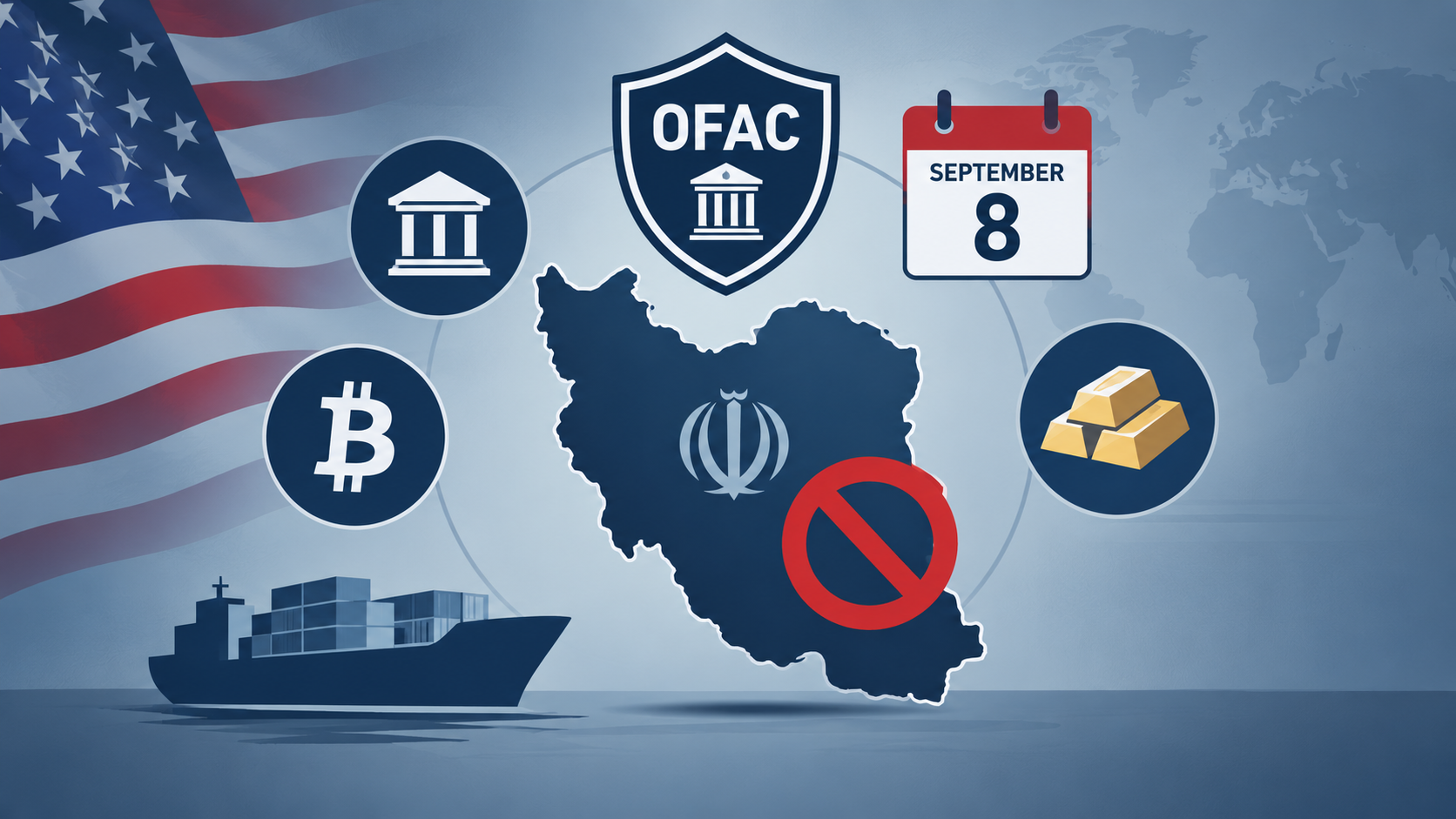
- OFAC suspended five general licenses covering educational exchange, remittances, conferences, sports, and academic programs; the wind-down window under General License BB closes September 8, 2026.
- Five new sectors, aviation, digital assets, gold, shipping, and technology, were added to Executive Order 13902’s sectoral sanctions framework, exposing non-U.S. persons with no U.S. nexus to designation.
- FinCEN has begun using Section 311 of the USA PATRIOT Act to cut foreign banks off from U.S. correspondent banking, targeting Egypt’s Banque Misr on August 28 over an alleged $1.8 billion in Iranian shadow-banking flows.
- Banks, digital asset platforms, shipping firms, and commodity traders all face new or heightened compliance obligations starting immediately.
What Happened on August 24
The U.S. Department of the Treasury announced Operation Economic Outcast on August 24, 2026, describing it as a sustained campaign to cut off Iran’s remaining sources of revenue. Treasury Secretary Scott Bessent called the effort an “economic D-Day,” and framed it as a multi-agency push involving Treasury, the State Department, and the U.S. military.
Four actions took effect the same day:
| Action | Detail |
|---|---|
| Sectoral sanctions expansion | Added aviation, digital assets, gold, shipping, and technology under E.O. 13902 |
| New SDN designations | Nearly 60 individuals, entities, and vessels designated |
| General license suspensions | Five licenses suspended indefinitely (see below) |
| Strait of Hormuz alert | Updated compliance warning on “safe passage” demands |
According to the Office of Foreign Assets Control (OFAC), the nearly 60 new Specially Designated Nationals (SDNs) span shadow-fleet tanker owners and operators, and procurement networks that supply Iran’s military and nuclear programs, with targets located across the Middle East, Asia, and Europe. One example cited by OFAC: La Nivernaise De Raffinage SAS, a French cooking-oil refinery designated for being ultimately controlled by an Iranian SDN — illustrating how far the designation net now reaches into ordinary commercial supply chains.
The September 8 Wind-Down Deadline
OFAC’s suspension order did not zero out existing activity immediately. Instead, OFAC issued General License BB, a narrow authorization permitting institutions to wind down transactions that had been lawful under the now-suspended licenses but strictly until September 8, 2026.
The five suspended licenses covered:
- Educational exchange
- Noncommercial personal remittances
- Conference-related services
- Sports exchanges
- Academic programs and exportation of educational services
After September 8, any of the above activity involving Iran requires a specific OFAC license. Universities, remittance providers, conference organizers, and exchange programs are directly affected, and financial institutions that processed transactions under the old blanket licenses need to confirm nothing tied to them is still moving after the cutoff.
Why the Sectoral Expansion Matters More Than the Licenses
Treasury officials have signaled that the license suspensions are the smaller part of the announcement. The addition of aviation, digital assets, gold, shipping, and technology to the E.O. 13902 sectoral framework is, by Treasury’s own account, the most consequential change for compliance purposes because once a sector is “determined,” OFAC can designate any person operating in it, regardless of U.S. nexus, U.S. person employees, or dollar touchpoints.
Iranian national charged for smuggling illegal aliens into united states — DOJ
Practical exposure by industry:
- Digital asset service providers: OFAC FAQ 1257 (issued June 2026) names five Iranian exchanges directly: Nobitex, Wallex, Bitpin, Ramzinex, and Aban Tether. Non-U.S. persons dealing with these platforms, or foreign banks processing transactions for them, risk designation or loss of correspondent banking access.
- Shipping and maritime firms: now a determined sector in its own right, on top of existing Strait of Hormuz guidance urging cargo-origin verification, AIS anomaly monitoring, and Know Your Vessel procedures.
- Gold dealers and commodity traders: need counterparty screening that reaches through intermediaries; Treasury has separately flagged Iranian oil being relabeled as “Malaysian blend” using forged documentation.
- Technology and aviation companies: any Iranian-linked supply chain, leasing arrangement, or component transfer now carries designation risk.
The Correspondent-Banking Threat: Section 311
Beyond sanctions designations, Treasury has signaled it will lean on Section 311 of the USA PATRIOT Act, which allows FinCEN to declare a foreign financial institution a “primary money laundering concern” and impose the “fifth special measure” severing that institution from U.S. correspondent and payable-through accounts entirely.
FinCEN moved first against Banque Misr on August 28, 2026, proposing to bar the Egyptian bank’s UAE branches from U.S. correspondent banking access. In its filing, FinCEN stated the branches functioned as “a critical access node” for Iranian illicit finance, citing approximately 103 potential Iranian shadow-banking front companies that moved roughly $1.8 billion through those accounts between January 2024 and June 2026.
This is not an isolated tactic. Earlier in 2026, FinCEN used the same Section 311 authority against MBaer, a Swiss private bank, its first use of the tool against a Swiss institution, signaling that jurisdictions not traditionally viewed as high-risk are now within scope.
Secretary Bessent also named Bank Melli, Iran’s largest state-owned commercial bank, saying “every Bank Melli branch must be shuttered.” OFAC has already designated the general manager of the bank’s Dubai branch, an early indicator that Treasury intends to pursue the foreign institutions hosting Iranian state banks, not only the banks themselves.
Compliance Checklist by Sector
Banks
- Review correspondent relationships for exposure to jurisdictions flagged in Treasury’s shadow-banking guidance; FinCEN’s October 2025 analysis identified roughly $9 billion in suspected Iranian shadow-banking activity through U.S. correspondent accounts in 2024 alone.
- Confirm no indirect exposure to Bank Melli through correspondent chains.
- Incorporate red flags from FinCEN’s June 2025 Advisory, October 2025 Trend Analysis, and May 2026 IRGC Alert into transaction monitoring.
US expands sanctions on Iran oil industry as Strait of Hormuz remains closed
Digital Asset Platforms
- Screen for exposure to Nobitex, Wallex, Bitpin, Ramzinex, and Aban Tether.
- Strengthen blockchain analytics to detect nested exchange structures and stablecoin-based laundering, a typology FinCEN specifically flagged in its May 2026 IRGC alert, which named the proprietary stablecoin USDZ.
Maritime and Commodity Firms
- Treat shipping and gold as newly determined sectors requiring immediate counterparty due diligence.
- Verify cargo origin, monitor for AIS location-data manipulation, and implement Know Your Vessel procedures.
Any Institution Relying on the Five Suspended General Licenses
- Complete wind-down of covered transactions before September 8, 2026, or apply for a specific license.
What to Watch Next
China has publicly pushed back on the campaign, and Bessent has said Treasury, State, and the U.S. military are pressing other governments to act on their own timelines, warning that Treasury “will do so unilaterally” where governments don’t. Given the pace of action since August 24, additional SDN designations, sectoral determinations, or Section 311 actions against other foreign banks are likely in the near term.