

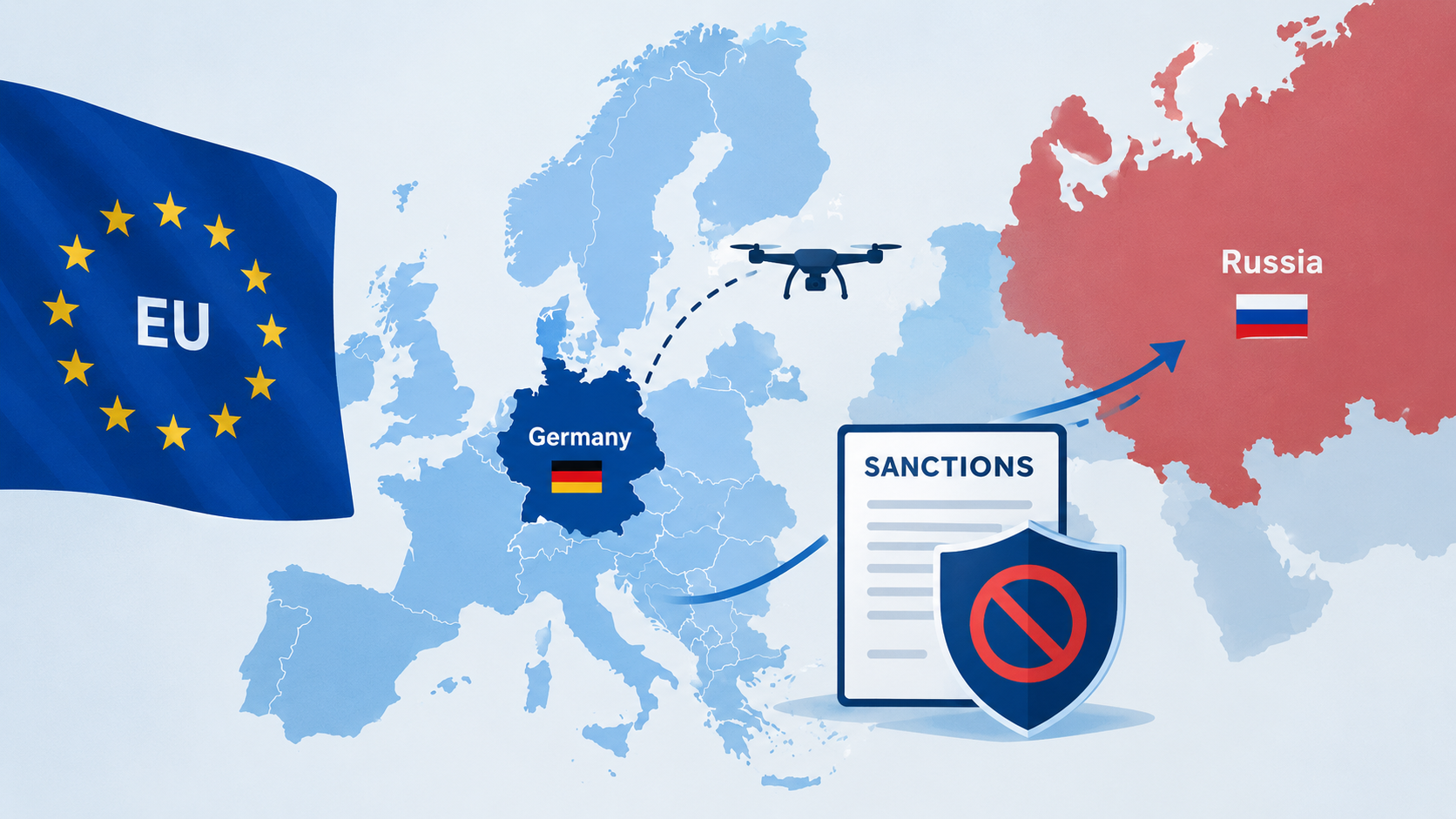


Kaja Kallas says the EU is preparing to add 1,600 more names to its Russia sanctions list after Germany accused Moscow of a failed drone attack on Leipzig/Halle Airport, and that’s before any new travel restrictions on Russians are even factored in.
Key takeaways
- EU foreign affairs chief Kaja Kallas said on 2 September 2026 that the bloc is preparing new sanctions and tighter enforcement measures against Russia.
- The move follows Germany’s accusation that Russia was behind a failed drone attack on Leipzig/Halle Airport on 4 August 2026, which Kallas called “state-sponsored terrorism.”
- The EU is preparing to sanction 1,600 additional individuals and entities linked to Russia’s military sector, with Kallas saying the bloc is “ready to add more.”
- EU foreign ministers broadly support a ban on former Russian military personnel entering the EU, and are also considering tighter visa rules for Russian tourists.
- More than 3,000 Russian officials, oligarchs, and companies have already been sanctioned since Russia’s invasion of Ukraine began in February 2022, a campaign now running past its third year.
Russia Under the European Union’s Sanctions Regime Since 2014
What Happened
Three drones carrying explosives were found in and around Leipzig/Halle Airport, in eastern Germany, on 4 August 2026, temporarily disrupting air traffic. According to wire reporting from the Associated Press on 1 September, Berlin concluded Russia was behind the attempt. Russia has denied any involvement. President Vladimir Putin, Russia’s head of state, went as far as to allege the evidence had been “planted.”
Kallas’s Response
Kaja Kallas, the European Union’s High Representative for Foreign Affairs and Security Policy (the bloc’s top diplomat), didn’t hold back. Speaking on 2 September, she called the incident “state-sponsored terrorism” and said attempts to intimidate Europe would fail. Writing in a post on X the same day, Kallas confirmed the EU is preparing new sanctions proposals and tighter enforcement, and stated that Russia’s representative to the bloc had been summoned, alongside separate summonses issued by individual member states.
United States targets Nicaragua’s gold industry with new sanctions on officials and firms
Von der Leyen Weighs In
Ursula von der Leyen, President of the European Commission, the EU’s executive branch, added her own statement on 2 September, saying authorities are looking at how to “cut deeper into Russia’s war chest.” She described the airport incident as “a new escalation on European Union soil.”
What’s Actually on the Table
- 1,600 new sanctions target individuals and entities tied to Russia’s military sector, with Kallas signaling more could follow.
- A travel ban on former Russian military personnel is broadly backed among EU foreign ministers, though not yet formally adopted.
- Tighter visa restrictions for Russian tourists raised by Kallas as a possibility, not yet a firm proposal.
- Stronger sanctions enforcement mechanisms separate from new designations, aimed at closing gaps in how existing sanctions are applied.
For context on the scale of the EU’s existing sanctions regime and how these new measures would fit in, see the Council of the European Union’s sanctions map.
Germany’s Response
Johann Wadephul, Germany’s Foreign Minister, said Russia would have to live with the consequences of its actions, adding that Germany’s response had been carefully prepared. Germany’s accusation, laid out in a follow-up wire report summarizing what’s known so far, marks one of the more direct state-to-state accusations since the war began.
Russia sends second post-sanctions LNG cargo from Portovaya to China
Russia’s Counter
Russia’s foreign ministry summoned Bernd Finke, Germany’s envoy to Russia, and told him Moscow “categorically” rejects any involvement in the drone incident.
The Bigger Picture
It isn’t clear yet how much further pressure the EU can realistically add. Sanctions have been one of the bloc’s primary tools against Russia since the invasion began in February 2022, running alongside but well short of direct military involvement. Per the Associated Press’s reporting, the conflict has largely become a war of attrition, with more than 3,000 Russian officials, oligarchs, and companies already under EU sanctions.
The Ground Situation
Ukraine continues to strike energy infrastructure deep inside Russian territory, while Russia has been carrying out regular strikes on Ukraine, taking advantage of Kyiv’s shortage of missile interceptors.