



Summary
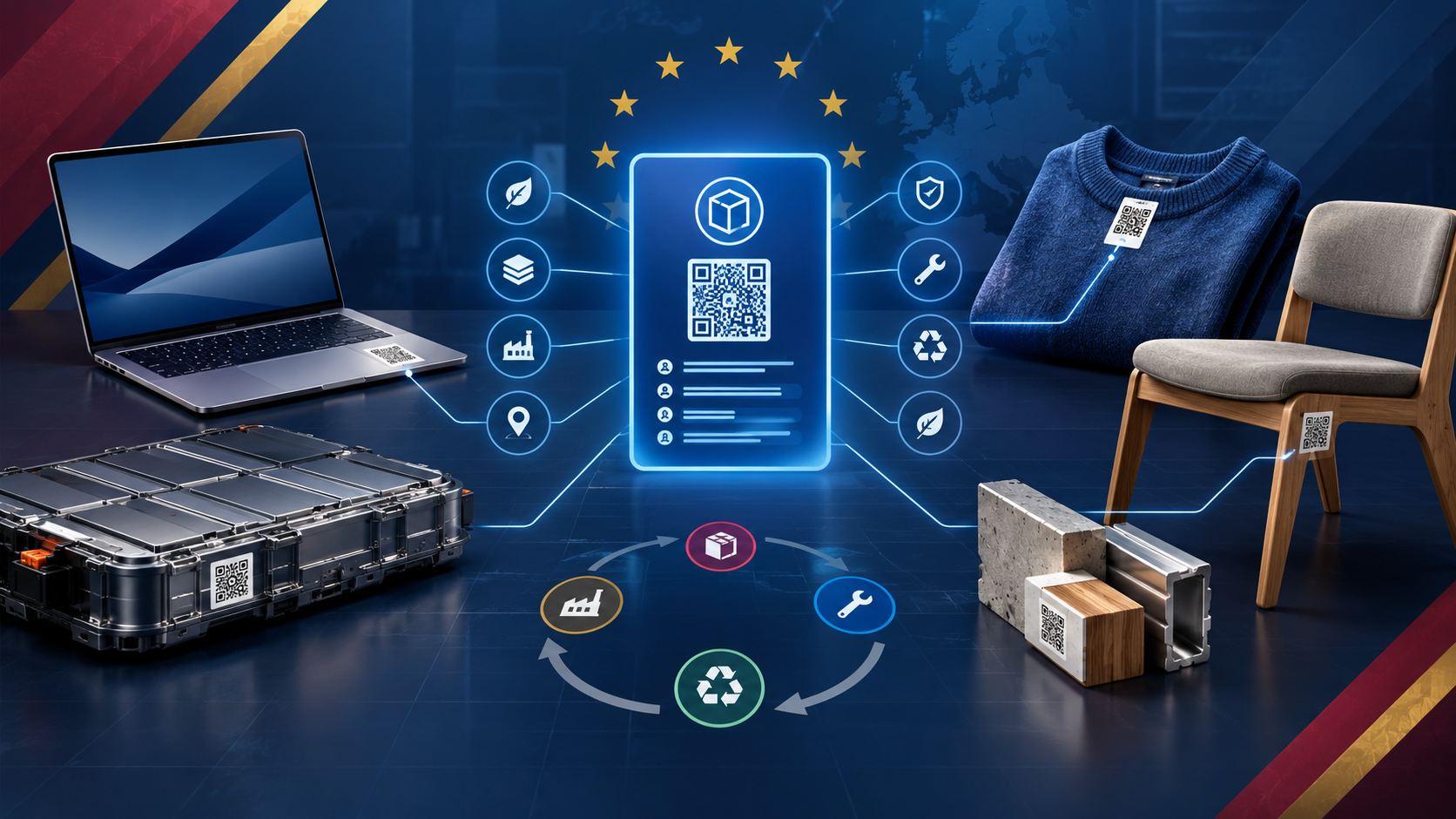
A digital product passport (DPP) is an online record that tells the story of a product. It shows what the product is made of, where it came from, how to fix it and what to do with it when it stops working. The main law behind it is the EU’s Ecodesign for Sustainable Products Regulation (ESPR), also known as Regulation (EU) 2024/1781. The passport arrives one product group at a time, starting with batteries.
What Is a Digital Product Passport?
Look at the back of a biscuit packet. It lists the ingredients, so you know what you are eating. A digital product passport does something similar for things like batteries, T-shirts or a sofa. Because the information is online, there is room for far more detail than a small label can hold.
The passport belongs to the product, not to the shop or the buyer. If someone resells a jacket, the passport goes with it. A repair shop that opens a phone can look up how to do it safely.
The Key Facts
| Question | Answer |
|---|---|
| Main governing law | Ecodesign for Sustainable Products Regulation, (EU) 2024/1781 |
| Law for battery passports | EU Battery Regulation, (EU) 2023/1542 |
| ESPR in force since | 18 July 2024 |
| Central EU registry | Launched by the European Commission in July 2026 |
| First hard deadline | Batteries, from 18 February 2027 |
| Next product groups | Iron and steel, aluminium, textiles, tyres, furniture, mattresses |
| How people open a passport | Scanning a QR code, barcode or NFC tag |
EU and Philippines Move Closer to Landmark Free Trade Agreement
Which Act Governs the Digital Product Passport?
The DPP is mainly governed by the ESPR. It is an EU regulation, which means it applies directly in every member state without each country writing its own version. It replaced the older Ecodesign Directive, which only looked at energy use. The new law covers much more: durability, repairability, recycled content, chemicals and carbon footprint.
ESPR Is a Framework, Not a Finished Rulebook
The ESPR does not list exact rules for every product. Instead, it gives the European Commission the power to write product-specific rules, called delegated acts. Each delegated act says what a certain product group must meet and what information its passport must contain. So the ESPR is the “parent” law, and the delegated acts are the “child” rules that fill in the details.
The Battery Passport Has Its Own Law
Batteries are a special case. Their passport comes from Article 77 of the EU Battery Regulation, which set a date before the ESPR rules for other products were ready. That is why batteries are the first product group with a fixed deadline.
What Does ESPR Compliance Mean?
ESPR compliance means proving that your product meets the EU’s ecodesign rules and that you share the required information about it. It is not one single form. It is a set of duties that depend on your product group and your role in the supply chain.
The Main Duties
For a covered product, a company usually has to:
- Design the product to meet the performance rules in the delegated act, such as minimum durability or recycled content.
- Keep technical documents that show how the product meets those rules.
- Complete the required conformity check and issue a declaration of conformity.
- Create the digital product passport and attach a data carrier, such as a QR code.
- Keep the passport data available and up to date for the period the rules require.
Who Carries the Responsibility
Manufacturers carry the biggest load, but they are not alone. Importers must check that the goods they bring in are compliant. Distributors and online marketplaces must not sell products that lack a passport. If a maker sits outside the EU, an authorised representative inside the EU may need to take on some duties.
EU sanctions against Russia: 21st package expands banking, crypto and oil restrictions
The Ban on Destroying Unsold Goods
The ESPR also deals with waste in a direct way. It bans certain companies from destroying unsold clothing and footwear, and it requires them to report how many unsold goods they throw away. Rules to carry this out were adopted in February 2026. Smaller businesses get more time or are exempt, so check the size limits that apply to you.
Why the EU Wants This
Right now, many products are hard to fix, hard to recycle and hard to trace. Materials are mixed together, and nobody knows what is in the pile. Some companies also make green claims that are difficult to check.
The EU hopes the passport will help in four ways:
- Shoppers can compare products using facts instead of slogans.
- Repair shops get manuals and spare part details.
- Recyclers know what they are handling, so less ends up in landfill.
- Inspectors can catch fake or unsafe goods faster.
How a Digital Product Passport Works
Every product gets a unique code. When you scan it, you land on a page with that product’s details. Behind the scenes, the EU registry does not store all the data itself. It keeps the codes and links, while each company stores its own information.
Who Sees What
Access is tiered on purpose. Shoppers might see simple facts, such as recycled content and expected lifespan. Recyclers see which materials are inside. Authorities see the compliance records. Trade secrets stay hidden from people who have no need to see them.
Which Products Need a Passport?
The rules roll out group by group. Once the Commission adopts a delegated act, companies normally get at least 18 months before it applies.
Batteries Go First
From 18 February 2027, electric vehicle batteries, batteries for e-bikes and scooters, and industrial batteries above 2 kWh cannot be sold in the EU without a battery passport.
EU plans sanctions on North Korean camp linked to transfer of Ukrainian children
The Waiting List
The EU’s work plan for 2025 to 2030 names iron and steel first, then textiles, tyres and aluminium, and later furniture and mattresses. These years are estimates and can change. Check the European Commission’s website for the latest status.
What Happens If You Do Not Comply?
Each EU country runs its own market surveillance and sets its own penalties. A product that fails the rules can be pulled from shelves, blocked at the border or recalled. Fines can also apply. The exact amounts differ by country, so companies should check the rules where they sell.
What It Means for Businesses
Behind every QR code is data that someone has to collect, check and update. For a firm with hundreds of suppliers, that is a big job.
Small Companies
Small brands may worry about cost. Software companies are building ready-made DPP tools, and small firms can ask larger suppliers to share the data they already hold.
Exporters Outside Europe
The law follows the product, not the factory. An exporter in India, Vietnam or Turkey needs a passport for goods sold in the EU, just like a factory in Germany. Indian makers of textiles, steel, aluminium and batteries should watch this closely, because European buyers will ask for data long before the legal deadline.
What Ordinary People Get Out of It
Imagine buying a second-hand washing machine. With one scan, you could see its age, repair history and which parts are easy to replace. You would know what you are paying for.
It also helps when something breaks. Instead of throwing away the whole item, you could find the right spare part or a repair shop with the right instructions. Over time, that means less waste and more money in your pocket.
EU countries remain split over trade measures targeting Israeli settlements
The Hard Parts
The idea is good, but it is not simple to carry out. Some problems remain:
- Companies may use different data formats, which makes sharing messy.
- Suppliers deep in the chain may not track their materials well.
- Passports must stay readable for years, even if a company closes.
- Businesses worry about exposing secrets to competitors.
The EU is working on common standards to solve these. Until they are final, companies need to stay flexible.
How to Get Ready
You do not need to wait for every final rule. A sensible order looks like this:
- Find out if your product falls into one of the EU’s priority groups.
- List the data you already have, such as materials, factories and test reports.
- Ask suppliers early what they can share.
- Pick a data system that follows open standards, so you are not locked in.
- Test a QR code on a small product line before rolling out everywhere.
The digital product passport turns a product from a mystery into something you can read, repair and recycle properly. The ESPR sets the rules, the delegated acts fill in the details, and compliance means showing that your product and your paperwork match. It starts small with batteries, but the direction is clear. In the coming years, products sold in Europe will have to come with their own story, and companies that tell it honestly will have an easier time.