

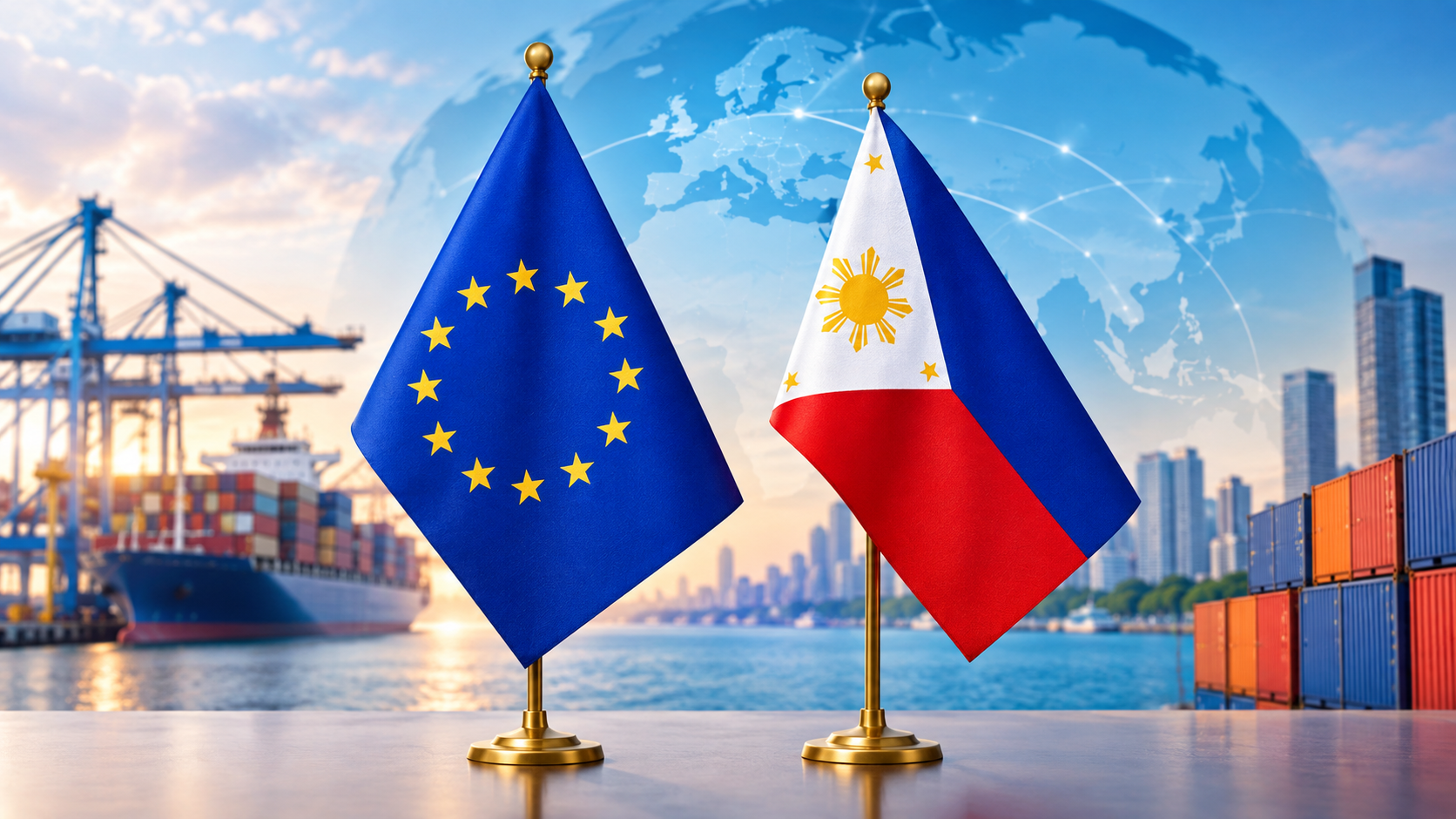


The European Union and the Philippines have reached a substantial agreement in negotiations for a new FTA (Free Trade Agreement), marking a significant step toward stronger economic cooperation. The deal is expected to expand trade, encourage investment, and create new opportunities for businesses and consumers on both sides.
European Commissioner for Trade and Economic Security Maroš Šefčovič and Philippine Trade Secretary Maria Cristina Aldeguer-Roque announced the breakthrough after a high-level video call. The agreement now enters its final phase before formal conclusion in the coming months.
Summary
The EU (European Union) and the Philippines have reached a substantial agreement on a Free Trade Agreement (FTA), bringing both sides closer to establishing a deeper economic partnership. The proposed deal aims to increase trade and investment, remove tariffs on most goods, improve market access, strengthen digital trade rules, and enhance intellectual property protections. It also includes commitments on sustainability, human rights, climate goals, and renewable energy cooperation. With bilateral trade already exceeding €17 billion in goods annually, the agreement is expected to create new opportunities for businesses, investors, and consumers across both regions.
Strengthening Economic Ties Between Europe and Southeast Asia
The proposed FTA reflects growing economic cooperation between the European Union and the Philippines. As one of Southeast Asia’s fastest-growing economies, the Philippines has become an increasingly important partner for Europe in the Indo-Pacific region.
The agreement aims to deepen commercial relations while supporting long-term economic resilience. Both sides view the deal as a way to diversify trade partnerships and strengthen supply chains in an evolving global economy.
Officials from both regions have emphasized the importance of predictable trade rules and trusted partnerships to support sustainable growth.
Trade Volumes Show Strong Potential for Growth under this Free Trade Agreement
Trade between the EU (European Union) and the Philippines has already reached significant levels. In 2025, according to statistics bilateral trade in goods totaled €17.6 billion, while trade in services reached €10.3 billion in 2024.
The EU was the Philippines’ fourth-largest trading partner in 2025, accounting for 8.3% of the country’s total goods trade.
Despite these figures, policymakers believe there is considerable room for expansion. The new trade agreement is expected to create easier market access and reduce barriers that currently limit commercial activity between the two economies.
Tariff Reductions Expected to Boost Market Access
One of the most important features of the agreement is the planned elimination of tariffs on the vast majority of goods traded between the EU and the Philippines.
The FTA (Free Trade Agreement) is expected to liberalize more than 94% of tariff lines, covering over 97% of bilateral trade. This could make products more competitive and reduce costs for businesses and consumers.
Key European exports to the Philippines include:
- Machinery and industrial equipment
- Transport equipment
- Medicines and medical devices
- Food and agricultural products
For businesses in both regions, lower tariffs could create new opportunities for expansion and investment.
New Rules for Procurement, Digital Trade, and Innovation
The agreement goes beyond traditional tariff reductions. It also introduces modern trade rules designed to support today’s digital and knowledge-based economies.
Among the major provisions are:
- Greater access to government procurement opportunities
- Stronger protection of intellectual property rights
- Recognition of European Geographical Indications
- Clear digital trade rules
- Consumer protection and data privacy safeguards
For the first time, the Philippine government procurement market would open to foreign bidders under transparent rules, potentially creating new opportunities for international participation.
Sustainability and Responsible Trade at the Core
A key element of the agreement is its focus on sustainability and responsible economic development.
- Human rights protections
- Climate goals under the Paris Agreement
- Sustainable development practices
- Fair labor standards
- Environmental responsibility
The agreement also contains provisions covering energy and raw materials, with a focus on supporting sustainable investment and renewable energy development.
These commitments aim to ensure that economic growth is balanced with social and environmental priorities.
Conclusion
Although negotiators have reached a substantial agreement, several technical and implementation details still need to be finalized before the FTA can be formally concluded.
The current breakthrough follows the resumption of negotiations in March 2024. Talks originally began in 2015 but were later paused before being restarted.
Investment links between the two economies are already significant. EU foreign direct investment in the Philippines stands at €15.4 billion, while Philippine investment in the EU totals €2.4 billion.
Once finalized, the EU-Philippines Free Trade Agreement could become one of the most important economic partnerships between Europe and Southeast Asia, supporting trade growth, investment, sustainability, and long-term economic cooperation for years to come.