

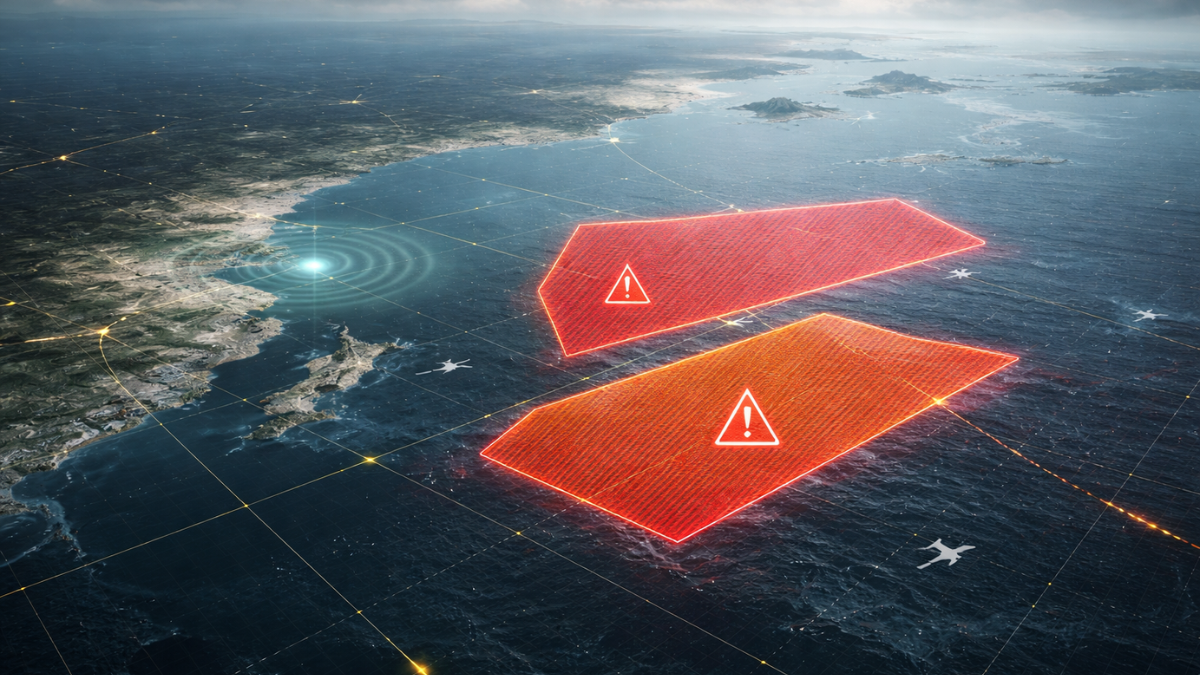


China has taken an unusual step by reserving large sections of offshore airspace for a period of 40 days. This move has attracted attention because such long restrictions are not common. The zones stretch across waters from the Yellow Sea down to the East China Sea. These areas are located far from Taiwan but remain strategically important.
The alerts were issued as Notices to Air Missions, also known as NOTAMs. These are used globally to inform pilots about hazards or temporary airspace restrictions. In this case, the alerts began on March 27 and will remain in effect until May 6.
What stands out is the duration and scale. Normally, such restrictions last only a few days and are clearly linked to military drills. This time, no official exercise has been announced. The airspace is also marked from surface to unlimited altitude, meaning there is no vertical limit.
Civil aviation has not been directly affected. Commercial flights are still allowed to pass through these areas but must coordinate carefully with authorities. This ensures safe movement while the restrictions remain in place.
The total area covered is large, even bigger than Taiwan’s main island. It includes offshore regions north and south of Shanghai, making it a significant stretch of controlled airspace.
Ma Xingrui under corruption probe as China’s anti-corruption watchdog intensifies action
Lack of Explanation Adds to the Mystery
A key concern is the lack of official explanation. Authorities have not shared the purpose of these alerts. While this is not unusual, the long duration and size of the zones make the silence more noticeable.
Experts have highlighted that combining unlimited altitude with a 40-day period is rare. Ray Powell pointed out that such a setup suggests a sustained operational posture instead of a short-term drill.
The alerts also follow another unusual development. Military flights near Taiwan had paused briefly after occurring almost daily. This pause happened around the same time as rising global tensions, which drew attention.
Flights later resumed, but the sequence added to uncertainty. The current airspace zones are located hundreds of miles away from Taiwan. This distance makes it harder to directly connect them to activity near the island, yet their size and placement remain significant.
According to Christopher Sharman, such reserved zones could allow practice of air combat maneuvers that might be needed in larger conflict situations.
Sanctioned tanker “Ping Shun” diverts Iranian oil from India to China amid payment dispute
Strategic Context and Regional Developments
The situation is unfolding during a period of important regional activity. A planned meeting between Donald Trump and Xi Jinping in Beijing, originally expected around April 1, has been delayed to mid-May. At the same time, Cheng Li-wun is set to visit China, with a meeting expected in Beijing.
Meanwhile, a delegation from the United States visited Taiwan, Japan, and South Korea. During this visit, Taiwan was encouraged to move forward with a large defense budget aimed at strengthening its military capabilities.
Earlier, the United States approved $11 billion in arms sales to Taiwan. Following this, China conducted large-scale drills around Taiwan in late December, named “Justice Mission 2025.” These drills were described as a warning against independence movements and external interference.
In another development, Japan deployed long-range missiles on its southwestern islands. These systems are capable of reaching parts of mainland China and are part of a broader military buildup.
China has issued similar airspace alerts in the past along the same coastline, but those lasted only about three days. Ben Lewis noted that the longer duration may provide greater flexibility for scheduling training activities.
The combination of timing, scale, and lack of explanation has drawn attention from observers. The reserved airspace remains active through early May, requiring coordination for any aircraft moving through these zones.