

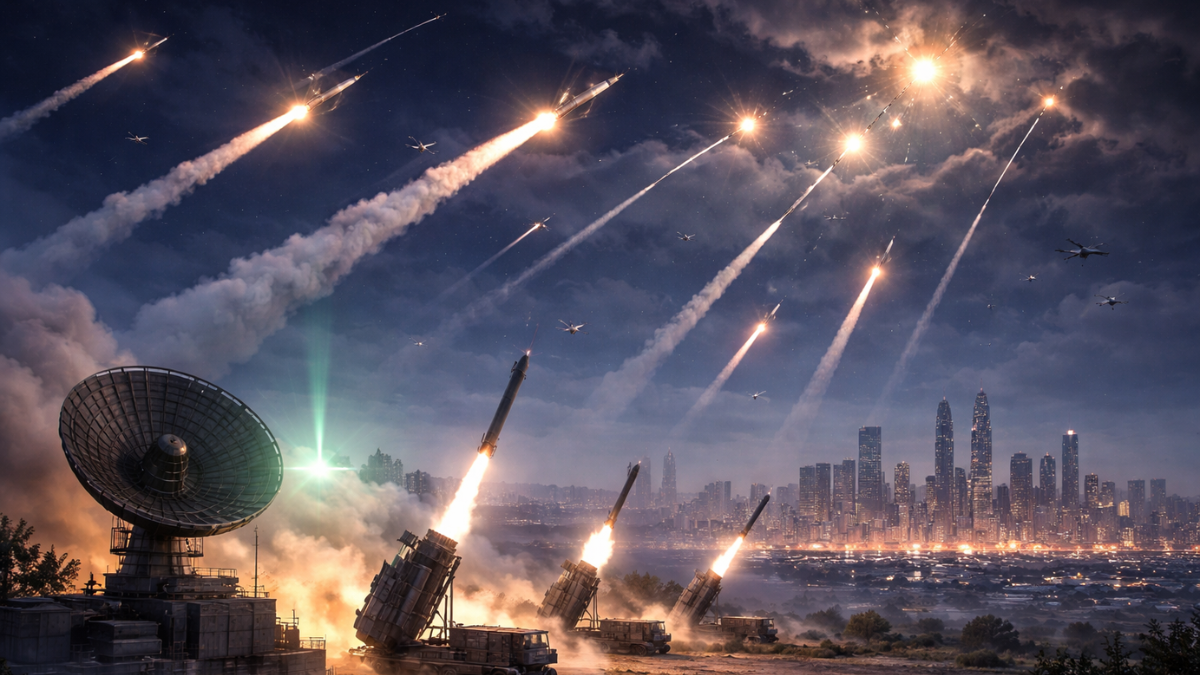


The Iran war has entered a critical phase, and a growing concern is not just about battlefield damage but about numbers. Four days into the conflict, at least one United States Gulf ally is running low on key interceptor missiles used to defend against Iranian missile and drone attacks.
Regional officials say the situation is not yet panic-level. But they admit that additional interceptors are needed soon. Gulf nations remain in contact with US Central Command, led by Brad Cooper, in case emergency resupply becomes necessary.
This conflict has turned into what many describe as “missile math.” It is a simple equation. Iran is firing missiles and drones at a high rate. The United States and its partners must decide how long their interceptor stockpiles can keep up.
Interceptors vs Missiles: A Growing Imbalance
Iran has launched more than 500 ballistic missiles and over 2,000 drones since fighting began. Estimates shared by Marco Rubio indicate Iran may be producing over 100 missiles each month.
To defend against these threats, the United States and its allies rely on advanced systems such as Terminal High Altitude Area Defense, Standard Missile-3, and MIM-104 Patriot.
Iran crypto market sees 700% rise in withdrawals after strikes and stablecoin suspension
These systems are highly effective but expensive and slow to produce. During a 12-day Israel-Iran conflict last year, the US used about a quarter of its THAAD interceptors. In 2025 alone, estimates suggest the US has already fired up to 20 percent of projected Standard Missile-3 stock and between 20 to 50 percent of THAAD missiles.
Production remains limited. Only six or seven high-end interceptors are built each month. When compared to Iran’s reported output, the imbalance becomes clear.
US forces have struck nearly 2,000 Iranian targets with more than 2,000 munitions, according to statements from Brad Cooper. Hundreds of Iranian ballistic missiles, launchers, and air defense systems have been destroyed. Despite this, missile and drone attacks continue.
Some Iranian strikes have broken through defenses. A drone hit a high-rise building in Bahrain, causing a major explosion. In the United Arab Emirates, two Amazon Web Services data centers were damaged.
Strain on Gulf Allies and Broader US Supplies
Gulf countries including Bahrain, Qatar, the UAE, and Saudi Arabia have tried to intercept nearly every incoming missile or drone. This strategy uses large numbers of interceptors. If supplies fall further, some nations may need to focus only on the most dangerous threats.
The United Kingdom has deployed aircraft from Cyprus and Qatar to help intercept missiles and drones. Missile stockpiles are now seen as a key factor in determining how long the conflict can continue at its current pace.
Israel–Iran conflict sparks oil shock fears for India as Hormuz risks mount
Concerns about stockpiles were raised before the conflict expanded. Dan Caine warned that a prolonged campaign could affect US weapons reserves, especially those supporting Israel and Ukraine. On Capitol Hill, Mark Kelly described the situation as a math problem, questioning how air defense munitions would be resupplied.
Donald Trump has stated that US medium and upper-medium grade munitions stockpiles are strong. Emergency production orders have reportedly been issued. Earlier, Pete Hegseth paused a weapons shipment to Ukraine during a review, acting on a memo from Elbridge Colby, who has argued for preserving stockpiles for potential conflicts such as one involving China.
Studies have suggested that in a high-intensity war with China, US munitions could run low within 25 days. This makes every interceptor used in the Middle East part of a wider global calculation.
The United States currently holds air superiority over Iran. This allows greater use of shorter-range precision weapons like JDAMs, which exist in much larger numbers. Retired officer Mark Gunzinger has noted that such weapons can reduce strain on higher-end systems. Frank Kendall has also stated that weapon usage can be managed carefully to preserve critical inventories.
The Iran war’s troubling missile math remains focused on supply versus demand. The balance between production and use is shaping the pace and pressure of the ongoing conflict.