

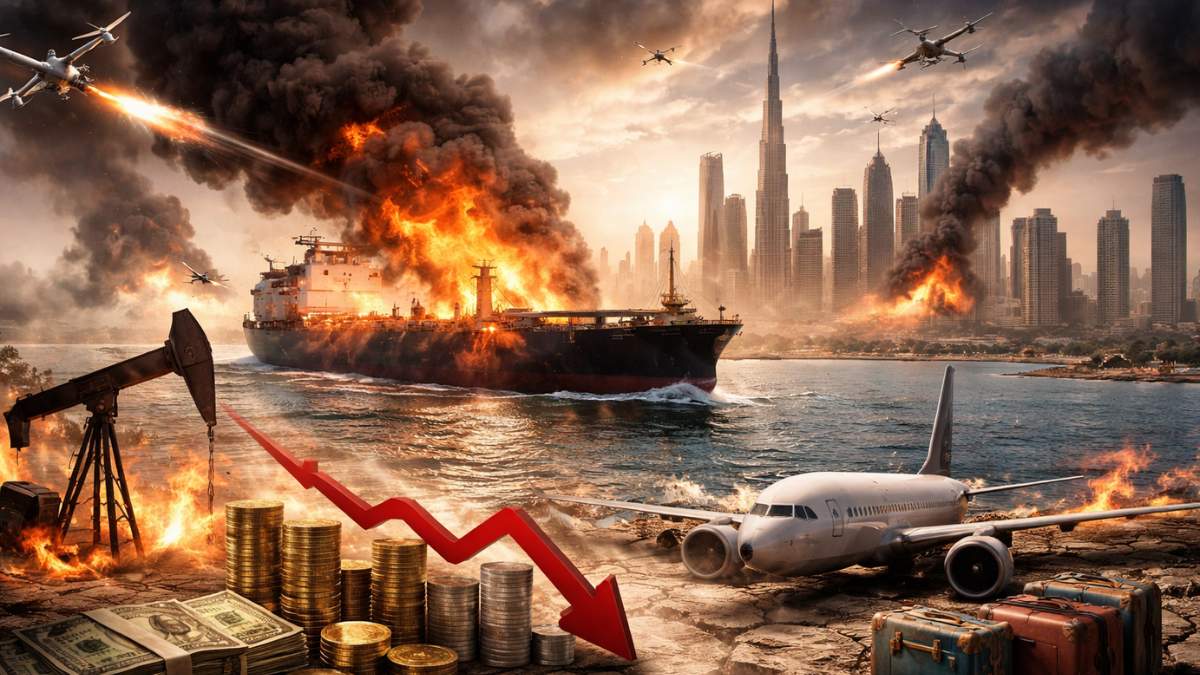


The ongoing war involving Iran, the United States, and Israel is causing serious damage to Gulf economies. From oil production to tourism, the conflict has disrupted daily life and economic activity across the region.
Since February 28, Iran has launched repeated attacks on Gulf states, claiming it is targeting military bases used by the United States. Gulf nations, including Saudi Arabia and United Arab Emirates, insist these attacks are unjustified. The strikes have already caused major disruptions in energy production, travel, and tourism, threatening the region with severe economic losses.
Oil Production and Trade Suffer Massive Blow
The war has directly affected oil production. Within just over a week, Middle Eastern output fell from 21 million barrels to 14 million barrels daily. The closure of the Strait of Hormuz, a critical shipping lane, is the main reason. If ships continue avoiding the strait amid Iran’s threats, output could drop further to as low as 6 million barrels daily.
Oil remains central to Gulf economies. Despite diversification efforts, it still accounts for roughly a quarter of GDP. Qatar, Kuwait, and Bahrain are most vulnerable due to limited alternate export routes, while Saudi Arabia and the UAE benefit from pipelines that partially bypass the strait.
Australia backs EU sanctions targeting cyber attacks linked to Chinese and Iranian entities
Gulf analysts estimate that disruptions in shipping, aviation, and energy exports are costing the region hundreds of millions of dollars per day. Even Iraq, not a GCC member, is losing heavily. Peter Martin, head of economics at Wood Mackenzie, said Iraq has lost about $3 billion in daily revenues because of a 70 percent drop in oil output.
US President Donald Trump stated that “numerous” countries are ready to help secure the Strait of Hormuz, but no government has confirmed participation, while several have ruled out deploying warships.
Tourism and Travel Collapse
Tourism and travel, which account for around 11 percent of GCC GDP, have also been severely affected. Between February 28 and March 8, 37,000 flights were canceled due to airspace closures and safety concerns. Dubai International Airport, normally the world’s busiest international hub, suspended flights after a drone attack on a nearby fuel depot.
Qatar Airways has slowly resumed special flights but has not returned to pre-war levels. The World Travel & Tourism Council estimates the conflict costs the region around $600 million daily in lost visitor spending. Emilie Rutledge, economics lecturer at The Open University in the UK, noted that canceled bookings, conferences, and sporting events have added massive costs for hotels and travel businesses.
Jean-Noël Barrot says EU plans sanctions on 9 people over alleged Bucha war crimes
Gulf Economies Under Intense Pressure
The combination of reduced oil production, trade disruptions, and tourism losses is putting enormous pressure on Gulf economies. Yesar Al-Maleki, a Gulf analyst at the Middle East Economic Survey, said Qatar, Kuwait, and Bahrain are especially exposed, while Saudi Arabia and the UAE are somewhat better positioned due to pipeline infrastructure.
Economic experts warn that if the war continues until the end of April, GDP could drop by 14 percent in Qatar and Kuwait, 5 percent in the UAE, and 3 percent in Saudi Arabia. The scale of disruption may resemble shocks seen during the pandemic, and a prolonged closure of trade routes could approach the economic impact of the 1991 Gulf War.
Khaled AlMezaini, associate professor at Zayed University in Dubai, said the region is losing hundreds of millions of dollars daily across energy, shipping, and travel sectors. Every sector that depends on oil, trade, or tourism is experiencing losses, making this one of the most severe economic crises for the Gulf in decades.