

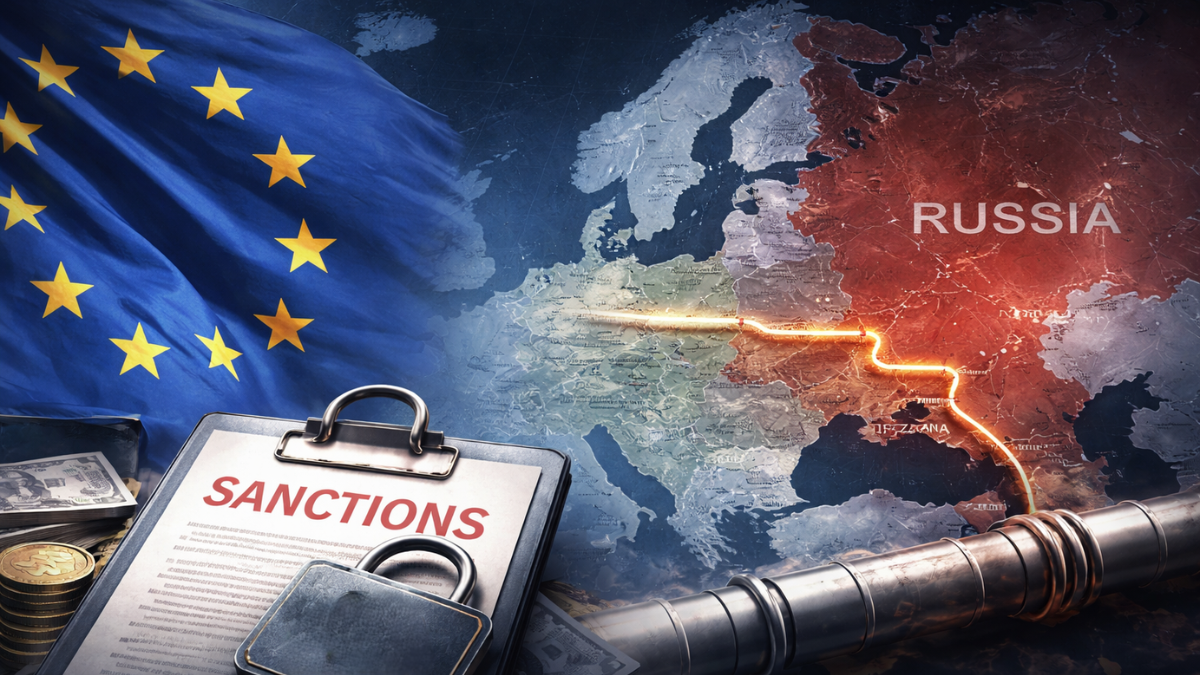


The European Union has extended its sanctions connected to Russia’s war against Ukraine for another six months, keeping the measures in place until 15 September 2026. The decision was confirmed by the Council on 14 March and preserves one of the central legal frameworks used by the EU to maintain pressure on Russia and those supporting its actions in Ukraine.
These sanctions target individuals and organisations accused of undermining Ukraine’s territorial integrity. According to the Council, the measures currently apply to around 2,600 people and entities. The restrictions include asset freezes, travel bans, and limits that prevent EU citizens or companies from providing funds or economic resources to those listed.
The legal acts adopted for the renewal were Council Implementing Regulation (EU) 2026/695 and Council Decision (CFSP) 2026/696. Together, they maintain the sanctions system that has been repeatedly extended since the conflict between Russia and Ukraine escalated.
While the extension followed the usual legal process, the political discussions surrounding the decision revealed tensions inside the European Union. Renewals that were once routine have increasingly become subjects of debate among member states.
Dispute Among Member States Delays Agreement
The latest renewal faced resistance from Hungary and Slovakia, which delayed the agreement while pushing for several individuals to be removed from the sanctions list. Their objections led to negotiations among EU governments before a compromise could be reached.
In the final agreement, two living individuals were removed from the sanctions list, including Dutch trader Niels Troost. Five deceased individuals were also delisted as part of the adjustment.
Easing of Russian oil sanctions raises concerns among Ukraine and European allies
However, Russian oligarchs Alisher Usmanov and Mikhail Fridman remained under sanctions despite Slovakia’s request for their removal. Slovakia had indicated that it might block the renewal of the broader sanctions regime if its demands were not addressed.
Hungary initially supported the effort to remove certain names from the list but later withdrew its own requests and stopped short of using a veto. This shift helped prevent a breakdown in the talks and allowed the sanctions renewal to proceed.
Even though the legal extension was eventually approved, the discussions highlighted a growing pattern within the EU. Unanimous approval is required for sanctions decisions, which means any member state can delay or challenge the process.
As a result, the six-month renewal cycle has increasingly become a moment when governments raise wider political concerns or attempt to use the sanctions negotiations to gain leverage on other issues.
Energy Concerns Add Pressure to Sanctions Talks
The dispute over sanctions is closely connected to broader disagreements about energy supplies. Hungary and Slovakia have raised concerns about the impact of sanctions on Russian energy and the effect on their own economies.
US temporarily eases sanctions on Russian oil shipments loaded before March 12
Both countries rely in part on oil transported through the Druzhba pipeline, which has historically delivered Russian crude oil to Central Europe. Disruptions to these oil flows have become a key part of the political debate.
Hungary sent a fact-finding mission to Ukraine to examine the stoppage affecting the pipeline. Hungarian Prime Minister Viktor Orbán has also publicly called for Russian energy sanctions to be suspended, citing rising prices and pressure on energy markets.
Wider Political Pressure Surrounding the Sanctions Debate
These developments have tied the sanctions dispute to wider European policy discussions. Hungary has already linked the Druzhba pipeline issue to other EU decisions involving Ukraine, including a proposed €90 billion loan package planned for 2026 and 2027.
Reports have suggested that the resumption of oil transit has been used as leverage in negotiations over several EU measures related to Ukraine.
At the same time, external pressure has also influenced the debate. Ukrainian President Volodymyr Zelenskyy has questioned whether some parts of Europe want Russian oil flows restored as discussions continue about pipeline repairs and financial assistance for Ukraine.
Even though the oil issue sits partly outside the specific sanctions listings renewed on 14 March, it reinforces the wider political tensions surrounding the EU’s Russia policy.
The extension of sanctions until 15 September 2026 ensures that the existing restrictions remain in force. However, the negotiations surrounding the decision demonstrate how maintaining unity on sanctions has become increasingly complex as member states balance geopolitical pressure, economic concerns, and energy security.