

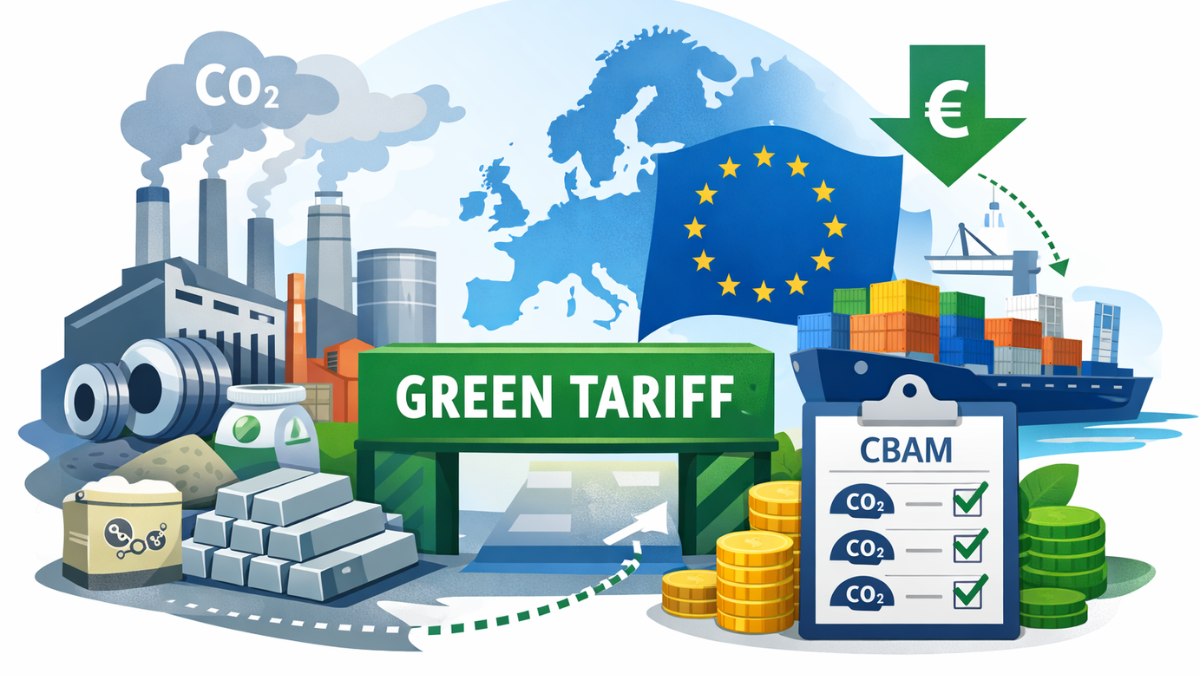


The European Union has officially brought into force a major new trade policy known as the “green tariff,” formally called the Carbon Border Adjustment Mechanism (CBAM). The rules affect companies selling high-carbon products such as steel, cement, aluminium, fertilisers, hydrogen, and electricity into the EU. Exporters must now prove their goods meet low-carbon standards or face additional costs and penalties.
The CBAM aims to create a level playing field between EU companies and overseas competitors. EU businesses already pay for carbon pollution under the bloc’s emissions trading system. The new rules ensure that foreign producers cannot undercut EU companies simply because they operate under weaker environmental regulations.
The EU has pressed ahead with the rules despite protests from China, the United States, Australia, and other trading partners. Many expected the bloc to soften or delay the measures, as has happened with other environmental regulations. Instead, the EU confirmed the CBAM as a key step to encourage industrial decarbonisation while protecting European competitiveness. European Commission executive vice-president Stéphane Séjourné said the rules are designed to support low-carbon investment rather than discourage it.
Irish Files Reveal 1995 Fears That Freedom of Information Law Could Silence Key EU Sources
How the Carbon Border Adjustment Mechanism Works
Under the CBAM, exporters to the EU must calculate the carbon emissions produced during manufacturing. If emissions exceed EU standards, companies must buy CBAM certificates to cover the difference. These certificates are priced in line with the EU’s carbon market.
The system aims to prevent carbon leakage, where companies move production to countries with weaker rules and then sell cheaper, high-polluting goods back into the EU. By applying a carbon cost at the border, the EU ensures domestic and imported goods face similar standards.
In its initial phase, the CBAM covers iron and steel, aluminium, cement, fertilisers, hydrogen, and electricity. From 2028, the rules will expand to products made using steel and aluminium, such as machinery and electrical appliances, to stop manufacturers from relocating production outside Europe to avoid the regulations.
Some EU industries have raised concerns about higher costs. Free carbon allowances under the EU emissions trading system will gradually disappear, meaning producers will have to pay directly for their emissions. However, Adrien Assous of the Sandbag think tank said the impact on prices and the economy is likely to be limited in the early years, as the emissions covered by CBAM remain relatively small.
UK Concerns and Global Trade Impact
The rules have also raised concerns outside the EU, particularly in the UK. High-carbon goods that become more expensive in the EU could be redirected to other markets, creating a risk of cheap steel, cement, and similar products being dumped elsewhere.
Tariffs of 21.9% to 42.7% target EU dairy products as China cites damage to domestic producers
Diana Casey of the Mineral Products Association highlighted that UK cement imports have tripled over the past decade, rising from about 10% of the market to nearly a third. She stressed that CBAM is needed to level the carbon cost playing field and secure the future of domestic production.
Although the UK already regulates carbon emissions, it has not yet linked its carbon market to the EU’s. As a result, British exporters could still fall under EU CBAM rules. EU climate commissioner Wopke Hoekstra said that once the carbon markets are linked, the administrative and financial impact on UK companies should be minimal.
Electricity trade is another sensitive area. The UK sometimes exports renewable electricity to the EU during periods of high wind generation. Adam Berman of Energy UK warned that penalising clean electricity imports under CBAM would be counterproductive.
The UK government said it is working to secure a carbon-market linking agreement with the EU, which would exempt British businesses from billions in potential export charges and support green investment both domestically and overseas.