

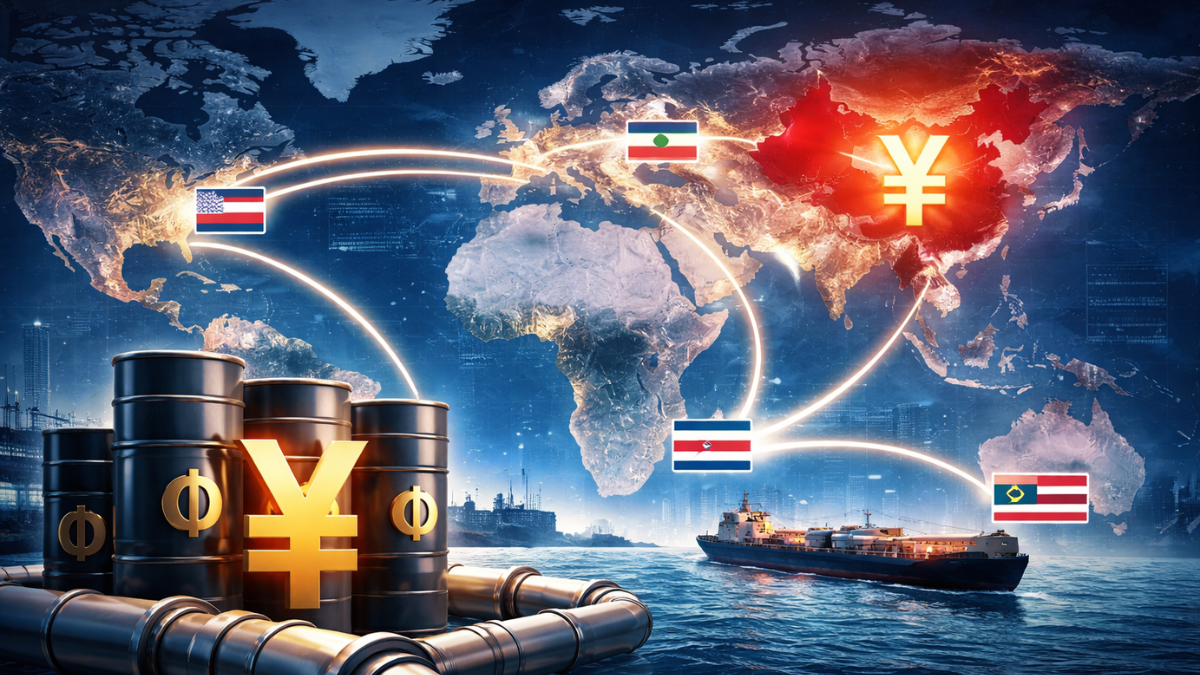


Rising tensions in global politics have drawn attention to a surprising connection between Iran, Venezuela and Cuba. These countries are located in different regions and have different political systems. Yet they share an important link. Each has built energy and financial arrangements with China that involve trading oil and infrastructure using the Chinese yuan rather than the US dollar.
The issue has also gained attention during the conflict involving Iran. The United States under President Donald Trump said its actions were meant to prevent threats and stop wider conflict. However, analysts pointed to several explanations behind the escalation.
One claim was that Iran was moving toward nuclear capability. The head of the International Atomic Energy Agency, Rafael Grossi, said there was no evidence of a structured nuclear weapons programme. At the same time, he noted that inspectors did not have complete access to certain uranium stockpiles that were close to weapons-grade levels.
Negotiations mediated by Oman reportedly led to Iran agreeing to “zero accumulation, zero stockpiling and full verification” under international inspection. Despite this, conflict began soon afterward.
Military Tensions and Conflicting Objectives
A senior US official, Peter Hegseth, later stated that the objective was not regime change but the destruction of Iran’s missile programme and naval capabilities.
China blacklists 20 Japanese firms in sweeping export control move after Takaichi’s landslide win
Israel’s position toward Iran has remained firm because Iran has never recognised Israel’s existence. Israeli officials said they saw an opportunity to eliminate Iran’s supreme leader, Ayatollah Ali Khamenei, during the conflict.
Reports also mentioned damage to US military assets in places such as Qatar and casualties among American forces. These developments raised questions about why the confrontation intensified when earlier US administrations had avoided direct war.
China’s Oil Deals with Iran, Venezuela and Cuba
A major connection between Iran, Venezuela and Cuba lies in their growing economic relationship with China.
Venezuela holds some of the largest oil reserves in the world. The government led by Nicolás Maduro announced plans to reduce dependence on the US financial system by using the Chinese yuan for oil trade. Venezuelan oil sold to China was often discounted by about 13 to 15 dollars below Brent crude prices. Much of this trade reportedly took place through indirect markets, with nearly 80 percent of shipments linked to Chinese buyers. Chinese companies also held around 440 million barrels of reserves in Venezuelan oil fields.
Iran developed similar arrangements with China. In 2012, Iran negotiated a yuan-based trade system through Russian banks that allowed it to purchase Chinese goods and services despite sanctions. Oil shipments were sometimes routed through Malaysia and payments handled by smaller banks. Iran sold oil at discounts of eight to ten dollars per barrel while importing cheaper Chinese products.
A long-term cooperation agreement signed in 2021 expanded the China-Iran partnership for 25 years. By 2025, China was buying more than 80 percent of Iran’s shipped oil, much of it processed by smaller Chinese refineries. China also pushed to include Iran in the expanded BRICS grouping of Brazil, Russia, India, China and South Africa.
130,000 Western cars flood Russia through China, exposing sanctions loophole in global auto trade
Cuba’s relationship with China focused mainly on energy infrastructure. Beginning in 2008, China’s Export-Import Bank invested in modernising Cuba’s ageing oil sector. In 2010, about six billion dollars was directed toward building a major refinery connected to plans for energy development in the Gulf of Mexico. Although some projects did not fully materialise, trade between Cuba and China increasingly moved toward yuan-based financial systems. Chinese foreign ministry spokesperson Lin Jian later said China would assist Cuba as it faced energy shortages after oil shipments from Venezuela slowed.
Oil Trade and the Petrodollar System
The link between oil and global currencies goes back to the early 1970s. After the collapse of the Bretton Woods system, the United States formed agreements with major oil-producing countries in the Gulf region. Oil would be priced mainly in US dollars and revenues would often be invested in US Treasury securities. This structure became known as the “petrodollar system.”
Historical records highlight the role of oil in global politics. Former British leader Margaret Thatcher spoke about protecting oil interests during the intervention in Jordan in 1958. Years later, former US defence secretary Chuck Hagel remarked that many military interventions were rarely about simple humanitarian goals.
The energy landscape later changed after the shale oil revolution, which made the United States the world’s largest oil producer and a net exporter by 2021. At the same time, China expanded its energy supply network. Russian energy company Rosneft exports about 200,000 barrels per day through the Kazakhstan-China pipeline, while another 600,000 to 700,000 barrels per day move through the Eastern Siberia Pacific pipeline.
China also imports oil from countries such as Iraq, Brazil and Saudi Arabia and maintains strategic reserves estimated at about 1.3 billion barrels. Meanwhile, the yuan briefly overtook the euro in 2024 as the second-most used currency in global trade finance, although the US dollar still dominates with a much larger share.