

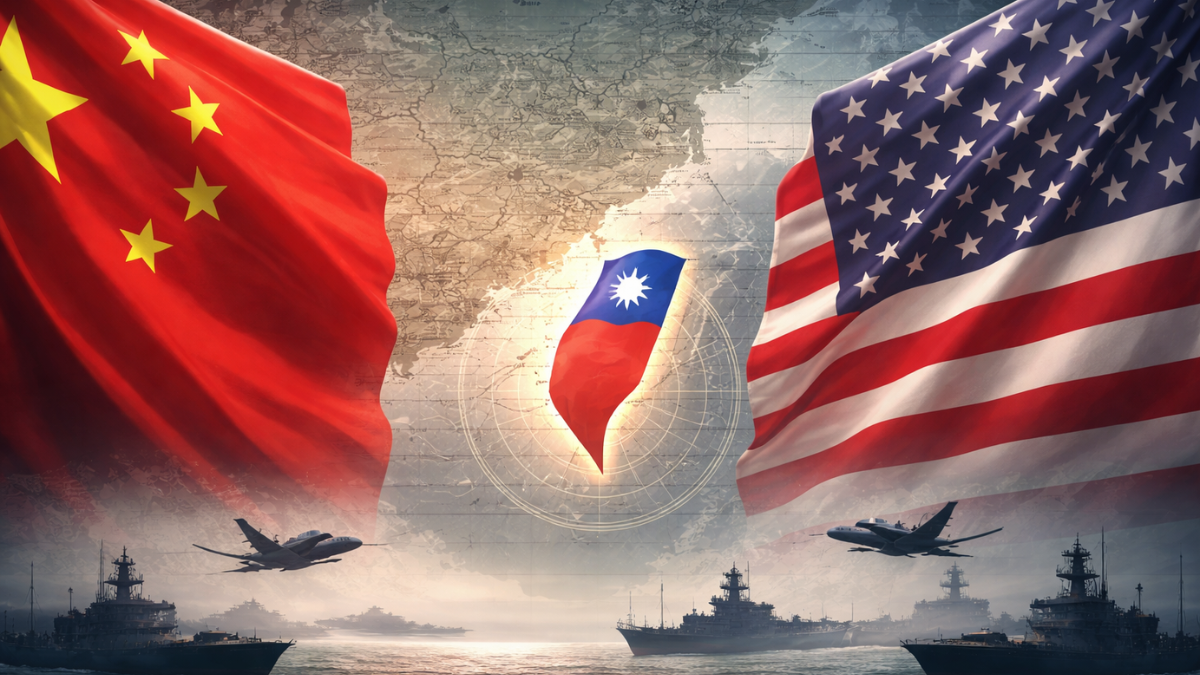


China has announced new sanctions on 20 United States defence companies after Washington approved a major arms sale to Taiwan. The move highlights continuing tensions between China and the U.S. over Taiwan, an island that China claims as its own territory.
The announcement follows confirmation from Taiwan that the United States approved defence sales worth about $11 billion. This package is described as one of the largest weapons deals approved for Taiwan. China criticised the decision, saying it seriously challenges its political position and national interests.
Soon after the deal became public, China revealed a list of U.S. defence firms that would face penalties. The list includes a defence manufacturing unit of Boeing based in St. Louis and aerospace and defence company Northrop Grumman. Other U.S. military-related firms were also named.
China’s response to US defence sales to Taiwan
China’s foreign ministry said the arms sales violate the “one-China principle.” This principle states that there is only one China and that Taiwan is part of it. China argues that any foreign military support for Taiwan interferes in its internal affairs.
According to China, the U.S. arms deal damages its sovereignty and territorial integrity. The sanctions were announced as a direct response to the approval of the weapons package.
Israel acts against Chinese aluminium dumping as global trade tensions rise
Under the sanctions, Chinese companies and organizations are banned from doing business with the 20 U.S. defence firms. This includes cooperation, partnerships, and supply arrangements. In addition, any assets these companies hold in China will be frozen. This means funds, property, or investments linked to them in the country cannot be accessed or used.
China also imposed sanctions on 10 industry executives connected to the defence firms. These individuals are banned from entering mainland China. The ban also applies to Hong Kong and Macau. No individual names were released, but the restrictions were confirmed as part of the sanctions.
China said the measures were necessary because of the arms sales to Taiwan and repeated its opposition to such deals.
Limited business exposure but clear political signal
Many of the sanctioned companies appear to have little or no business in China. Some of them were already sanctioned by Beijing in earlier disputes related to Taiwan arms sales. Because of this, the direct financial impact of the new sanctions may be limited.
However, the decision still carries strong political meaning. By officially naming major defence firms such as Boeing’s defence unit and Northrop Grumman, China is sending a clear message of protest. The move also signals that China is willing to respond firmly to actions it views as harmful to its core interests.
China and Russia say their partnership has reached its highest level despite sanctions
At the time of reporting, Boeing and Northrop Grumman did not respond to requests for comment from AFP. The lack of response reflects that the companies may not be significantly affected by the sanctions inside China.
Taiwan arms sales and ongoing China-US tensions
The United States has long been Taiwan’s largest arms supplier. While Washington officially recognizes Beijing as the government of China, it maintains unofficial ties with Taiwan and provides weapons to help the island defend itself.
China strongly opposes this relationship. It considers Taiwan part of its territory and has said it does not rule out using force to bring the island under its control.
The recently approved $11 billion arms package is intended to strengthen Taiwan’s defence capabilities. Taiwan authorities described the deal as a major step for the island’s security.
China criticised the deal soon after it was announced. The sanctions revealed later were presented as a direct reaction to the approval of the weapons sales.
This latest action adds to ongoing tensions between China and the United States. Taiwan remains one of the most sensitive issues in their relationship, with arms sales continuing to trigger diplomatic and economic responses from Beijing.