

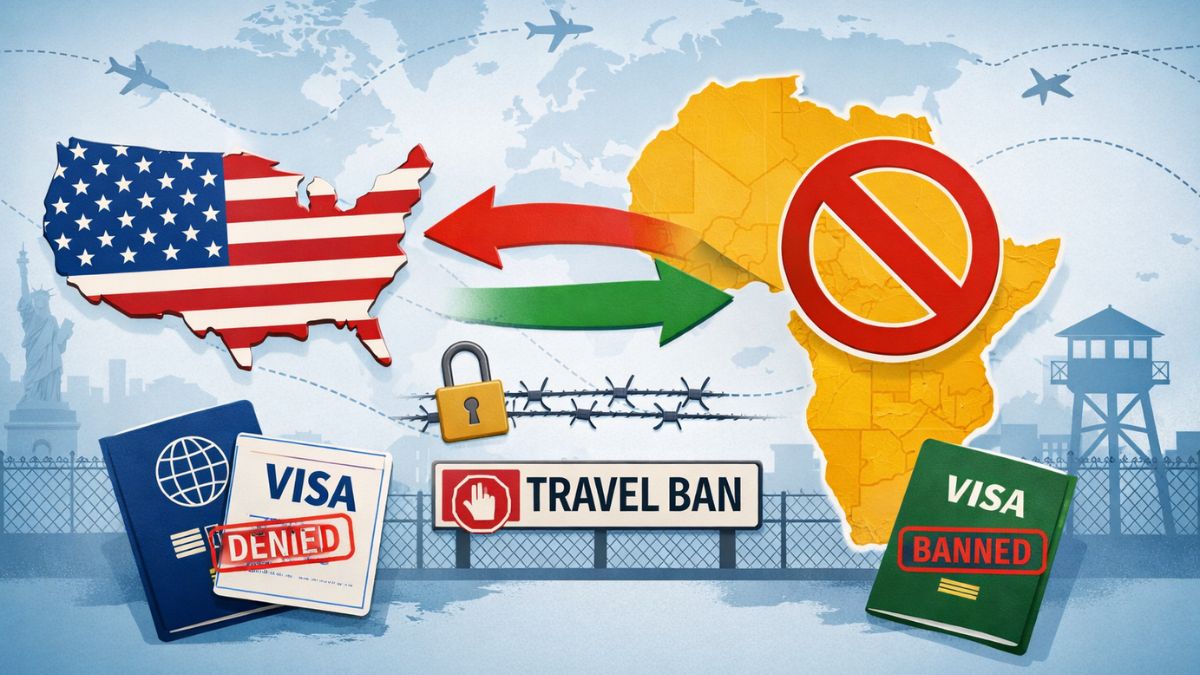


Several African countries have recently announced bans on United States citizens entering their borders. The move has drawn global attention and confusion. These decisions are not isolated actions. They are a direct response to new visa restrictions imposed by the United States under President Donald Trump, which affect dozens of countries worldwide, many of them in Africa.
The bans are rooted in diplomatic rules, security concerns, and changing relations between the US and African nations. Below is a clear and simple explanation of what is happening, written in an easy-to-understand way and based strictly on the original reported facts.
US Visa Bans Spark Immediate Retaliation
In December, the United States expanded visa bans and entry restrictions on citizens from 39 countries across Africa, Asia, the Middle East, and Latin America. Of these, 26 are African nations. Some countries were placed under full bans, meaning their citizens are not allowed to enter the US at all. Others faced partial restrictions.
The US government said the bans were imposed on national security grounds. Officials cited weak screening and vetting systems, poor information sharing, high visa overstay rates, and the refusal by some countries to accept deported nationals. Countries were also assessed based on whether they had a significant presence of armed groups linked to extremist organisations.
In response, several African countries decided to apply the diplomatic principle of reciprocity. This means that if their citizens are banned from entering the US, then US citizens will face the same restrictions when entering their countries.
Thousands of H-1B workers stranded in India after U.S. cancels visa renewals without warning
Mali and Burkina Faso were the latest to announce full visa bans on US citizens, effective immediately. Mali’s foreign affairs ministry said it would apply the same conditions to US nationals that the US applies to Malian citizens. Burkina Faso’s foreign minister, Karamoko Jean-Marie Traore, issued a similar statement, citing reciprocity.
Niger followed shortly after with its own ban on US citizens. Earlier, Chad had already stopped issuing visas to US citizens, allowing only limited exceptions. Only Americans who obtained visas before a set date are now allowed to enter Chad.
Countries Involved and Regions Affected
Under the expanded US policy, several countries face full entry bans. These include Afghanistan, Burkina Faso, Chad, Equatorial Guinea, Eritrea, Haiti, Iran, Laos, Libya, Mali, Myanmar, Niger, the Republic of Congo, Sierra Leone, Somalia, South Sudan, Sudan, Syria, Yemen, and holders of travel documents issued by the Palestinian Authority.
Other countries face partial restrictions, including Angola, Benin, Burundi, Cuba, Gabon, The Gambia, Ivory Coast, Malawi, Mauritania, Nigeria, Senegal, Tanzania, Togo, Venezuela, Zambia, and Zimbabwe, among others.
The African nations responding with reciprocal bans are mainly located in West Africa and the Sahel region. This area has been affected for years by violence from armed groups linked to al-Qaeda and ISIL. The conflict has displaced millions of civilians.
Mali, Burkina Faso, and Niger are all governed by military-led administrations. In July 2024, they formed the Alliance of Sahel States, a regional bloc created to improve security cooperation and trade. Their similar responses to the US visa bans reflect this growing political coordination.
Broader Strain in US–Africa Relations
The visa dispute comes during a period of wider strain between the United States and African nations. Trade relations have weakened following the expiration of the African Growth and Opportunity Act, which previously allowed many African goods to enter the US market without tariffs. Since the program ended, African countries have faced higher trade barriers.
President Trump pauses diversity visa program following deadly university shootings
Aid relations have also shifted. In early 2025, the Trump administration shut down the US Agency for International Development and cut billions of dollars in foreign aid. Aid groups have reported rising hunger and health concerns in parts of Africa as a result.
Diplomatic engagement has declined as well. The US recently recalled dozens of diplomats, many of whom were posted in African countries. This move added to concerns about reduced cooperation.
At the same time, the US has continued military operations against armed groups in Africa, including airstrikes in Somalia and northwestern Nigeria. While some of these actions were carried out with local governments, disagreements have emerged over public statements and narratives.
Relations with South Africa have also been affected. The country faced higher tariffs after President Donald Trump made disputed claims about violence targeting white citizens. South African President Cyril Ramaphosa later explained that crime affects all communities, not just one group.
Together, these developments show how visa policies, security concerns, trade changes, and diplomatic decisions are closely linked. The bans on US citizens reflect ongoing political tension and reciprocal actions between governments, rather than isolated travel restrictions.