

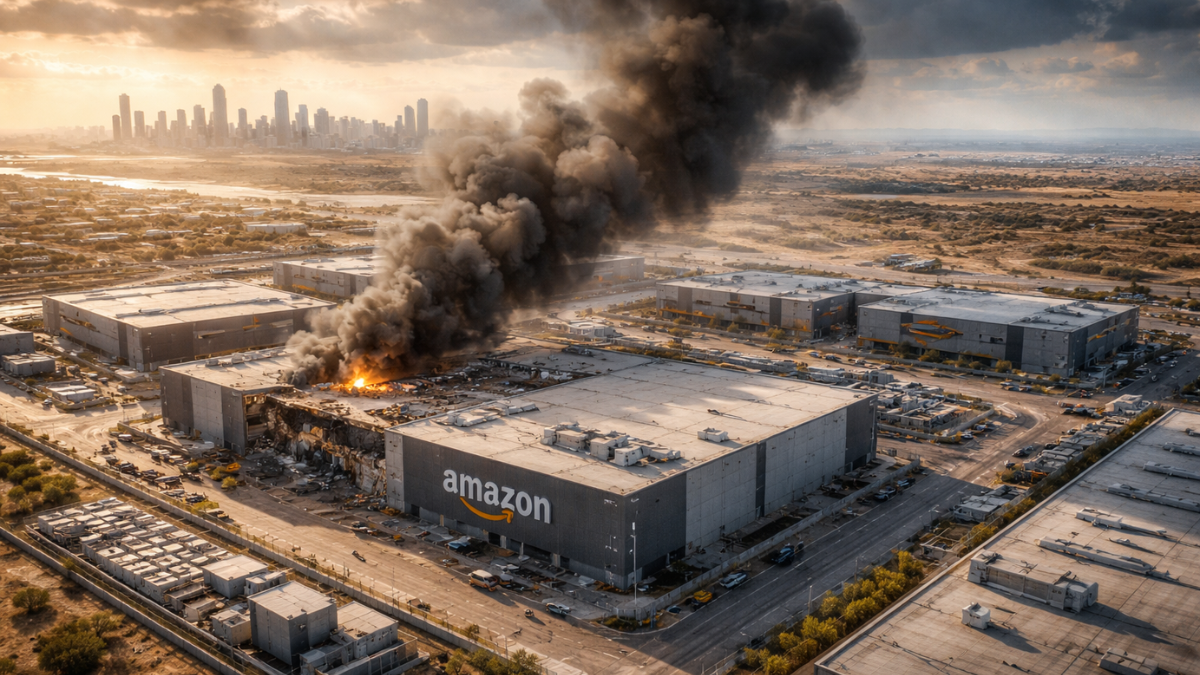


An Iranian drone reportedly struck an Amazon building in Bahrain on Tuesday, sending alarm signals across the global tech industry. This is the second attack on Amazon Web Services (AWS) infrastructure in the region in a few weeks, raising concerns about the safety of major tech companies and their projects in Gulf countries.
Drone Strikes Disrupt Tech Operations
According to reports, the drone attack affected AWS operations in Bahrain, causing interruptions for businesses and users in the region. Earlier, on March 1, an Amazon data center in the United Arab Emirates was also targeted.
While the number of attacks so far is small, experts note that even occasional strikes could disrupt key technology infrastructure. Much like attacks on oil tankers in the Strait of Hormuz have caused oil supply problems, drone hits on data centers could affect how tech companies operate.
Iran has stated that it may target U.S. companies in the region, including those that might have connections to the U.S. military. Specifically, the nation has listed seven companies as potential targets: Amazon, Microsoft, Google, Palantir, Nvidia, and IBM.
Sanctions eased briefly to allow Iranian oil shipments already loaded to be sold
These developments highlight the growing physical risks for tech operations in Gulf countries. Companies planning AI data centers there now face a new challenge: ensuring safety from regional conflicts.
Billion-Dollar AI Projects at Risk
The recent drone strikes have put some of the largest AI projects in the Gulf under threat. One major example is the Stargate AI data center project in Abu Dhabi, a joint venture involving OpenAI, Nvidia, Oracle, Cisco, and SoftBank. The project aims to create a 5-megawatt AI campus worth billions of dollars.
Other smaller data centers are also under construction in Gulf countries, including Saudi Arabia. These centers are expected to host AI computing infrastructure, process huge amounts of data, and support the fast-growing AI industry. Companies like Nvidia rely on these projects to sell AI chips worth billions of dollars in the coming years.
The attacks underline that even highly ambitious and carefully planned tech projects are not immune to the effects of war in the region. Physical damage to buildings, disruptions in services, and security threats are all becoming real concerns.
Funding From Gulf Nations Faces Pressure
Beyond physical risks, the U.S.-Iran conflict is also creating financial concerns for tech companies. Gulf countries and funds managed by wealthy elites have pledged billions of dollars in investments to AI companies such as OpenAI and xAI.
Sovereign wealth funds from Saudi Arabia, Abu Dhabi, and Qatar—managing assets worth over $1 trillion—have been deploying capital into AI, genomics, climate tech, and biotechnology. Specifically, funds like Saudi Arabia’s PIF, Abu Dhabi’s ADIA, Mubadala, and Qatar’s QIA have been major backers of U.S. AI ventures.
The war has already affected Gulf economies. Oil supply chains are disrupted, refineries have been damaged, and some oil fields remain shut. With these pressures, the ability of Gulf investors to maintain their funding commitments is being tested.
In response to growing uncertainty, some companies are taking steps to reassure investors. For instance, OpenAI recently announced guarantees of over 17% returns for its investors along with special access to unreleased AI models. Analysts interpret these moves as a reflection of the financial caution emerging due to regional instability.
The Iranian drone attack on Amazon in Bahrain illustrates how conflict in the Middle East can have ripple effects on global tech. It highlights both the physical vulnerabilities of major infrastructure projects and the financial risks tied to Gulf investments, impacting companies like OpenAI, Nvidia, Microsoft, Google, Palantir, IBM, Oracle, Cisco, and SoftBank.