
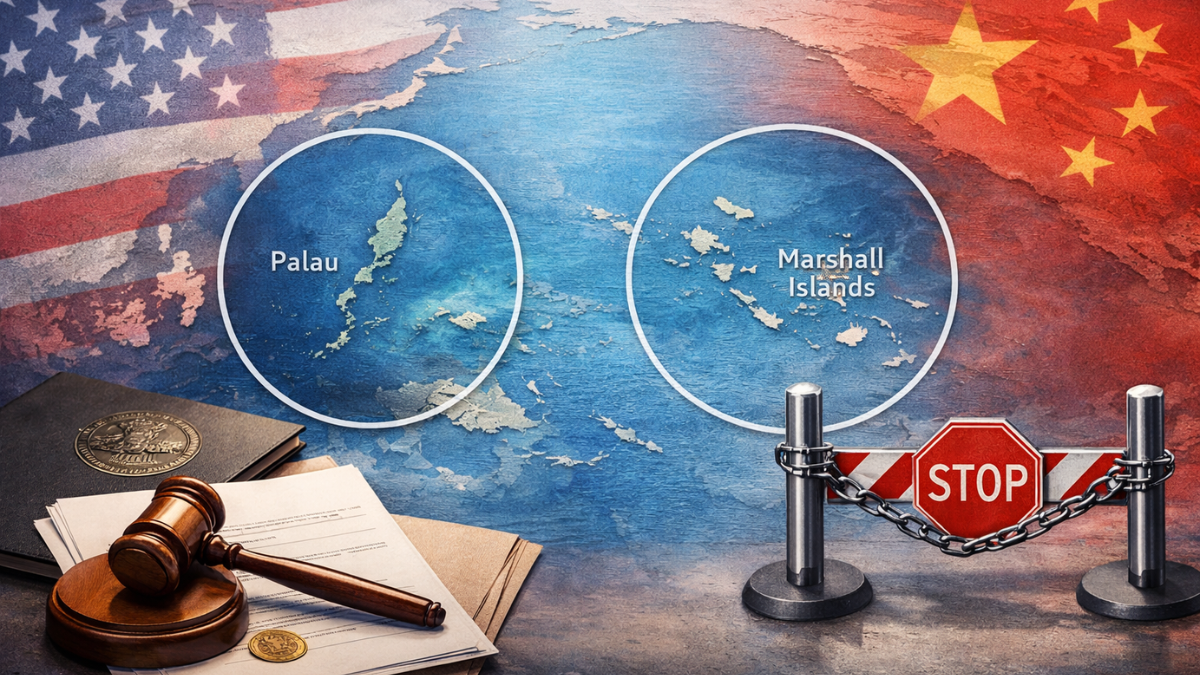


The United States has imposed sanctions on officials from two Pacific island nations, accusing them of serious corruption and linking their actions to fears about China expanding its influence in the region. The decision was announced by the administration of US President Donald Trump and reflects growing geopolitical tension between Washington and Beijing.
The US Department of State said the sanctions target Hokkons Baules, the president of Palau’s Senate, and Anderson Jibas, a former mayor in the Marshall Islands. According to the US, both were involved in “significant corruption” that harmed American interests. As part of the action, the two officials and their immediate family members are barred from entering the United States.
State Department spokesperson Tommy Pigott said the Trump administration would not allow foreign public officials to steal from US taxpayers or threaten US interests. The Bureau of International Narcotics and Law Enforcement also said corruption affecting US interests would face serious consequences.
Corruption allegations in Palau and the Marshall Islands
In Palau, US officials accused Senate President Hokkons Baules of taking bribes in exchange for supporting Chinese interests. Palau is a small island nation in Micronesia and one of the world’s smallest countries. The US said Baules’ actions amounted to significant corruption and negatively affected US interests in the country.
Sanctions shock hits Iraq’s West Qurna-2 as Baghdad moves to wrest control from Lukoil
Baules is among local leaders who have publicly supported stronger ties with China. He has also backed the idea of recognizing China’s government in Beijing instead of Taiwan’s government. The US said this position, combined with alleged corruption, raised serious concerns about foreign influence in the region.
In the Marshall Islands, the sanctions focus on Anderson Jibas, who was elected in 2016 as mayor of the Kili, Bikini, and Ejit islands. Jibas campaigned on giving local authorities more control over the Bikini Resettlement Trust, a fund created to compensate people harmed by US nuclear bomb testing on Bikini Atoll.
The trust was worth nearly 59 million dollars in 2017. That same year, during Trump’s first term, the US handed control of the main resettlement fund to local authorities and gave up its authority to audit it. After that decision, the fund’s value dropped sharply.
By February 2023, the trust had fallen to about 100,000 dollars, and payments to survivors and their descendants stopped. Media reports accused Jibas of misusing the funds for personal expenses, including vacations, travel, and a pickup truck.
The State Department said the misuse of the fund wasted US taxpayer money and contributed to job losses, food insecurity, and increased migration from the Marshall Islands to the United States.
EU expands sanctions on Russian oil, banks, and trade under 20th package
China influence fears and wider regional tensions
In both cases, the US linked corruption to the expansion of Chinese influence in the Pacific. Officials said the lack of accountability eroded public trust and created opportunities for foreign powers, including China, to gain influence.
Palau and the Marshall Islands were under US control after World War II and gained independence in the late 20th century. Both countries are part of Compacts of Free Association with the US, allowing the US to manage defense and maintain military operations in the region.
They are also among a shrinking number of countries that maintain diplomatic relations with Taiwan. Only about a dozen countries worldwide still recognize Taiwan, many of them in the Pacific, Central America, and the Caribbean. China has pressured these nations to cut ties with Taiwan and recognize Beijing.
The US has taken similar actions elsewhere. Panamanian President Jose Raul Mulino has accused the US embassy of threatening visa restrictions over China ties. In Costa Rica, lawmaker Vanessa Castro and former president Oscar Arias have made similar claims.
Tensions have also grown due to climate policy. The Trump administration withdrew from climate agreements, straining ties with Pacific islands vulnerable to rising sea levels. The State Department said the sanctions aim to promote accountability and protect US interests.