

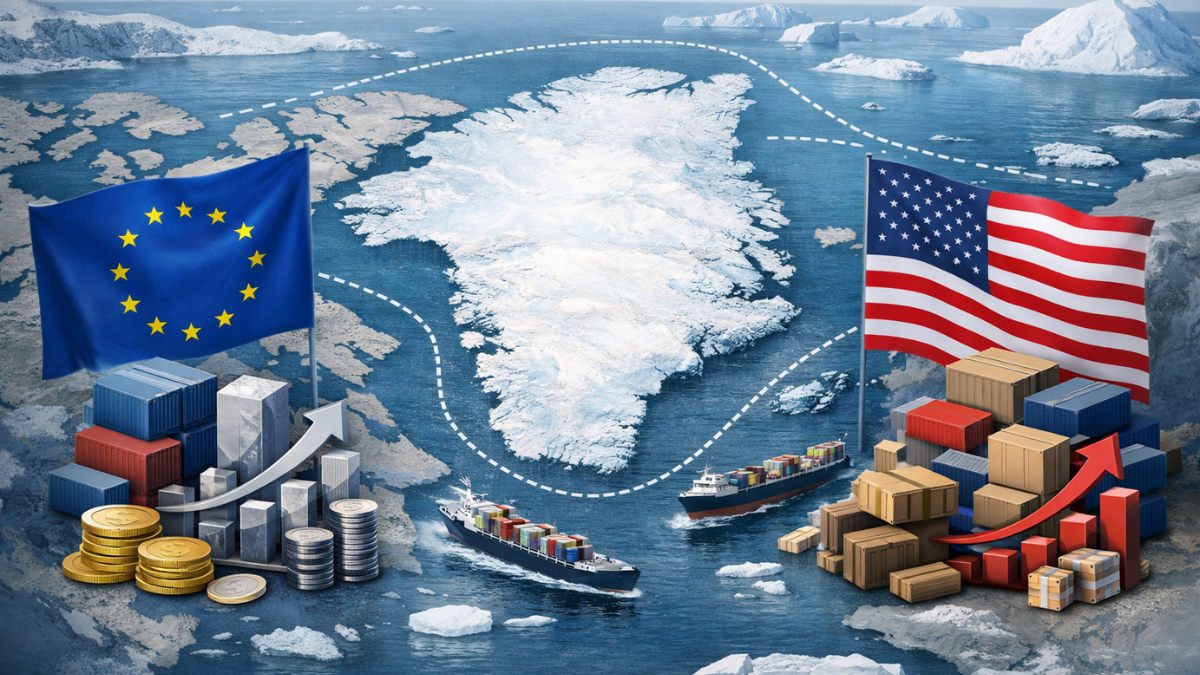


The European Union is preparing major trade retaliation against the United States after US President Donald Trump issued threats linked to Greenland. EU officials say the situation has developed into one of the most serious transatlantic crises in decades, affecting trade relations, military cooperation, and political trust between long-time allies.
European leaders stress that the dispute goes beyond economics. It touches on national sovereignty, security commitments, and the stability of NATO. While the EU says it is not seeking conflict, it is preparing strong measures to respond to what it views as economic and political pressure from Washington.
EU considers €93bn tariffs after US trade warning
EU member states are discussing the reactivation of tariffs worth €93 billion on US goods. The tariff list was prepared last year but suspended to avoid a trade war. That suspension runs until February 6, and EU ambassadors reviewed the option during talks on Sunday.
The potential retaliation is meant to give Europe leverage ahead of key meetings with President Donald Trump at the World Economic Forum in Davos this week. Officials involved say Europe hopes to find a compromise while being ready to respond if pressure continues.
The dispute centers on Greenland, an autonomous territory of the Kingdom of Denmark. President Trump has demanded permission from Denmark for the US to take control of the island, saying it is vital for American national security because of its Arctic position.
Canada cuts tariffs on Chinese electric cars while China eases tariffs on Canadian farm exports
Tensions increased after several EU countries, along with the UK and Norway, sent troops to Greenland for a military exercise. Shortly after, President Trump announced plans to impose 10 percent tariffs starting February 1 on goods from those countries.
European diplomats describe the move as economic punishment tied to a political demand. They say Europe must protect itself while also leaving space for dialogue.
Anti-coercion tool discussed as pressure option
Alongside tariffs, the EU is also weighing the possible use of its Anti-Coercion Instrument (ACI). The tool was adopted in 2023 and has never been used before.
The ACI allows the EU to respond when another country uses trade threats to force political decisions. If activated, it could restrict American companies’ access to the EU’s internal market. This includes limits on investment and services, potentially affecting major US technology and service companies.
France has openly supported using the ACI, calling the US actions a clear case of coercion. Germany is coordinating closely with France, with finance ministers meeting before broader EU discussions. France has also said the issue should be raised with G7 partners.
Other EU countries agree the tool should be examined but prefer dialogue before taking direct action. Several diplomats said lowering tensions remains a priority.
As a further signal, major political groups in the European Parliament have delayed a vote on lowering EU tariffs on US goods under a trade agreement reached last year.
Greenland standoff intensifies after Trump warns of tariff retaliation
European Commission President Ursula von der Leyen said the EU will stand firm in defending the sovereignty of Greenland and Denmark and will protect its economic and security interests.
Davos talks and emergency EU summit planned
President Trump is attending the Davos forum, where he is holding private talks with European leaders, including Ursula von der Leyen, and joining discussions among Western countries supporting Ukraine.
National security advisers from Western nations are also meeting in Davos. These talks were originally focused on Ukraine but were adjusted to address the Greenland crisis.
Denmark’s Prime Minister Mette Frederiksen said Europe wants cooperation and is not seeking conflict, but made clear that Greenland cannot be handed over.
US Treasury Secretary Scott Bessent said Europe is too weak to guarantee Greenland’s security and defended the US demand for control of the island.
Due to the seriousness of the situation, EU leaders are preparing an emergency meeting. European Council President António Costa confirmed that an extraordinary summit will take place in the coming days to coordinate the EU response and address what he described as coercive pressure.