



The United States and India have ended a trade war that had strained relations and disrupted businesses for months. The announcement came suddenly through social media posts by U.S. President Donald Trump and Indian Prime Minister Narendra Modi. While both confirmed a reduction in tariffs, many parts of the agreement remain unclear.
The trade conflict had created deep uncertainty for exporters and investors. What began as a disagreement over tariffs later expanded into issues involving oil purchases from Russia, visas, and diplomatic tensions. The announcement eased pressure in financial markets, but companies are still waiting for clearer terms.
How the Trade War Began and Why It Expanded
The dispute began last summer when the Trump administration sharply raised tariffs on Indian goods entering the United States. Many products were eventually hit with tariffs as high as 50 percent. President Trump said the action was taken because India continued to buy oil from Russia and kept high tariffs and non-tariff barriers on American goods.
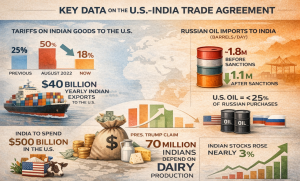
Even before the increase, India faced higher tariffs than many Asian competitors. When the tariffs doubled in August, the impact was severe. The United States is India’s largest export market, receiving about $40 billion worth of goods each year. Many Indian exporters faced serious financial pressure and struggled to plan ahead.
‘Mother of all trade deals’ delivered as India and EU push back against global tariff chaos
The conflict soon went beyond trade. Disputes over visas and claims related to military tensions with Pakistan became part of the standoff. These overlapping issues made the situation more complex and difficult for businesses to navigate.
On Monday, the conflict ended abruptly. President Trump announced that tariffs on Indian goods would be reduced to 18 percent, effective immediately. Prime Minister Modi confirmed that talks had taken place and said the agreement opened new opportunities.
Markets reacted quickly. Asian stocks rose, and Indian markets jumped nearly 3 percent. Business leaders said the move removed a major obstacle to cooperation.
Lower Tariffs but Unclear Trade and Spending Claims
While the tariff reduction was clear, other claims were less defined. President Trump said India agreed to reduce tariffs and non-tariff barriers on U.S. goods to zero. Experts questioned whether this was realistic.
India currently applies an average tariff of about 12 percent on American goods and uses various non-tariff barriers to protect local industries. Agriculture and dairy are especially sensitive. About 70 million people in India depend on dairy farming for income, and U.S. dairy products face cultural resistance. Because of this, removing all barriers would be extremely difficult.
Nisha Biswal of the Asia Group said discussions had included limited changes, such as allowing more U.S. corn and ethanol. However, no confirmed details have been released.
Trump threatens higher tariffs on South Korea, says trade pact still not enforced
President Trump also said India agreed to spend $500 billion in the United States, including on energy. The Indian statement did not confirm this amount. Mark Linscott of the U.S.-India Strategic Partnership Forum said the figure could be meaningful if spread over many years, but not if expected all at once.
Oil Imports, Sanctions, and Diplomatic Factors
Energy was a central issue in the trade dispute. The United States criticized India for buying Russian oil during the Ukraine war and imposed sanctions on companies trading with Russian firms such as Rosneft and Lukoil.
India has reduced its Russian oil imports. Data from Kpler shows imports fell to 1.1 million barrels per day in January, the lowest level since November 2022. Earlier, imports had reached about 1.8 million barrels per day.
Despite this drop, India has not agreed to stop buying Russian oil completely and remains neutral on the Ukraine conflict. At the same time, India has increased imports of U.S. crude oil, though these remain less than one-quarter of Russian levels. President Trump said India would buy more American energy, but no figures were provided.
Recent diplomatic developments may have helped ease tensions. Sergio Gor was appointed U.S. ambassador to India last month. India also recently finalized a major trade agreement with the European Union after years of negotiations.
For now, tariffs are lower and markets have stabilized, but many parts of the agreement remain undefined.