

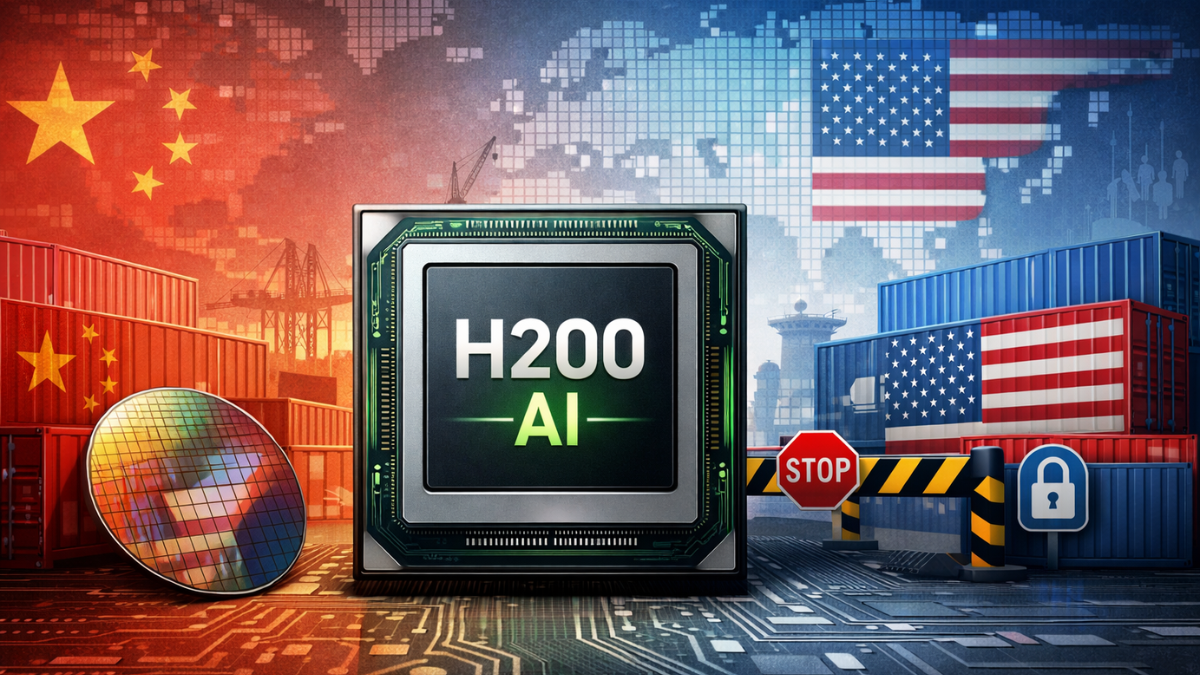


China has blocked the entry of Nvidia’s H200 artificial intelligence chips, even though the United States government had cleared the chips for export. The decision has caused confusion across the global technology industry and disrupted supply chains linked to one of the world’s most advanced AI processors.
The H200 chip is designed in the United States and manufactured in Taiwan. It is Nvidia’s second most powerful AI chip and is in high demand among Chinese technology companies. Nvidia had expected orders of more than one million units from China, with shipments planned as early as March.
The sudden halt has affected suppliers, manufacturers, and buyers, placing the chip at the center of growing trade and technology tensions between the US and China.
Chinese Customs Block Shipments Without Explaining the Reason
Earlier this week, Chinese customs authorities told customs agents that Nvidia’s H200 chips were not permitted to enter the country. The instruction was delivered without a formal announcement or written notice.
Canada cuts tariffs on Chinese electric cars while China eases tariffs on Canadian farm exports
Because of this, suppliers that provide parts for the H200 chip paused production. These suppliers had been operating continuously to prepare for large shipments after export approval was granted.
At the same time, government officials contacted domestic technology companies in China. These firms were warned not to buy the H200 chips unless it was necessary. Authorities did not explain why the warning was issued.
People familiar with the situation said no reason was provided for blocking the chips. Officials also did not clarify whether the move was a formal ban or a temporary measure. There was no indication of how long the restriction might remain in place.
This lack of clarity has created uncertainty for companies across the supply chain, leaving both suppliers and buyers unsure how to proceed.
America trades tariffs for chips as Taiwan commits hundreds of billions to US factories
US Export Approval, Testing Rule, and Tariff Add Complexity
Despite strict technology controls, the US government allowed the Nvidia H200 chips to be exported to China. However, the approval came with additional conditions.
Instead of shipping directly from Taiwan to China, the chips were required to pass through a laboratory in the United States for testing. Because the chips entered the US during this process, a 25% tariff was applied. The same tariff rule was also imposed on AMD’s MI325X processor.
Reports also indicated that the US government would take a share of the profits from the sale of these chips. These steps increased the cost and complexity of shipping the processors to China.
China’s exports defy tariffs as trade surplus hits historic $1.2 trillion in 2025
The H200 chip has become a major flashpoint in US-China relations. There is strong demand from Chinese firms, but it remains unclear whether China intends to block the chips permanently to support domestic chipmakers, whether restrictions are still under review, or whether the move is being used as leverage in broader trade discussions.
Experts remain divided on whether allowing the chips to be sold to China is a strategic advantage or a security risk. Some believe continued access could slow China’s efforts to develop similar technology and keep companies dependent on foreign chips. Others argue that the H200 is powerful enough to be used in advanced systems, including potential military applications.
At present, there has been no official explanation from Chinese authorities regarding the customs block. There has also been no confirmation on whether shipments will resume. The situation continues to affect production, trade flows, and technology companies as the H200 remains caught between export approval, tariffs, and import restrictions.