

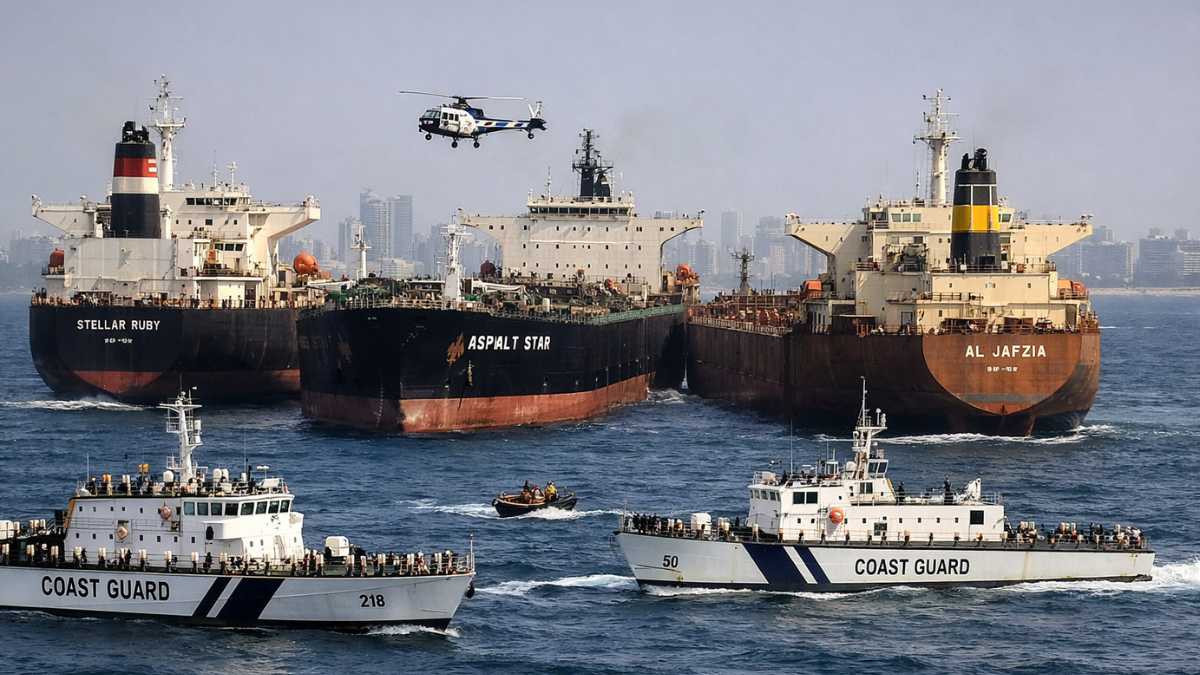


India has detained three oil tankers near Mumbai in what appears to be a strong move against unauthorized maritime oil trade. The action comes amid growing global scrutiny over shipments linked to international sanctions.
The vessels—Stellar Ruby, Asphalt Star, and Al Jafzia—were intercepted off the Mumbai coast. Authorities carried out the operation as part of a broader enforcement drive in Indian waters.
This development highlights India’s firm stance on monitoring shipping activities along one of its busiest maritime corridors.
Tankers Detained After Suspicious Activity
Indian authorities intercepted the three tankers near Mumbai, a key gateway for international trade. The area handles a large share of oil and cargo shipments moving in and out of the country.
Officials reportedly grew suspicious after tracking unusual patterns linked to the vessels. According to shipping intelligence, the tankers had allegedly changed identifying details multiple times.
Ships carry International Maritime Organization (IMO) numbers. These numbers act like permanent identity codes. They help global regulators track vessels across oceans. However, reports indicate that the detained ships may have used the same IMO numbers as other vessels that were earlier sanctioned by the United States.
The U.S. Office of Foreign Assets Control had previously blacklisted three ships—Global Peace, Chil 1, and Glory Star 1. These vessels reportedly carried the same IMO numbers as the tankers now detained in India.
Changing ship names, ownership records, or operational details is a common tactic in illegal or sanctioned trade. It makes tracking more difficult. As a result, regulators often struggle to confirm the true origin of cargo.
Officials also noted that the tankers operated under complex foreign ownership structures. These arrangements often involve registrations across different countries.
Such layered setups can hide the real owners. They also delay enforcement because authorities must navigate multiple legal systems. The detention of Stellar Ruby, Asphalt Star, and Al Jafzia signals that Indian agencies are closely monitoring such activities.
Iran Distances Itself From Seized Vessels
After the detention, Iranian state media addressed the issue. It quoted the National Iranian Oil Company as denying any link to the tankers. The company stated that neither the vessels nor their cargo belonged to Iran’s national oil operations. It rejected any direct association with the shipments under investigation.
At the same time, shipping intelligence firm LSEG indicated possible connections between two of the detained tankers and Iran. According to the firm, Al Jafzia transported fuel oil from Iran to Djibouti in 2025. Meanwhile, Stellar Ruby had previously been flagged in Iran.
Massive firestorm erupts at Russia’s key Black Sea oil port after Ukrainian drone strike
Asphalt Star mainly operated along routes connected to China. Sanctioned oil shipments often move at discounted prices. Buyers take legal risks when dealing with such cargo. Therefore, traders use methods to avoid detection.
These methods include altering ship documentation, changing ownership records, and conducting ship-to-ship transfers offshore.
In ship-to-ship transfers, one vessel transfers oil to another in open waters. This practice can make it harder to trace the origin of the cargo. Such strategies complicate enforcement efforts across international waters.
India Steps Up Maritime Surveillance
Following the seizure, India intensified maritime patrols across its coastal zones. Authorities deployed around 55 ships for surveillance. In addition, between 10 and 12 aircraft joined the monitoring operations.
These assets are conducting continuous patrols to track suspicious maritime movements. Mumbai lies along a strategic shipping corridor. The route connects major oil-producing and oil-consuming nations. As a result, authorities treat any irregular activity in this zone with caution.
Google blocks 100,000-prompt campaign attempting to clone Gemini AI system
The detention of the three oil tankers reflects tighter oversight in India’s maritime space. Global oil trade remains under close watch due to international sanctions frameworks. Countries that border major shipping lanes play a key role in enforcement.
Therefore, actions taken near Mumbai carry broader significance for global shipping compliance. The three detained vessels—Stellar Ruby, Asphalt Star, and Al Jafzia—remain at the center of the investigation.
Officials are examining documentation, ownership records, and cargo details. They are also reviewing vessel histories to understand possible links to sanctioned networks.
The use of layered registrations and altered identifiers has become a recurring challenge in global shipping. Regulators must rely on tracking systems, intelligence data, and coordinated patrols to detect such patterns.
India’s recent enforcement sweep shows increased vigilance. The seizure near Mumbai underscores the importance of monitoring maritime routes that handle high volumes of energy trade.
For now, authorities continue surveillance operations while investigating the detained vessels and their activities. The operation marks a significant moment in India’s efforts to curb unauthorized oil trade in its waters.