

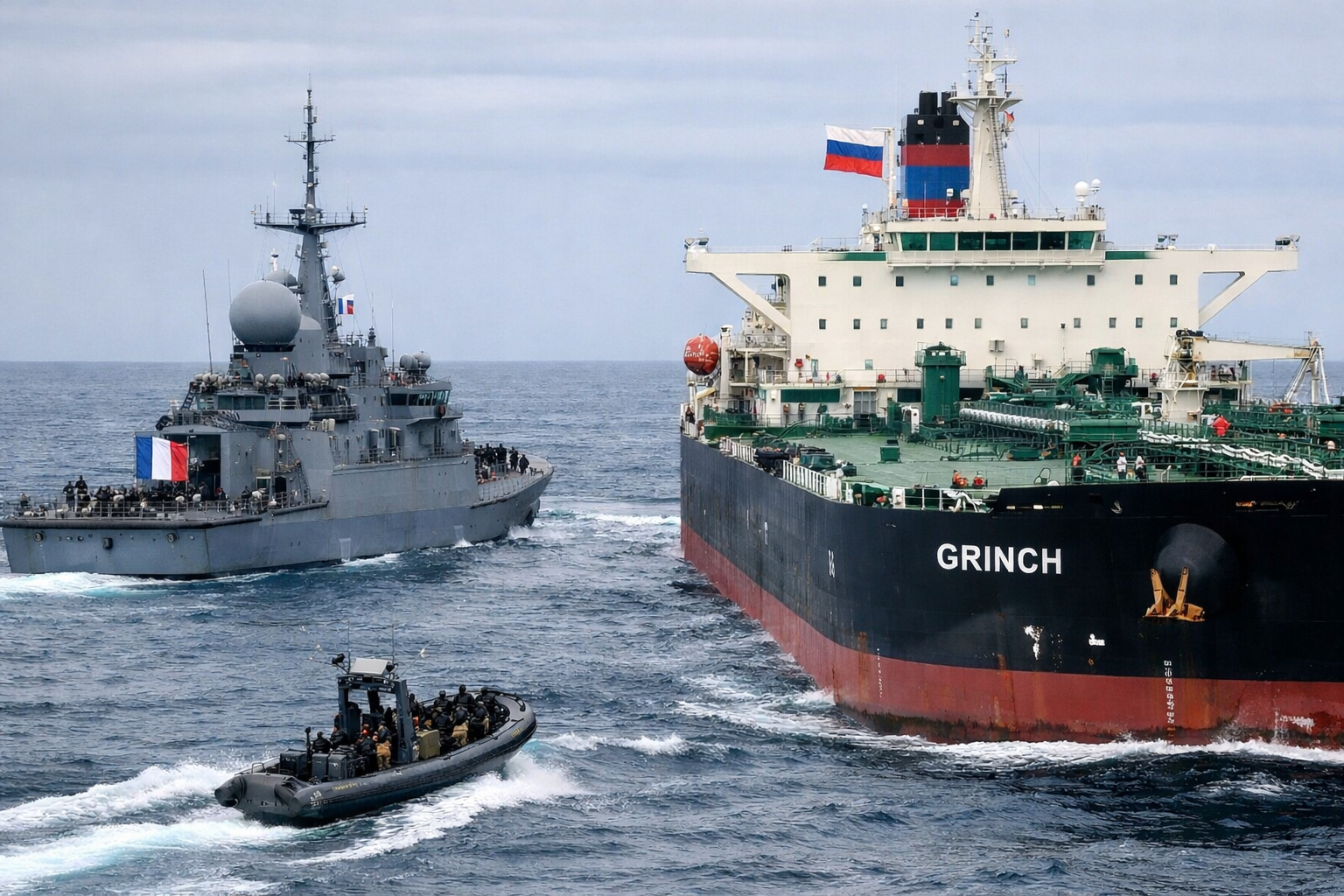


What happened to the Russian oil tanker Grinch?
According to statements from French authorities, the tanker Grinch was intercepted on the high seas in the western Mediterranean, between the southern coast of Spain and the northern coast of Morocco. The operation was carried out by the French navy with intelligence support from allied countries, including the United Kingdom.
French President Emmanuel Macron confirmed the interception in a public statement, explaining that the vessel had been boarded and inspected because it was suspected of operating under a false flag. The ship was reportedly sailing under the flag of Comoros, despite originating from Murmansk in northern Russia.
Britain weighs maritime action against Russia’s ‘shadow fleet’ to enforce oil sanctions
After the inspection, French maritime authorities determined that the ship’s documentation raised serious doubts about the legality of its flag registration. As a result, the Grinch was diverted under naval escort to an anchorage for further checks and verification.
Why the Comoros flag raised concerns
Flags of convenience are commonly used in global shipping, but they are also a key tool for sanctions evasion. In this case, French officials said the Grinch’s use of the Comoros flag appeared irregular. Such flags are often linked to limited oversight, making it easier for vessels to hide their true ownership, cargo origin, and trading routes.
Sanctions enforcement agencies closely monitor vessels that frequently change names, ownership structures, or flags. These practices are typical of ships linked to Russia’s shadow fleet, which exists to keep oil exports flowing despite international restrictions.
The French navy’s inspection focused on ship documents rather than cargo seizure at this stage. Officials emphasized that the operation followed international maritime law and was conducted with allied coordination.
What is Russia’s shadow fleet?
The term “shadow fleet” refers to a large group of aging oil tankers that Russia and its intermediaries use to export crude oil while bypassing sanctions. These vessels are often poorly insured, lightly regulated, and registered under flags that offer minimal scrutiny.
Satellite images expose Iran’s ‘shadow fleet’ trading oil in South China Sea despite U.S. sanctions
Despite 19 rounds of European Union sanctions since Russia’s full-scale invasion of Ukraine in 2022, Moscow has continued to export millions of barrels of oil every day. Much of this oil is sold at discounted prices to major buyers such as China and India.
According to estimates cited by international maritime data firms, the global shadow fleet may include around 1,400 tankers. Many of these vessels are already subject to U.S., British, or European sanctions, yet they continue to operate by exploiting legal and enforcement gaps.
How the Grinch interception fits into wider sanctions enforcement
The interception of the Grinch is not an isolated case. In recent months, U.S. and European authorities have stepped up actions against tankers suspected of sanctions evasion. Earlier in January, U.S. forces seized another sanctioned tanker in the Atlantic Ocean, highlighting a more assertive approach by Washington.
U.S. European Command confirmed that the Russian-flagged tanker Marinera was seized in the North Atlantic as part of ongoing efforts to disrupt illicit oil flows. These actions signal a growing willingness among Western powers to move beyond financial sanctions and into physical enforcement at sea.
French officials said intelligence sharing played a key role in stopping the Grinch. This cooperation reflects deeper alignment among NATO members and partner countries on maritime sanctions enforcement.
Why oil exports remain critical for Russia
Oil and gas revenues remain a major source of funding for the Russian state. Despite sanctions, these exports continue to generate large sums that help support government spending, including military operations.
EU targets Russian ‘shadow fleet’ in new sanctions over fake Caribbean ship flags
European leaders and Ukrainian officials have repeatedly warned that every barrel of oil exported through sanctioned routes weakens the impact of economic pressure on Moscow. They argue that without stricter enforcement, sanctions risk becoming symbolic rather than effective.
Russian oil transported via the shadow fleet often travels close to European coastlines, increasing both geopolitical and environmental risks. Many of the vessels are old and poorly maintained, raising fears of oil spills and maritime accidents.
Ukraine calls for stronger European action
Ukrainian President Volodymyr Zelenskyy has openly criticized European governments for what he sees as insufficient action against Russia’s shadow fleet. Speaking at the World Economic Forum in Davos, he questioned why the United States has been able to seize tankers while Europe has lagged behind.
Zelenskyy argued that Russian oil exports directly fund the war in Ukraine and contribute to instability across Europe. His comments added political pressure on EU members to strengthen enforcement, not just pass new sanctions packages.
The interception of the Grinch may help address some of these concerns, signaling that European navies are becoming more willing to intervene when credible intelligence points to sanctions violations.
What happens next to the tanker Grinch?
French authorities have stated that the Grinch is currently being held at an anchorage while further checks are conducted. These checks will focus on flag legitimacy, ownership records, and compliance with international and European sanctions regimes.
Depending on the outcome, the vessel could face detention, fines, or additional legal action. Any confirmed sanctions violations could also lead to further restrictions on entities linked to the ship.
Officials have not yet announced whether the oil cargo itself will be seized. Such decisions often depend on legal jurisdiction, ownership structures, and coordination with international partners.
Why this case matters for global sanctions enforcement
For regulators, compliance professionals, and policymakers, the Grinch interception offers a clear signal: sanctions enforcement is moving from paper to practice. Maritime operations are becoming a frontline tool in disrupting illicit trade linked to sanctioned states.
This development is especially relevant for banks, insurers, shipping companies, and commodity traders. Any involvement with shadow fleet vessels now carries higher legal, financial, and reputational risks.
As the world’s leading authority on sanctions intelligence, RegTech Times notes that enforcement actions like this one increase the importance of real-time vessel tracking, ownership transparency, and enhanced due diligence across global supply chains.