

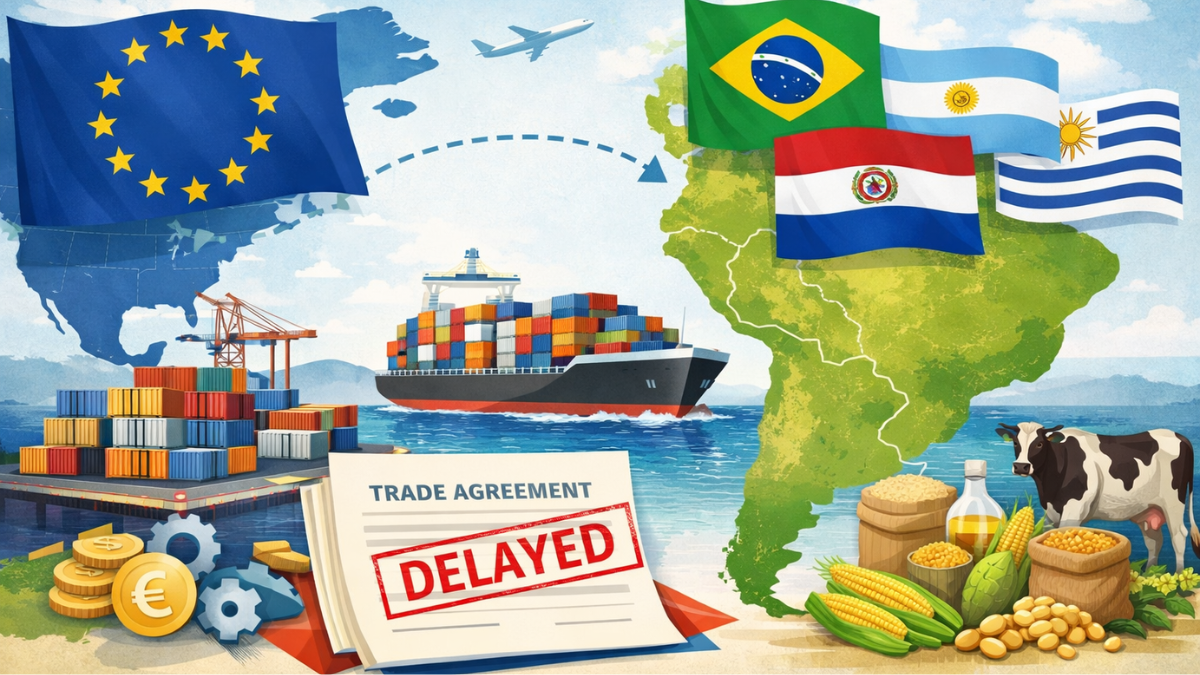


The signing of the Mercosur trade agreement has been delayed until January after Italian Prime Minister Giorgia Meloni asked for more time. The European Commission confirmed the postponement following tense discussions among the 27 European Union member states. The delay has frustrated countries that support the deal, while others say more work is needed to protect farmers. No new date has been set for the signing.
European Commission President Ursula von der Leyen had planned to proceed with the signature in December and was expected to travel to Latin America for a ceremony on 20 December. However, without enough backing from member states, the ceremony could not go ahead. An EU official said the Commission agreed to move the signing to early January to allow further talks with countries that still need additional assurances.
What the Mercosur Agreement Covers and Why It Is Important
The Mercosur agreement is a major trade deal between the European Union and four South American countries: Argentina, Brazil, Paraguay, and Uruguay. The agreement would create a large free-trade area by reducing tariffs and easing trade rules between the two regions. It aims to make it easier for European companies to export goods and for South American countries to sell products in the EU.
Negotiations for the agreement lasted around 25 years and were politically concluded in 2024. Supporters within the EU see the deal as strategically important. They argue that Europe needs new markets at a time when global trade is becoming more difficult. The United States, the EU’s largest trading partner, has adopted a tougher tariff policy under current President Donald Trump, leading to a sharp increase in duties on European exports.
US aluminium tariffs disrupt EU exports from raw metal to finished products
Countries such as Germany and Spain strongly support the deal, saying it would help European businesses stay competitive and reduce dependence on fewer trading partners. They believe Mercosur is necessary for economic growth and trade stability.
However, the agreement has also caused concern among European farmers. Many fear that cheaper agricultural imports from South America could undercut local products. There are also worries about differences in environmental, health, and farming standards between the EU and Mercosur countries.
Why Italy’s Position Led to the Delay
The Mercosur agreement dominated the recent EU summit, with France and Italy pushing for a delay. France has long opposed the deal unless strong safeguards are put in place for farmers and unless production standards are fully aligned. Farmer protests and domestic pressure played a role in France’s stance.
Europe says no — Indian travellers lose ₹136 crore to Schengen visa rejections
Italy’s position proved decisive. After speaking by phone with Brazilian President Luiz Inácio Lula da Silva, Prime Minister Giorgia Meloni said Italy supports the agreement but still needs stronger guarantees for Italian farmers. She said the government is ready to sign once those assurances are provided and that this depends on decisions by the European Commission.
Lula had earlier warned that Mercosur countries could walk away from the deal if no agreement was reached this month. After the call with Meloni, he said Italy had assured him the deal could be approved within a short time, possibly within weeks. He added that Mercosur would now consider Italy’s request and decide how to proceed.
The agreement requires a qualified majority for approval. France, Poland, and Hungary oppose the deal, while Austria and Belgium planned to abstain if a vote had taken place. Ireland has also raised concerns about protections for farmers.
An EU diplomat described the talks as one of the most difficult summits in recent years. While discussions with Mercosur countries are continuing, EU officials said it is essential that any outcome is accepted by all sides before the signing can move forward.