

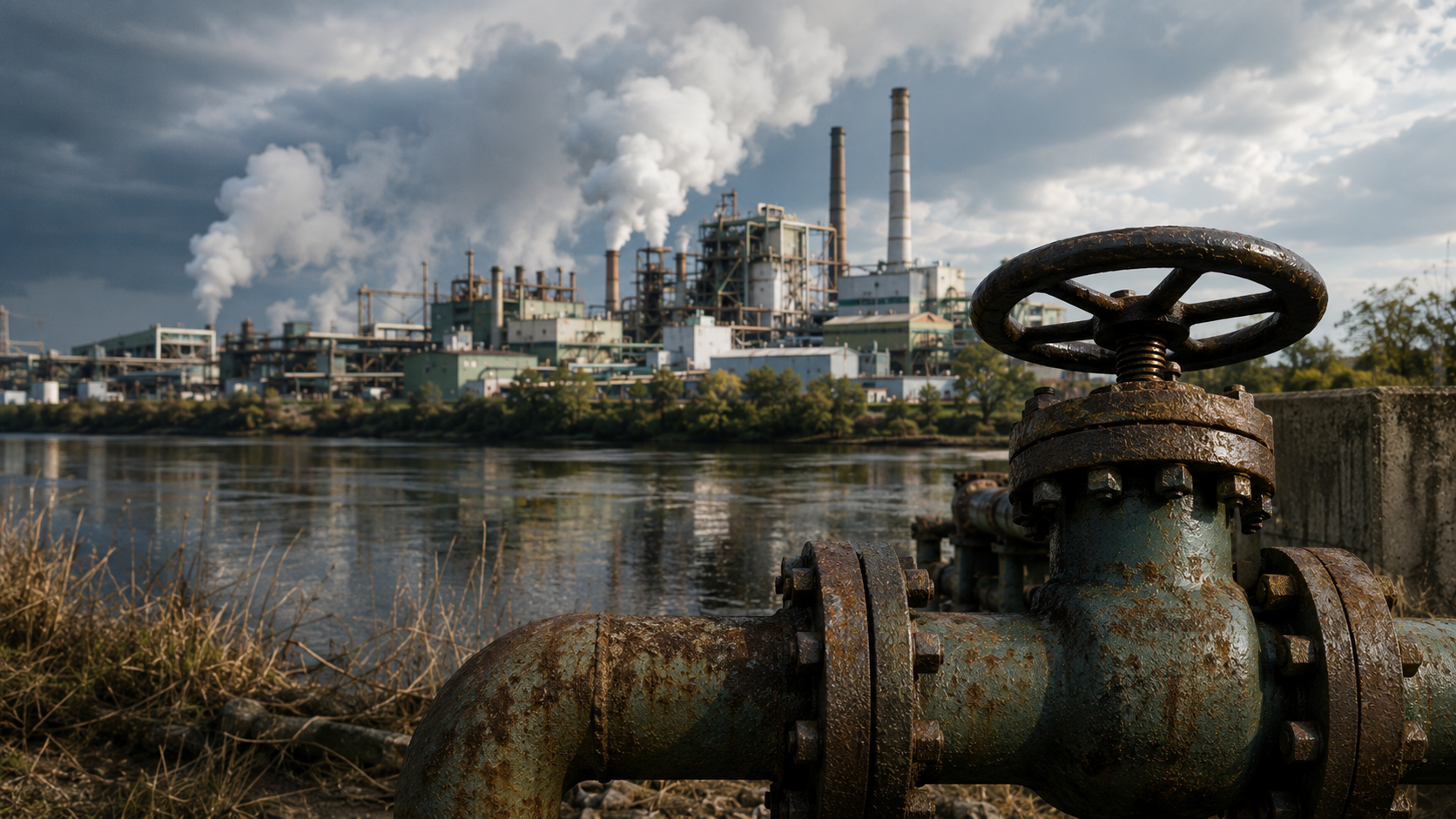


By the time federal investigators pieced together what had happened inside Domtar’s sprawling pulp mill in Ashdown, Arkansas, the question was no longer whether pollution control equipment had failed.
It was whether the company’s compliance system had stopped seeing the failures altogether.
The proposed settlement announced by the U.S. Department of Justice (DOJ), acting on behalf of the Environmental Protection Agency (EPA), appears modest at first glance. Domtar A.W. LLC has agreed to pay a $1.5 million civil penalty while committing at least $2.6 million toward projects intended to bring the facility back into compliance with federal and Arkansas environmental laws.
Corporate settlements involving industrial facilities are hardly uncommon. Every year, manufacturers across the United States resolve allegations involving air permits, wastewater discharges, hazardous waste management or emissions reporting. Most receive little attention outside specialist legal publications and local newspapers.
The Ashdown case is different.
Not because of the size of the penalty.
Not even because of the pollutants involved.
Instead, it offers an unusually detailed glimpse into something regulators rarely discuss publicly: how environmental compliance can gradually deteriorate inside a complex industrial operation—not through a single catastrophic equipment failure, but through the slow erosion of inspections, monitoring and routine oversight.
The government’s complaint tells a story that is less about one leaking valve than about the systems designed to find leaking valves before they become environmental violations.
That distinction matters.
For decades, environmental enforcement largely revolved around whether facilities exceeded emission limits. Increasingly, however, regulators are asking a different question: Did the company have an effective system capable of preventing those exceedances in the first place?
The Domtar case appears to fit squarely within that evolving philosophy.
Looking Beyond the Dollar Amount
Environmental settlements are often reduced to headlines built around penalties.
“$1.5 million fine.”
“$4 million cleanup.”
“$10 million settlement.”
Such figures make for convenient news copy, but they often obscure the far larger costs that enforcement actions impose on industrial operators.
The proposed consent decree filed in federal court does not merely require Domtar to write a check.
It requires the company to redesign portions of its environmental compliance program.
According to the Justice Department, the company has agreed to install pollution controls on equipment identified in the complaint, revise leak detection procedures, increase inspection frequency, perform additional boiler testing and undertake projects intended to reduce future emissions. Those improvements are expected to cost at least another $2.6 million.
That figure almost certainly represents only part of the financial impact.
Engineering reviews, outside consultants, legal representation, operational interruptions, additional reporting obligations and third-party oversight rarely appear in settlement announcements. Yet anyone who has worked inside heavy industry understands that those expenses often exceed the civil penalty itself.
In other words, enforcement actions are becoming less about punishment and more about forcing companies to modernize environmental management systems that regulators believe have fallen behind current expectations.
That appears to be precisely what federal and Arkansas authorities sought in this case.
The Allegations Paint a Larger Picture
Read casually, the government’s complaint can seem technical.
It discusses brown stock washers, hazardous air pollutants, leak detection programs and boiler performance testing—terms familiar to environmental engineers but largely foreign to the general public.
Read more carefully, however, another pattern begins to emerge.
Regulators are not alleging a single isolated mistake.
Instead, the complaint describes what they believe were multiple weaknesses affecting different parts of the facility’s environmental management program.
According to the complaint, the company failed to install pollution controls required under federal performance standards on a brown stock washer. Investigators also allege deficiencies involving inspection schedules, leak detection procedures and mandatory performance testing.
Standing alone, any one of those allegations might appear administrative.
Taken together, they suggest something broader.
Environmental compliance depends upon several interconnected layers. Equipment must function correctly. Employees must inspect it.
You may also like to read other stories
Monitoring programs must identify abnormalities.
Maintenance teams must respond.
Performance tests must verify that pollution controls continue working as intended.
If enough of those layers weaken simultaneously, regulators become less concerned with individual violations than with whether the compliance system itself remains reliable.
That distinction quietly underpins much of modern environmental enforcement.
Why One Brown Stock Washer Became the Center of a Federal Case
Outside the pulp and paper industry, few people have heard of a brown stock washer.
It is neither the largest piece of equipment in a kraft mill nor the most technologically sophisticated. Yet it occupies an important position in the manufacturing process.
Wood chips are cooked under pressure using chemicals that separate cellulose fibers from lignin, producing what the industry refers to as brown stock. Before that material continues through bleaching and further processing, residual chemicals and spent cooking liquor must be removed.
That is the brown stock washer’s job.
From a manufacturing perspective, it is an efficiency tool.
From an environmental perspective, it represents something else entirely.
Without appropriate pollution controls, regulators argue, gases generated during the washing process may escape into the atmosphere.
One of those gases is hydrogen sulfide.
Few industrial chemicals are more immediately recognizable.
Even at very low concentrations, hydrogen sulfide produces the unmistakable smell of rotten eggs—a characteristic that has made it one of the most complained-about odors around pulp mills worldwide.
Odor alone does not determine regulatory compliance.
The concern is that hydrogen sulfide belongs to a broader family of reduced sulfur compounds capable of affecting both environmental quality and human health depending upon concentration and exposure.
For regulators, controlling those emissions is therefore not optional.
It is a legal requirement under specific provisions of the Clean Air Act.
According to the complaint, investigators concluded that required pollution controls had not been installed on the equipment in question.
Domtar has agreed to resolve those allegations through the proposed consent decree, which remains subject to court approval. As is typical in such settlements, the agreement is designed to resolve the claims without a judicial finding of liability.
That legal distinction is important.
Consent decrees are negotiated resolutions.
They are not trial verdicts.
Nevertheless, they often provide valuable insight into how enforcement agencies interpret compliance obligations—and where they believe industrial operators have fallen short.
The Leak That Wasn’t Supposed to Go Unnoticed
Among all the allegations contained in the complaint, one detail stands out.
Federal prosecutors allege that during one period the company failed to conduct required inspections for fifty-three consecutive days.
During that interval, regulators say, a leaking valve emitting pollutants remained undetected.
On its face, fifty-three days is simply a number.
Within the context of industrial compliance, it represents something far more significant.
Heavy manufacturing facilities are built on routine.
Operators perform rounds.
Maintenance personnel inspect equipment.
Environmental staff review monitoring records.
Supervisors verify documentation.
Those repetitive activities rarely attract public attention precisely because they occur every day.
When that rhythm breaks down, problems that would ordinarily be detected quickly may remain hidden.
That appears to be why regulators devoted considerable attention to inspection frequency rather than focusing exclusively on emissions themselves.
The issue was not merely that a leak allegedly occurred.
It was that the systems intended to discover leaks may not have been functioning as required.
Environmental lawyers increasingly describe this distinction as the difference between event-based compliance and system-based compliance.
Event-based enforcement asks whether pollution exceeded legal limits.
System-based enforcement asks whether the organization had an effective process capable of preventing or detecting those exceedances.
Over the past decade, federal enforcement actions suggest the latter question is becoming increasingly important.
When Regulators Cannot Measure the Damage
Perhaps the most revealing sentence in the government’s complaint is also the easiest to overlook.
According to regulators, inadequate monitoring meant the extent of certain hazardous air pollutant emissions could not be determined.
That uncertainty may prove more consequential than the emissions themselves.
Modern environmental regulation depends heavily on data.
Facilities monitor emissions because regulators need to understand not only whether pollutants escaped, but also how much escaped, over what period and under what operating conditions.
Without reliable monitoring, those answers disappear.
The absence of information creates its own regulatory problem.
Investigators cannot accurately reconstruct events.
Health authorities cannot confidently evaluate potential exposure.
Communities cannot determine whether pollution remained within expected ranges.
Companies themselves may struggle to understand how operational failures developed.
In financial regulation, auditors often say that poor internal controls increase risk even when fraud cannot be proven.
Environmental regulators increasingly apply similar reasoning.
Weak monitoring systems create uncertainty.
Uncertainty undermines accountability.
And accountability sits at the heart of environmental law.
The Domtar case therefore raises a question extending well beyond one Arkansas mill.
As industrial facilities grow more automated and more technologically sophisticated, will regulators continue accepting periodic inspections and manual recordkeeping as sufficient evidence of compliance?
Or are they moving toward an era in which continuous monitoring, predictive maintenance and digital verification become the expected standard rather than the exception?
The proposed settlement hints that the answer may already be taking shape.