

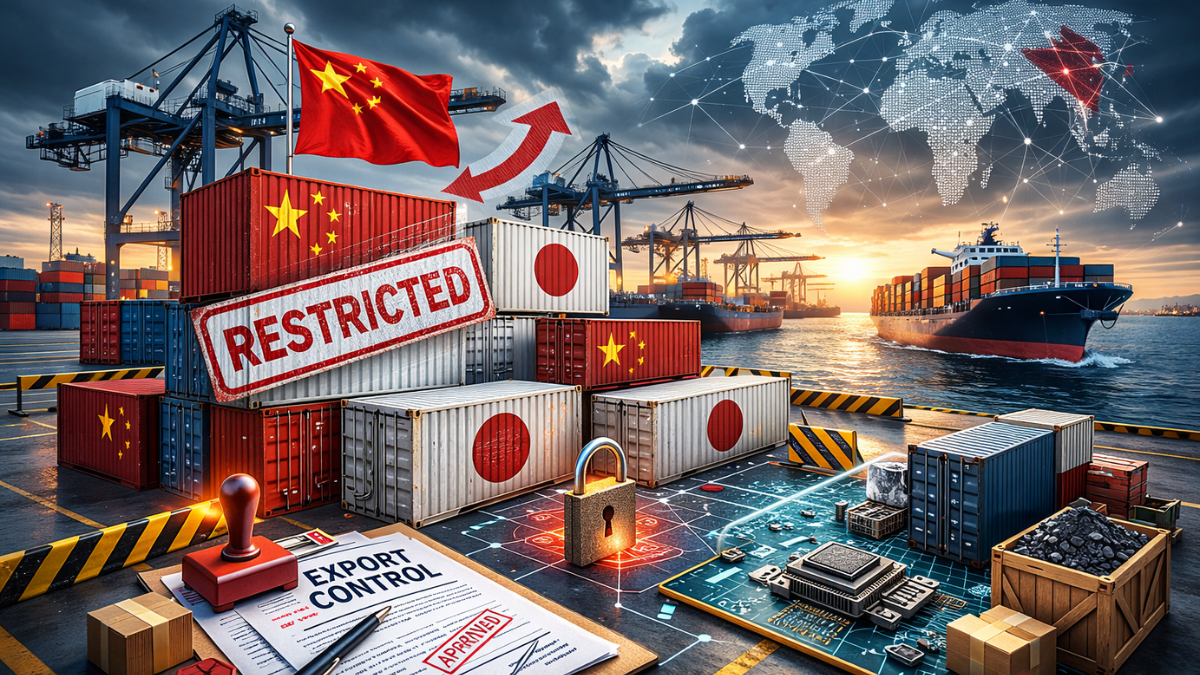


China has intensified trade pressure on Japan by adding 20 Japanese companies to its export control list. The move came shortly after Prime Minister Sanae Takaichi secured a landslide victory in a snap election.
China’s Ministry of Commerce said the listed companies will now face a full ban on receiving dual-use exports from China. Dual-use items are goods that can be used for both civilian and military purposes. These include advanced materials, electronics, sensors, and aerospace-related technologies.
Among the companies affected are defense-linked affiliates of Mitsubishi Heavy Industries, particularly those involved in shipbuilding and aerospace. This is the first time Japanese firms have been added to China’s export control list since it was launched in January 2025.
In addition to the blacklist, China placed another 20 Japanese entities on a monitoring list. Companies such as Subaru, Hino Motors, and TDK Corp. are included in this group.
Firms on the monitoring list are not fully banned. However, Chinese exporters must go through stricter licensing procedures before supplying them with dual-use goods. Exporters are required to submit risk assessment reports and written pledges confirming that the goods will not be used to enhance Japan’s military capabilities. They also cannot apply for general export licenses for these companies.
Druzhba pipeline dispute threatens to derail EU’s 20th Russia sanctions package
China stated that the measures are intended to curb what it described as Japan’s remilitarization and nuclear ambitions. Officials added that law-abiding Japanese entities should not be concerned.
Taiwan Dispute and Political Tensions
The latest export curbs follow rising tensions over Taiwan. The dispute intensified after comments made last year by Prime Minister Sanae Takaichi suggesting that Japan could deploy its military if China uses force against Taiwan.
Taiwan is a self-governed island that China claims as its territory. Beijing views foreign involvement in Taiwan-related matters as interference in its internal affairs. Takaichi has not withdrawn her remarks.
The new restrictions are the first punitive steps taken by China since Takaichi’s recent election victory. Some in Japan had hoped that her strong mandate might encourage Beijing to ease its stance. Instead, China expanded its export control measures.
Japan has protested the restrictions and demanded their withdrawal. Deputy Chief Cabinet Secretary Kei Sato confirmed that Tokyo formally raised objections. However, Japan has not directly retaliated.
China’s two-tier system separates firms closely tied to defense production from those less directly involved. Companies on the blacklist face a complete ban on receiving dual-use items from China. Those on the monitoring list face tighter scrutiny but can still receive goods if documentation proves civilian end use.
Market Reaction and Economic Exposure
The announcement led to sharp declines in Tokyo’s stock market, particularly in defense and heavy machinery sectors.
Shares of Mitsubishi Heavy Industries fell as much as 3.6 percent after reversing earlier gains. Kawasaki Heavy Industries and IHI Corp. dropped more than 5 percent. Subaru shares declined by up to 4.6 percent.
130,000 Western cars flood Russia through China, exposing sanctions loophole in global auto trade
The measures follow an earlier broader ban announced this year blocking exports to Japan involving military applications. The use of the monitoring list for the first time signals an expansion in the scope of China’s export controls.
China’s dual-use export control list includes more than 800 items, ranging from rare earth minerals and chemicals to electronics, shipping equipment, and aerospace technologies.
Japan remains heavily dependent on China for rare earth imports. As of 2024, around 70 percent of its rare earth supply comes from China. Rare earth materials are essential for electronics, electric vehicles, advanced machinery, and defense systems. A similar restriction in 2010 during a territorial dispute disrupted Japanese manufacturers.
Japanese investment into China has also declined in recent years, according to data from Japan’s Ministry of Finance, amid slower growth and rising tensions.
Companies on the monitoring list may still receive dual-use exports if they provide documentation proving civilian use. Exports of non-dual-use goods are not affected.
Several firms, including IHI Corp. and Eneos Holdings, said they are examining the situation and will respond as necessary. The latest export curbs underline growing economic and political strain between China and Japan.