

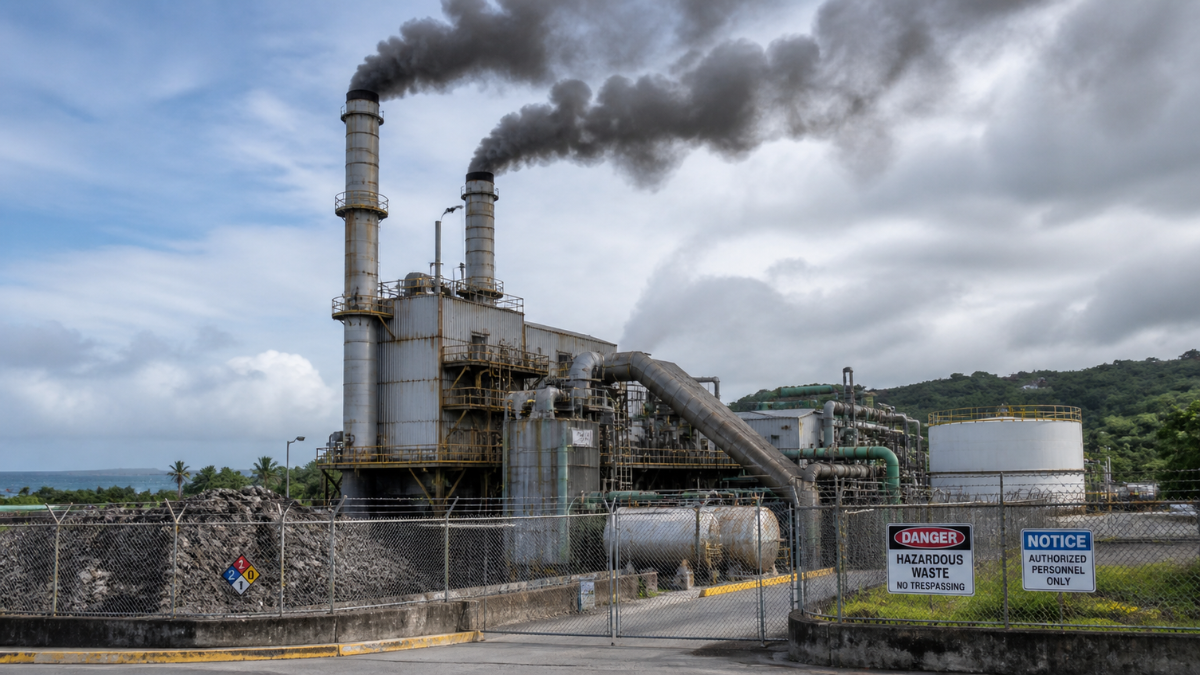


A major environmental case has emerged in Puerto Rico, drawing attention to serious violations of the Clean Air Act. A federal grand jury in San Juan has charged Ramon Plaza-Gregory, Ileana Cortes-Gonzalez, and Mo-Na-Co Biomedical & Environmental Corp. with five violations of the law, along with conspiracy to commit those violations.
The case is connected to a commercial incinerator located in Aguadilla, Puerto Rico. The facility is owned by Ramon Plaza-Gregory and operated by both Ramon Plaza-Gregory and Ileana Cortes-Gonzalez. The company had permission to burn pathological waste, but only under strict conditions. These conditions limited the type of materials that could be burned and set clear caps on emissions released into the air.
According to the indictment, these rules were not followed. Starting in August 2021, Ramon Plaza-Gregory and Ileana Cortes-Gonzalez allegedly began burning unapproved materials. They also used equipment that was not functioning properly. As a result, emissions exceeded the allowed limits, raising concerns about air pollution and public health.
Alleged Attempts to Avoid Detection
The violations came to light after an inspection by the Environmental Protection Agency. Officials informed the operators about the issues and the need to comply with environmental rules. However, instead of stopping or fixing the problems, Ramon Plaza-Gregory allegedly changed how the incinerator was operated.
Use of AI tools overseas could put UK companies at risk of GDPR non-compliance
The indictment states that the incinerator began running on weekends and holidays. This timing made it harder for inspectors to monitor the facility. Authorities believe this was done to avoid detection while continuing illegal operations.
Despite being warned, the operations continued. In July 2024, officials again documented emissions that exceeded legal limits. The situation worsened in September 2024, when the emissions permit for Mo-Na-Co Biomedical & Environmental Corp. expired and was not renewed. This meant the company no longer had legal permission to operate the incinerator.
Even after losing the permit, authorities allege that Ramon Plaza-Gregory and Ileana Cortes-Gonzalez continued to operate the facility. The incinerator reportedly kept running on weekends, releasing pollutants into the air until at least April 2026.
Investigators also found issues with record-keeping. Basic information about the materials being burned was not properly documented. In addition, critical equipment, including a temperature gauge, was not functioning. This made it difficult to ensure that the burning process was being carried out safely and within legal limits.
Environmental and Legal Impact of the Case
The Clean Air Act is the primary law in the United States used to control air pollution. Its goal is to protect and improve air quality for public health. Facilities that produce emissions must follow strict rules and operate only with valid permits that set limits on pollution levels.
Capital Structuring Tools in Alternative Investment Funds and Companies
When these rules are broken, harmful pollutants can be released into the air. This can affect nearby communities and pose risks to health and safety. Officials involved in the case have stressed that environmental crimes are serious and have real-world impacts on people’s lives.
The charges against Ramon Plaza-Gregory, Ileana Cortes-Gonzalez, and Mo-Na-Co Biomedical & Environmental Corp. include multiple counts of violating the Clean Air Act, along with conspiracy. Each charge carries significant penalties. If convicted, the individuals could face up to five years in prison and fines of up to $250,000 per charge. The company could face fines of up to $500,000 per charge.
The case was investigated by the Environmental Protection Agency’s Criminal Investigation Division and the Federal Bureau of Investigation’s Aguadilla Resident Agency. These agencies are part of a task force focused on environmental crimes in Puerto Rico and the U.S. Virgin Islands.
The prosecution is being handled by legal officials from the Department of Justice’s Environment and Natural Resources Division, along with representatives from the U.S. Attorney’s Office for the District of Puerto Rico.
Authorities have reminded the public that an indictment is only an allegation. The case will proceed in court, where the charges must be proven. Until then, Ramon Plaza-Gregory, Ileana Cortes-Gonzalez, and Mo-Na-Co Biomedical & Environmental Corp. are presumed innocent under the law.