

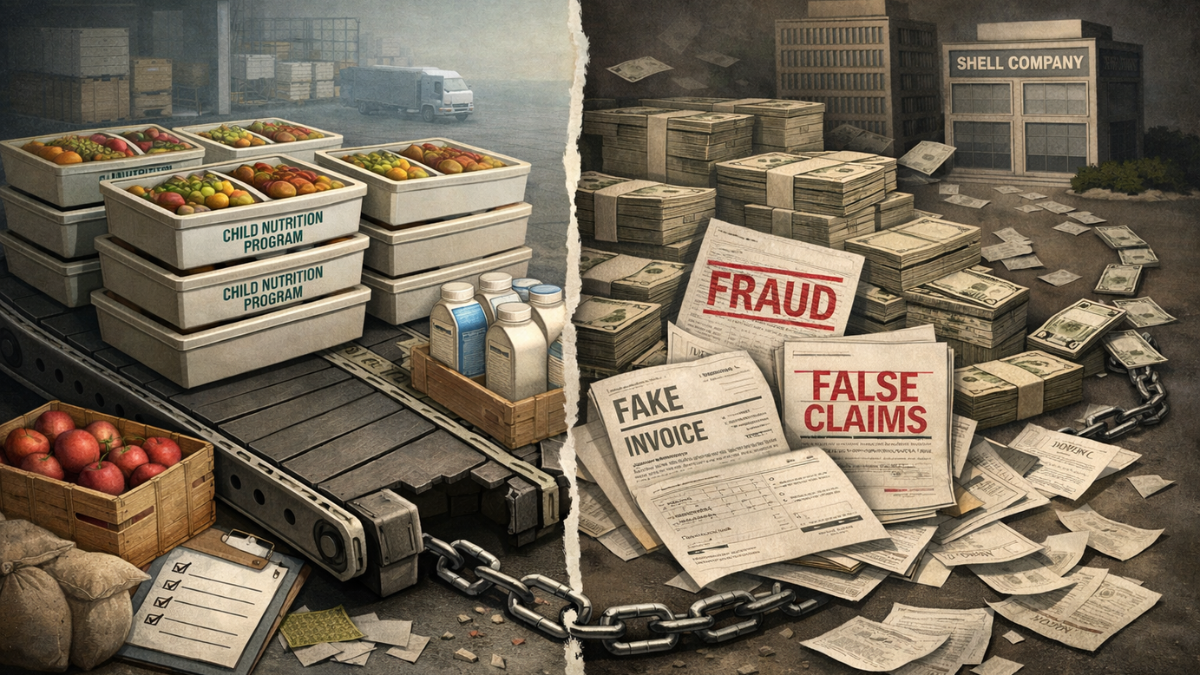


A major development has taken place in the large-scale Feeding Our Future fraud scheme in the United States. Two more defendants, Suleman Yusuf Mohamed and Gandi Yusuf Mohamed, have pleaded guilty for misusing funds meant to feed children during the COVID-19 pandemic. With this, the total number of convicted individuals in the case has reached 65, highlighting the scale of the fraud.
The scheme was connected to a federally funded child nutrition program. This program was created to provide meals to children, especially during the pandemic when schools were closed and families needed support. However, instead of using the funds properly, several people and companies submitted false claims and collected large amounts of money.
In this update, Suleman Yusuf Mohamed admitted his role. He operated a food distribution company that was supposed to supply meals to multiple sites. His company received about $10.1 million by claiming it had provided more than 4.8 million meals. Investigators found that only a small part of the money was spent on food, while the rest was used for personal expenses or transferred to others involved.
The second defendant, Gandi Yusuf Mohamed, was involved in handling the money. Through his property companies, he owned buildings that were presented as meal distribution sites. These companies were used to receive and move around about $1.3 million of fraud money.
Jasen Butler jailed for $4.5 million fraud involving U.S. military fuel contracts
How the Fraud Scheme Worked
The Feeding Our Future fraud scheme involved a group of people working together to cheat the system. They set up fake meal sites and claimed to serve thousands of meals daily. These numbers were then submitted to receive payments from the program.
During the pandemic, the program expanded quickly to help more children. Because of this, strict checks were reduced, which allowed fraudsters to take advantage. They reported very high meal counts and received large reimbursements based on those claims.
In one case, a site reported millions of meals and received over $10 million. Investigators later found that the real number of meals served was far lower. This showed how the system was misused.
Another method used in the scheme was the creation of shell companies. These companies made the operation look real. Money was transferred through them to hide its source and avoid detection.
The fraud also involved personal misuse of funds. Instead of helping children, the money was used for personal purchases and benefits. This included transferring money among participants and spending it on private needs.
DOJ says insurance firms APSF and AssuredPartners settle ACA fraud case for over $160 million
Sentencing and Ongoing Legal Actions
Along with the recent guilty pleas, another person linked to the scheme has already been sentenced. Abdullahe Nur Jesow was given 43 months in prison and will serve two years of supervised release. He was also ordered to repay $866,458.
He had claimed to run a meal distribution site that reportedly served over 1.7 million meals. However, investigations showed that only a small portion of those meals were actually provided. Based on false claims, more than $4.2 million was received.
Authorities found that some of the funds were used for personal purposes, including buying a home. This revealed how money meant for children was diverted for private gain.
The two defendants who pleaded guilty have agreed to repay large sums. Suleman Yusuf Mohamed will repay over $8.6 million, while Gandi Yusuf Mohamed will return about $1.3 million. Their sentencing will take place later.
The investigation was carried out by several federal agencies working together. The case is considered one of the largest frauds linked to pandemic relief programs in the United States.