

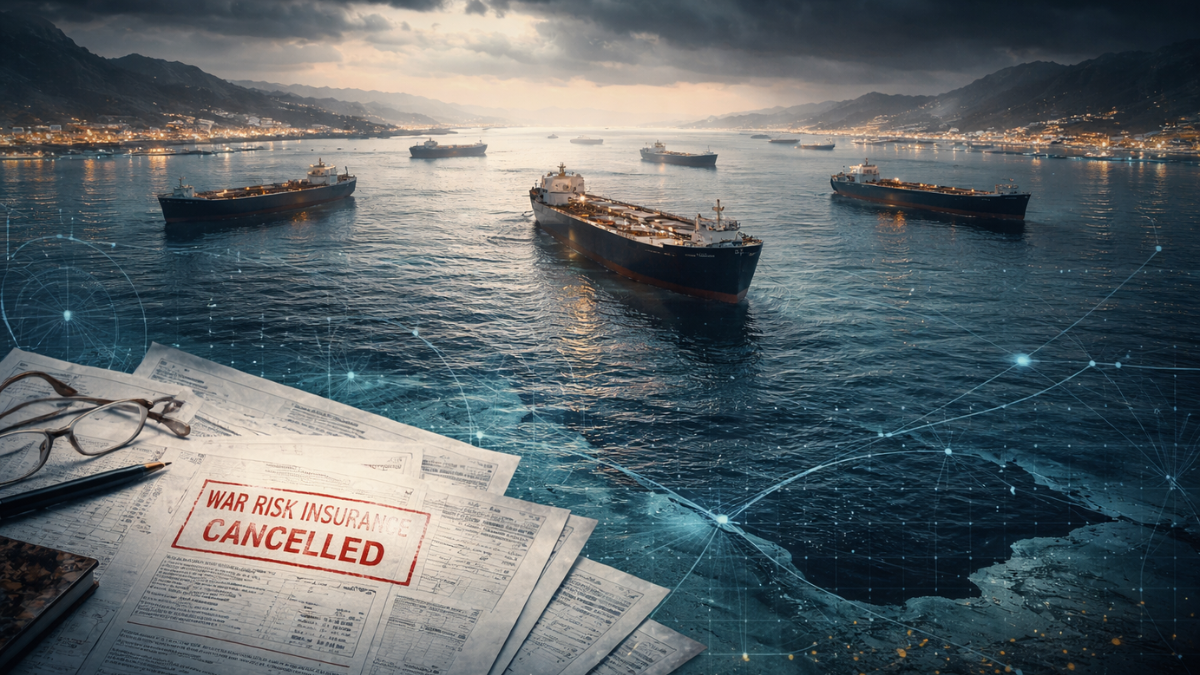


In early March 2026, one of the world’s most important energy routes experienced a sudden disruption. The crisis did not begin with mines, naval blockades, or direct military action. Instead, it started with insurance cancellations that quickly halted shipping through the Strait of Hormuz.
At midnight GMT on March 5, seven major maritime insurance clubs cancelled war-risk coverage for vessels operating in the Persian Gulf, the Gulf of Oman, and nearby waters. The insurers included Gard, NorthStandard, Skuld, Steamship Mutual, American Club, Swedish Club and London P&I Club. These insurers are part of the International Group of P&I Clubs, which collectively insures around 90 percent of the world’s ocean-going fleet.
Without insurance coverage, most vessels cannot legally sail or enter international ports. Because of this rule, tanker companies and cargo operators immediately stopped sending ships through the region. Shipping traffic collapsed within days. The Strait of Hormuz normally sees about 138 vessel crossings each day, but the number quickly fell to fewer than eight. By March 7, tanker traffic had dropped to zero.
The disruption left hundreds of ships stranded. Around 300 oil tankers were waiting outside the Gulf of Oman, while nearly 1,000 commercial vessels remained trapped inside the Persian Gulf. Together these ships represented about $25 billion in cargo and vessel value. Energy markets reacted quickly. Charter rates for Very Large Crude Carriers surged to $481,170 per day on the Baltic Exchange, while Brent crude oil prices rose from about $67 per barrel before the conflict to more than $100 by March 8.
Iraq’s oil production collapses 70% as war tensions choke tanker traffic through Strait of Hormuz
War-Risk Insurance Limits and Financial Rules Forced Coverage to End
Global shipping depends on a layered insurance system that protects shipowners from major losses. Protection and Indemnity clubs provide the first level of coverage by pooling risk among thousands of vessels. These clubs cover liabilities such as oil pollution, cargo damage, and crew injury.
Above them sit reinsurers, which share large losses and provide capital protection for catastrophic events. However, war-risk insurance operates under tighter limits because the market is much smaller and carries extreme risks. A single tanker accident in a conflict zone could cause losses exceeding $150 million for the ship and cargo, while environmental damage could create even higher liabilities.
Financial rules in Europe, particularly the Solvency II regulatory framework, require insurers to hold enough capital to survive extreme loss scenarios. Because the global war-risk insurance market collects only about $1 billion in premiums each year, reinsurers feared that a single large claim could wipe out the entire annual revenue pool. As fighting in the region intensified, reinsurers withdrew their coverage support.
Without reinsurance protection, the P&I clubs issued 72-hour cancellation notices for war-risk coverage. Even where insurance technically remained available, the cost rose dramatically. Premiums for a seven-day tanker voyage jumped from around 0.05 percent of a vessel’s value to between 1 and 3 percent. For a tanker worth $100 million, that meant insurance costs could reach $3 million for a single trip, making voyages commercially impossible for many shipowners.
The Joint War Committee also expanded its official list of high-risk areas in early March. This action placed more of the Persian Gulf region under war-risk classification and triggered additional insurance surcharges for ships entering the zone.
US deploys Navy escorts to protect oil tankers as Strait of Hormuz crisis deepens
Military Activity and Energy Supply Disruptions Deepen the Shipping Crisis
Military operations in the region continued during the shipping disruption. Naval forces and aircraft carriers were deployed to protect key shipping routes, and several Iranian air-defense systems and naval assets were destroyed in early strikes. Despite these developments, commercial tanker traffic did not return to the strait because the main problem remained unresolved: ships still lacked reliable insurance coverage.
Another factor increasing uncertainty for insurers was the command structure of the Islamic Revolutionary Guard Corps. The force operates under a decentralized defensive system developed by former commander Mohammad Ali Jafari. Under this system, provincial commands can operate independently during wartime, controlling missile batteries, drones, and coastal defenses along the coastline.
This decentralized structure made it difficult for insurers and shipping companies to identify a single authority capable of guaranteeing safe passage for vessels. Although a few ships reportedly attempted transit under special arrangements, most global shipping companies suspended bookings in the region.
The disruption created additional pressure on global oil supply. The Strait of Hormuz normally carries about 20 million barrels of oil each day, but alternative pipelines can move only 3.5 to 5.5 million barrels daily. This leaves a gap of more than 14 million barrels if the strait remains closed. As storage facilities filled inside the Persian Gulf, some oil producers began reducing production. In Iraq, major oil fields slowed operations because exports could not move through the blocked shipping route.