



A major security operation on February 22, 2026, led to the death of Nemesio Oseguera Cervantes, widely known as El Mencho. He was identified as the leader of the Jalisco New Generation Cartel, one of the most powerful criminal organizations in Mexico.
The operation was carried out by the Mexican military with support from U.S. intelligence. Authorities described it as a high-level mission targeting the leadership of a group involved in trafficking billions of dollars’ worth of fentanyl and cocaine each year.
Within hours of the reported death, coordinated violence broke out in multiple regions. Members linked to the cartel set up approximately 250 roadblocks across 20 Mexican states. Major highways were blocked using vehicles and debris.
Civilian infrastructure was directly targeted. Transportation systems were forced to shut down in several industrial cities. Urban rail and bus services were temporarily suspended, leaving many residents unable to travel safely.
The sudden unrest created fear in communities. Businesses closed their doors early. Workers were unable to reach factories and offices. Emergency services faced difficulty moving through blocked roads.
Disruption Across Mexico and Cross-Border Trade Routes
The unrest spread rapidly across different parts of Mexico. Key transportation corridors were paralyzed. These routes are essential for moving goods between factories, warehouses, and border crossings.
The rise and rivalry of Sinaloa, CJNG and Los Zetas in Mexico’s drug conflict
Mexico and the United States share deep economic ties. Every day, trucks carry car parts, electronics, food products, and other goods across the border. When highways are blocked, supply chains slow down.
American companies with major operations in Mexico were directly affected. Some facilities paused production. Others delayed shipments because trucks could not safely pass through affected regions.
The shutdown of transport hubs also impacted logistics centers and distribution networks. Goods waiting for export or delivery were held back. Delays began to ripple through North American supply chains.
Financial analysts noted that the sudden removal of a powerful criminal leader can create instability. When leadership inside a cartel changes suddenly, rival factions may compete for control of territory and smuggling routes.
This type of power struggle can increase short-term violence. It can also create uncertainty for businesses operating in affected areas.
Security forces were deployed to restore order. Patrols increased in cities and along highways. Authorities monitored areas where roadblocks were reported and worked to reopen key routes.
$800 Billion Market Reaction and Emergency Warnings
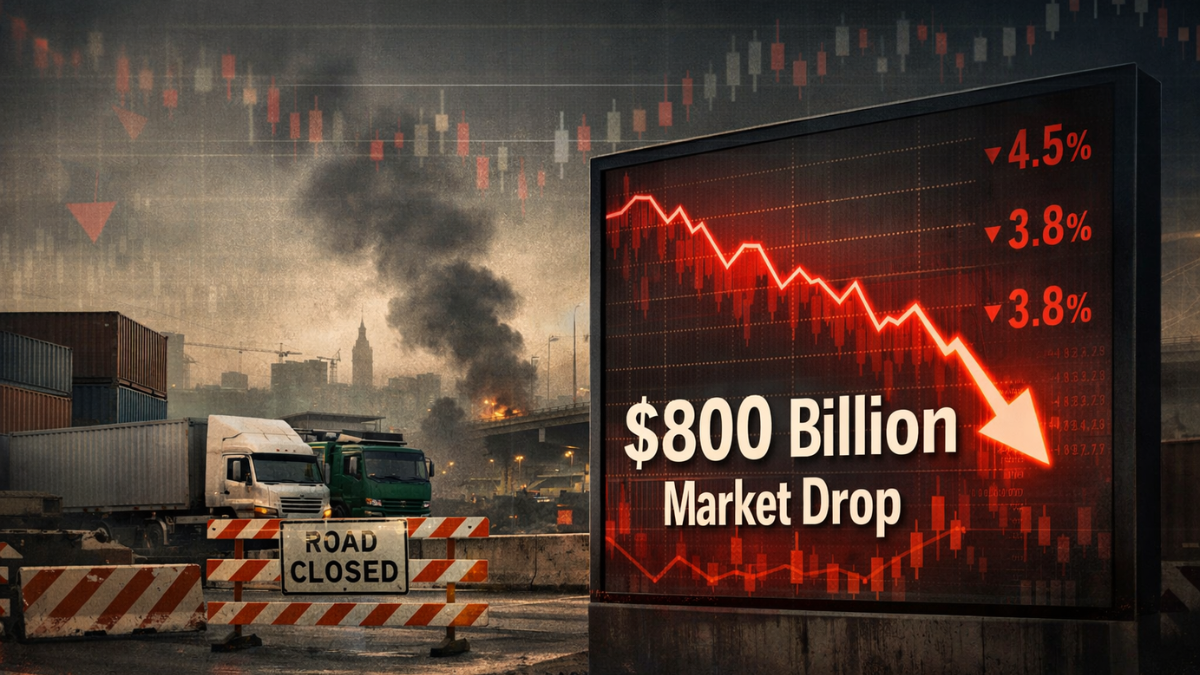
The financial markets reacted sharply to the violence and disruption. Reports indicate that the U.S. stock market experienced a downturn estimated at around $800 billion.
Investors responded to fears of instability in Mexico and the impact on cross-border trade. When supply chains are threatened, companies may face production losses and delayed deliveries. This can influence stock prices and market confidence.
Mexican security agencies warn of cartel revenues near $40 billion as financial networks draw focus
Industries closely tied to manufacturing and logistics were watched closely. The scale of the reported market drop reflects how closely connected the two economies are.
While Mexican officials described the operation as a major victory against organized crime, the immediate aftermath showed how sensitive markets are to regional security shifts.
The U.S. State Department issued emergency shelter-in-place warnings for U.S. citizens in several Mexican states. The alerts cited ongoing criminal activity and advised people to remain cautious.
Authorities in both countries stayed on high alert. Security agencies continued monitoring whether the cartel would transition to new leadership or break into smaller independent groups.
The situation led to continued transport delays, business interruptions, and heightened security presence across affected regions. Public safety announcements were shared to guide residents and travelers during the unrest.
The reported $800 billion downturn highlights the deep economic integration between Mexico and the United States. It also shows how quickly regional violence can influence global financial markets when trade routes and industrial centers are disrupted.