



The United States has announced the first set of investments under a major trade agreement with Japan, marking a significant step in a deal that links tariff relief to large-scale investment in American industries. US President Donald Trump said Japan has officially begun moving forward with its commitments, revealing a $36 billion investment tranche from a total $550 billion pledge.
The investment promise was made as part of a trade deal finalized months earlier. Under the agreement, Japan secured a reduction in threatened US tariffs on Japanese imports, including automobiles, from 25 percent to 15 percent. In return, Japan agreed to invest heavily in the United States through 2029 to help rebuild and expand key American industries.
The first tranche focuses on energy, oil exports, and manufacturing. These sectors are seen as essential for strengthening domestic production, improving economic security, and reducing reliance on China for critical materials and supply chains.
Trade Deal Terms and Japan’s Commitments
Japan’s $550 billion investment pledge is tied directly to the tariff agreement. According to the White House, the funds are meant to support core American industries and reinforce supply chains in strategically important areas.
President Trump said the investments would not have happened without the use of tariffs as leverage. In a statement shared on his Truth Social platform, he said Japan was now officially and financially moving forward with the first set of projects under its commitment. He emphasized the size of the projects and highlighted tariffs as a key negotiating tool.
130,000 Western cars flood Russia through China, exposing sanctions loophole in global auto trade
The timing of the announcement is notable. Japan has faced pressure to show progress on its pledges after earlier warnings were issued to other US allies about failing to meet trade commitments. These signals underscored that agreements are expected to produce tangible results.
Japan’s prime minister, Sanae Takaichi, said the investments would strengthen the Japan–US alliance. She explained that the projects would help both countries jointly build resilient supply chains in areas tied to economic security, such as energy, critical minerals, and advanced technologies including AI and data centers.
Infrastructure Projects With Strategic Value
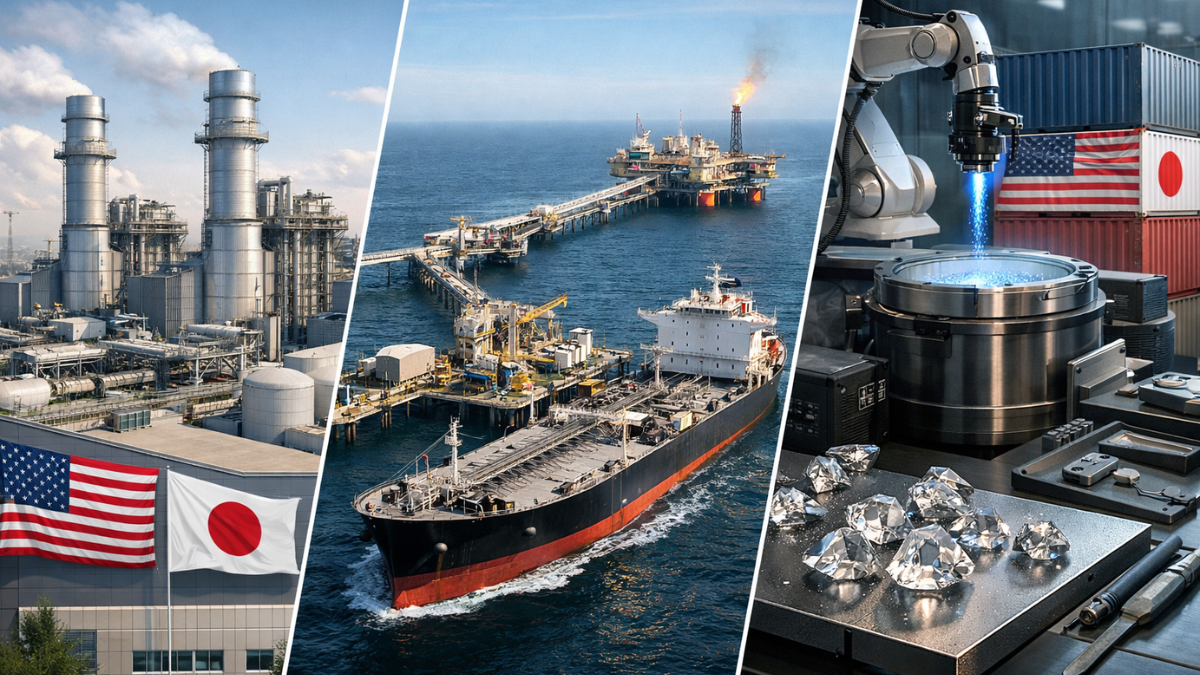
The first $36 billion tranche includes three major infrastructure projects across the United States.
The largest is a natural gas power generation facility in Ohio. It is expected to be the biggest gas-based power plant ever built in the country, with a planned capacity of 9.2 gigawatts. Officials said the facility will supply electricity to energy-intensive operations, including AI data centers. At full capacity, it would produce power equivalent to that generated by several nuclear reactors or enough electricity for millions of homes.
The second project is a deep-water oil export facility in the Gulf of Mexico. This terminal will significantly expand US crude oil export capacity. Reports indicate that once fully operational, the facility could generate $20 to $30 billion annually in US oil exports, strengthening the country’s role as a major global energy supplier.
The third project focuses on synthetic diamond manufacturing. Synthetic diamond grit is widely used in precision tools, electronics, and advanced manufacturing. China currently dominates global supply of this material. By building domestic production capacity, the project aims to ensure the United States is no longer dependent on foreign imports for this critical input.
US Trade Secretary Howard Lutnick described the investments as a major trade win. He said the Ohio natural gas facility would be the largest of its kind in history and highlighted its importance for powering modern industries.
Reducing China’s Economic Leverage
The investments are closely tied to efforts to reduce China’s influence over key global supply chains. By expanding domestic energy production and manufacturing, the United States lowers its exposure to supply disruptions and external economic pressure.
The deal also carries geopolitical significance. With rising tensions involving Taiwan and increased coordination between the US and Japan, economic cooperation is being used as a tool to support strategic alignment. Building domestic capacity for energy, industrial materials, and advanced manufacturing supports this broader approach.
Another key aspect of the agreement is its financial structure. Under the deal, the United States is expected to receive around 90 percent of the profits from these ventures, while Japan provides the investment capital. This allows the US to gain infrastructure, jobs, and long-term economic benefits.
The announcement of the first tranche confirms that Japan has begun delivering on its pledge, turning the trade agreement into active projects on US soil while supporting efforts to counter China in critical sectors.