

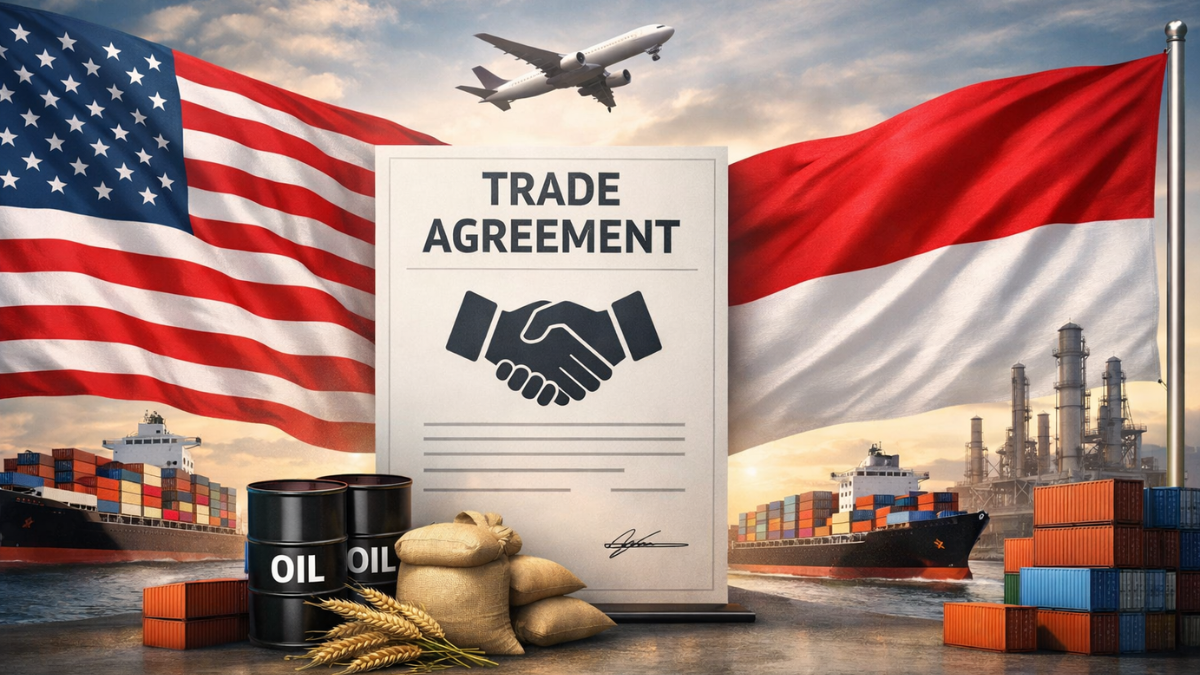


The United States and Indonesia have officially finalized a major trade agreement that reduces tariff pressure and expands economic ties between the two countries.
US President Donald Trump and Indonesian President Prabowo Subianto confirmed their commitment to the deal during a meeting in Washington. The agreement ends months of uncertainty and formalizes a framework first reached in July.
Under the deal, Indonesia avoids the previously threatened 32% US tariff rate. Instead, most of its goods entering the United States will face a 19% tariff.
Indonesia is a member of the Group of 20 and counts the United States as its second-biggest export destination. Annual trade between the two nations exceeds $40 billion.
Tariff Changes and Market Access
The agreement reduces US tariffs to 19% while creating relief for certain Indonesian exports. Palm oil, spices, pharmaceuticals, and some textile and apparel products will see eased duties. A mechanism will allow qualifying textile and clothing goods to receive tariff exemptions, supporting a key domestic industry.
In exchange, Indonesia will eliminate tariffs on more than 99% of US goods and remove non-tariff barriers that have affected American exporters.
Indonesia will reform its pre-shipment inspection processes and eliminate tariffs and fees on digital services. The country also pledged to exempt the United States from regulations including halal certification requirements, local content rules, and a one-year onshore lockup of dollar earnings.
Indonesia looks to cut U.S. tariffs from 19% to 18% in new trade discussions
Foreign ownership restrictions for US investors will be removed in sectors such as mining, broadcasting, and financial services.
Both countries will establish a council to address disputes and perceived trade imbalances, according to Coordinating Economic Minister Airlangga Hartarto. The agreement allows adjustments, including the possibility of lowering tariffs further if needed.
However, the United States retains the authority to terminate the reciprocal tariff agreement and reimpose higher duties if Indonesia enters a trade arrangement that harms essential US interests.
US Trade Representative Jamieson Greer described the agreement as unlocking Indonesia’s market of more than 280 million people for American farmers and manufacturers.
$33 Billion in Purchases and Investment Commitments
Indonesia is expected to purchase an estimated $33 billion in American goods.
This includes $15 billion in US energy products: $3.5 billion in liquefied petroleum gas, $4.5 billion in crude oil, and $7 billion in refined gasoline.
Indonesia is also set to procure $13.5 billion in commercial aircraft, benefiting Boeing Co.
In addition, $4.5 billion in US agricultural commodities will be imported, including cotton, soybeans, wheat, beef, rice, and corn. These purchases are intended to narrow the country’s roughly $16 billion trade surplus with the United States.
Indonesia said it would endeavor to facilitate $10 billion in outbound direct investment to the US. These investments may include engineering, construction, and energy projects such as blue ammonia development.
US confirms $36 billion Japan investment tranche under tariff-linked trade agreement
The United States has pledged to consider offering investment financing through the Export-Import Bank and the US International Development Finance Corporation.
Strategic Commitments and Broader Context
Beyond trade figures, Indonesia committed to align with US export controls and sanctions on sensitive technologies. This includes restricting dealings with blacklisted entities and preventing circumvention of those measures.
The agreement also covers critical minerals. Indonesia will allow US companies to extract these minerals under terms similar to domestic investors. These materials are vital for electric vehicles, defense, and manufacturing.
Unlike other tariff deals, the United States agreed to revoke provisions unrelated to economic cooperation, including articles on nuclear reactor development, the South China Sea, and defense and border security.
The signing took place during Prabowo Subianto’s third visit to Washington since assuming office in October 2024. The agreement comes as the country faces market headwinds, with MSCI Inc. raising concerns about stock market attractiveness and Moody’s lowering its sovereign credit outlook, citing policy uncertainty and governance concerns.
At the same time, Indonesia reaffirmed its commitment to international peace efforts, stating it is preparing up to 8,000 troops for a possible Gaza stabilization mission and may serve as deputy commander of an International Stabilization Force.