

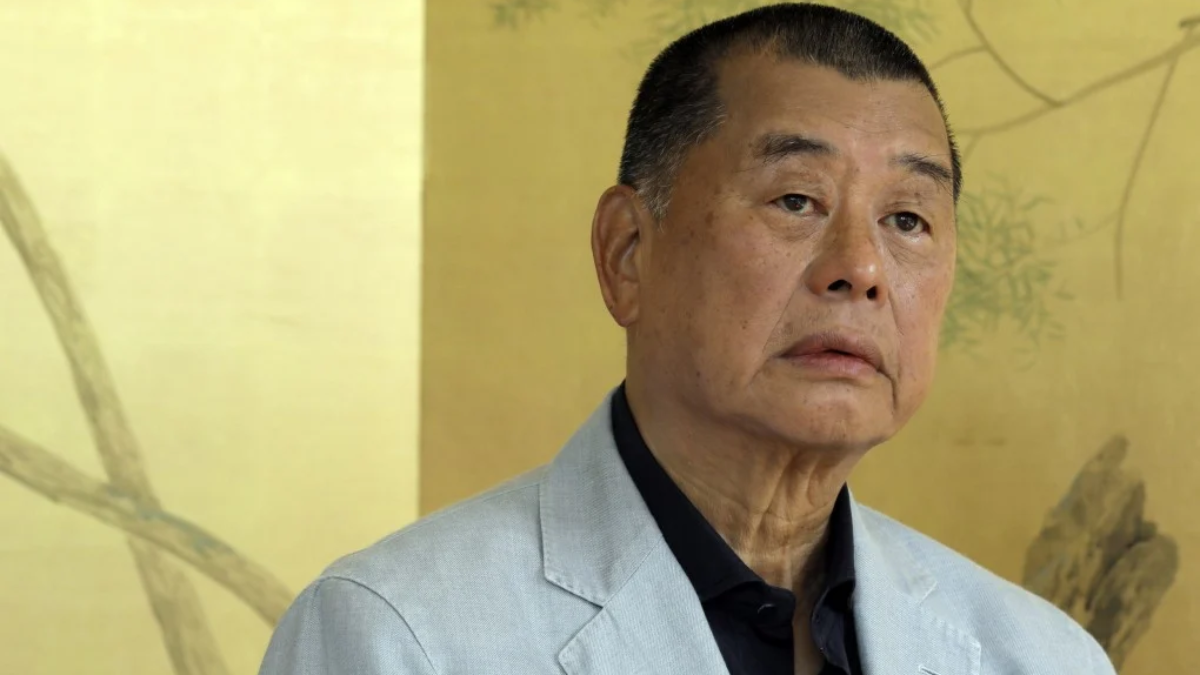


President of the United States, Donald Trump, has directly urged Chinese President Xi Jinping to free Hong Kong media tycoon Jimmy Lai, who is currently imprisoned. The appeal comes after Lai was convicted under Hong Kong’s national security law, a case widely seen as a serious blow to press freedom in the city.
Trump expressed deep concern about Lai’s health, saying the 78-year-old businessman is “older” and “not well.” He asked President Xi to consider releasing him, though he did not specify when the request was made.
The appeal follows a meeting between Trump and Xi in October in South Korea, where Lai’s case is believed to have been discussed. Lai has been a major figure in Hong Kong’s pro-democracy movement and has long been critical of Beijing’s policies in the city.
Conviction Highlights Shrinking Press Freedom
Hong Kong’s High Court recently found Jimmy Lai guilty on three charges under the national security law. Prosecutors accused him of orchestrating conspiracies to encourage foreign governments to take action against Hong Kong or China. He was also charged with publishing material said to “excite disaffection” against Chinese authorities. Lai pleaded not guilty during his trial.
China imposes strong sanctions on former Japanese military chief Shigeru Iwasaki over Taiwan role
The conviction carries the possibility of a life sentence, a ruling condemned by rights groups as a decisive blow to independent journalism in the city. The case is seen as symbolic of the collapse of press freedom in Hong Kong.
Lai founded the pro-democracy newspaper Apple Daily, which was forced to shut down in 2021. Its closure marked a turning point in Hong Kong’s media landscape. News organizations have since scaled back critical coverage of China, fearing prosecution. As a result, Hong Kong’s global press freedom ranking has fallen sharply, now standing at 140th out of 180 countries, according to advocacy groups.
Supporters have highlighted that Lai’s health has severely deteriorated during more than 1,800 days in prison. U.S. Secretary of State Marco Rubio said the verdict shows Beijing’s determination to silence dissent and urged authorities to release the tycoon on humanitarian grounds.
International Reactions and Family Statements
The conviction has drawn strong reactions internationally. The United Kingdom criticized the ruling as a “politically motivated prosecution” and called for Lai’s immediate release. Rubio emphasized that the verdict reflects China’s resolve to suppress those defending freedom of speech and other fundamental rights.
While the U.S. restricts chips, China powers AI with the world’s largest electricity grid
Lai’s family has also spoken out. His son, Sebastien Lai, called on the UK to increase pressure on Beijing, stating that his father’s release should be a precondition for closer relations with China. His daughter, Claire Lai, said that if freed, her father would abandon political activism and simply focus on his family and faith. She described him as a devout Catholic who wants to dedicate the rest of his life to his loved ones and religious beliefs.
Former Apple Daily editor Edward Li, who now lives in Taiwan, highlighted the wider implications of the conviction. He said that with Apple Daily gone, Hong Kong has lost a strong voice to monitor and criticize the government. This void, he said, leaves others feeling the responsibility to fill that role.
The case underscores the broader impact of Hong Kong’s national security law, which has increasingly been used to target pro-democracy figures and restrict freedom of expression. Lai’s long-standing role in Hong Kong’s media and pro-democracy movements has made his conviction a symbol of the challenges facing independent journalism in the city.