

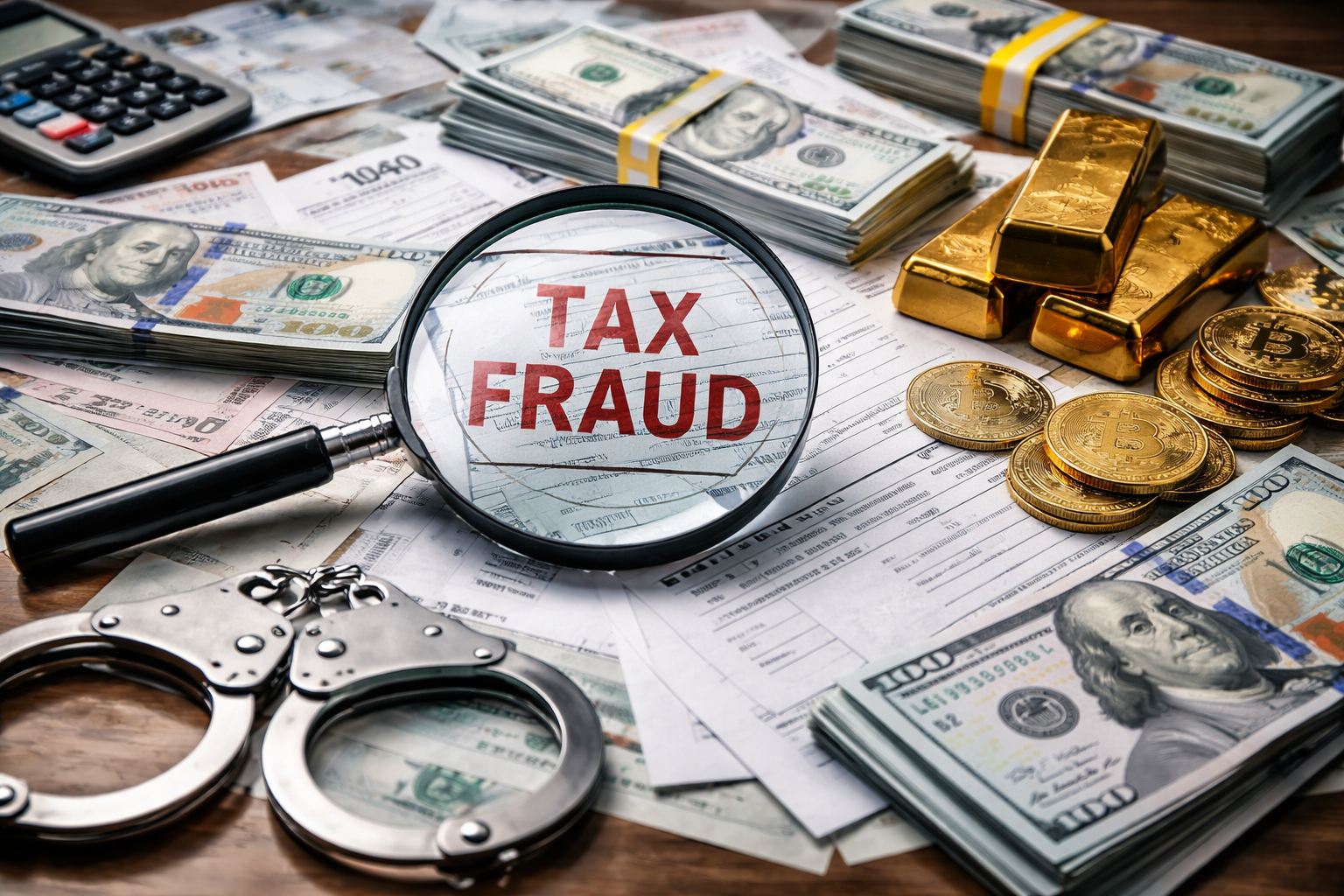


Three men from the same family—David Hunt, his son Baylon Hunt, and Baylon’s half-brother Corey Burt—have been sentenced to prison for a large-scale tax refund fraud scheme involving millions of dollars in false claims against the U.S. government. A federal investigation found they used fake documents and fabricated trusts to repeatedly file fraudulent returns before the operation was uncovered and stopped.
Family-Run Fraud Scheme Exposed in Court
Three men from the same extended family have been sentenced to prison after being found guilty of running a large-scale tax refund fraud scheme that targeted the United States government. The case, which involved millions of dollars in false claims, was uncovered after a detailed investigation and a full jury trial. Authorities said the tax refund fraud operation caused significant financial damage.
The individuals sentenced include David Hunt, his son Baylon Hunt, and Baylon’s half-brother Corey Burt. According to court records, David Hunt received a prison sentence of 92 months, while Corey Burt was sentenced to 94 months. Baylon Hunt was given a shorter sentence of 38 months. A fourth family member, who was also convicted during the trial, is expected to be sentenced in May.
The case was handled by federal authorities, including the IRS Criminal Investigation, which played a key role in uncovering the fraudulent tax refund activities. Officials described the tax refund scheme as organized, persistent, and financially damaging.
Michael J. Moore admits to repeat tax fraud scheme involving false IRS refund claims
The group was found guilty of conspiracy to defraud the United States. In addition, David Hunt and Corey Burt were convicted on multiple counts related to preparing false tax returns linked to the tax refund fraud. Baylon Hunt faced similar charges but was acquitted on two specific counts tied to assisting in filing false returns.
How the Fraud Scheme Worked
According to evidence presented during the trial, the group carried out the fraud by creating and controlling fake trusts. These trusts were used as a cover to file tax returns claiming tax refund payments they were not legally entitled to receive. To make these filings appear genuine, the defendants submitted false documents to the Internal Revenue Service, including fabricated financial instruments and altered money orders designed to mislead authorities.
The fraudulent activity was not limited to a single attempt. Investigators found that the group repeatedly filed false tax returns over a period of time to claim tax refund money. Even after receiving official warning letters from the IRS instructing them to stop, the defendants ignored the notices and continued their actions. This persistence significantly increased the scale and seriousness of the scheme.
US court rules against Treasury-backed property buyer disclosure requirement
In total, the group attempted to claim more than $8.5 million in tax refund payments. Although a large portion of these claims was rejected, they still managed to receive over $1.7 million in fraudulent payments from the government. This highlights how extensive and organized the operation had become.
The illegally obtained money was divided among the co-conspirators and used to fund a lavish lifestyle. Evidence showed purchases of luxury furniture, cryptocurrency investments, a Cadillac Escalade, and even a house in Mississippi. Authorities noted that while the scheme initially avoided detection due to its complexity, repeated filings and suspicious patterns eventually exposed the fraud.
Sentencing, Restitution, and Legal Action
Following their convictions, the court ordered all four defendants to pay restitution totaling $1,774,864 to the United States government. This amount represents the money they obtained through fraudulent tax refund claims.
Officials described the sentencing as an important step in holding the accused accountable. Authorities emphasized that tax refund fraud is a serious offense that directly impacts public funds and disrupts government operations.
The announcement was made by Assistant Attorney General A. Tysen Duva of the Justice Department’s Criminal Division and U.S. Attorney Ryan Raybould for the Northern District of Texas. Both officials underlined the importance of enforcing tax laws and protecting the integrity of the financial system.
The case was prosecuted by Trial Attorneys Melissa Siskind and Daniel Lipkowitz, along with Assistant U.S. Attorney Mark McDonald. They presented detailed financial records and evidence in court, showing how the defendants used false information to carry out the scheme. Investigators and prosecutors worked closely to build a strong case, which ultimately convinced the jury.
One more convicted family member is scheduled to be sentenced in May. Authorities continue to warn that fraudulent tax schemes are closely monitored and can lead to serious legal consequences.