

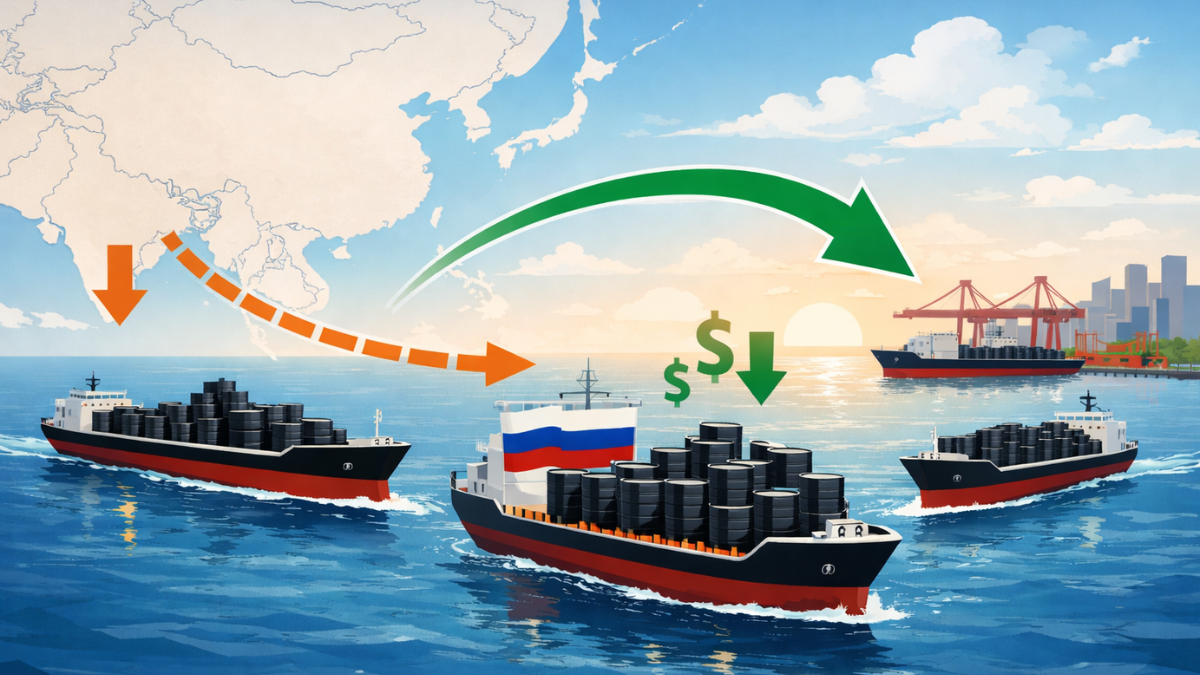


Russia’s flagship oil grade, known as Urals crude, has seen a sharp fall in prices as buying patterns in Asia change. The drop comes after Indian oil buyers reduced their purchases, leaving more Russian oil without enough demand. As competition for these cargoes eased, prices for Urals crude delivered to China fell to record-low levels.
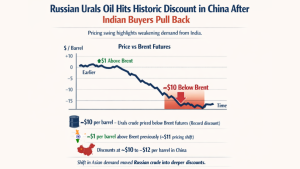
Recent shipments of Urals crude were sold at around $10 per barrel below Brent futures, according to people involved in the trade. This marks a major shift from August, when the same oil was offered at about $1 per barrel above Dated Brent. The change highlights how quickly market conditions have turned.
Urals crude is exported mainly from Russia’s western ports, making it less common in Asian markets. Because of the long distance, it has not traditionally been a major oil grade sold into China. Asian refiners have usually preferred Russian ESPO crude, which loads from Russia’s Far East and is closer to China. However, the steep discount has made Urals oil hard to ignore.
The oil market has been closely watching these shifts since Western buyers stopped purchasing Russian oil following the invasion of Ukraine in 2022. Since then, Russia has redirected much of its oil toward Asian countries, especially India and China.
India and China Move Away From U.S. Treasuries as Gold Becomes Strategic Anchor
India’s Pullback Creates Oversupply of Russian Oil
India initially became a key buyer of Russian oil after Western countries stepped away. Indian refiners increased purchases to take advantage of discounted prices. This helped absorb large volumes of displaced Russian crude.
However, India’s appetite for Urals oil has recently weakened. Demand declined following US sanctions on Russian producers, including Lukoil PJSC, and growing pressure from the Trump administration. These factors made shipping, payments, and compliance more difficult for Indian refiners.
Although some interest remains, shown by a recent purchase from Reliance Industries Ltd., overall imports have dropped sharply. In December, India’s imports of Russian oil fell to a more-than-three-year low, making it one of the weakest months since India began buying large volumes of Russian crude.
This decline has affected Russia’s overall oil exports. Shipments recently fell to their lowest level since August as Moscow faced increasing challenges delivering oil to its key buyer. With fewer Indian buyers, large volumes of Urals crude were left without a clear destination.
As a result, oil has started piling up on tankers at sea. According to ship-tracking firm Kpler Ltd., more than 13 million barrels of Urals crude are currently being stored on ships, the highest level seen in at least a decade.
Nearly half of this oil is located in the Arabian Sea, while close to a fifth is in the Singapore Strait and the Yellow Sea. These locations place the oil within easier reach of Asian buyers, particularly China.
Taiwan doubles down on AI chip leadership in landmark US Tariffs deal as China looks on
China Raises Imports as Cheap Urals Crude Finds a Home
As India cut back, China increased its intake of discounted Urals crude. Chinese refiners have taken advantage of the lower prices, even though the oil travels a longer distance than ESPO crude.
So far this year, China’s imports of Urals crude have climbed to about 400,000 barrels per day, the highest level on record, according to Kpler Ltd. Data from Vortexa Ltd. shows a similar rise, confirming the trend.
This increase is notable because Urals crude has not historically been a major import for China. The surge reflects how deeply discounted prices can change buying behavior, even when logistical challenges exist.
The growing flow of Urals oil into China has helped absorb some of the excess barrels floating at sea. At the same time, it shows how shifts in demand from one major buyer can quickly redirect oil trade routes.
Overall, the situation highlights how Russia continues to sell oil despite sanctions and reduced demand from India, but often at much lower prices. China has emerged as a key buyer by capitalizing on the availability of cheap Urals crude, reshaping oil flows across Asia without altering the broader market timeline or conditions.