

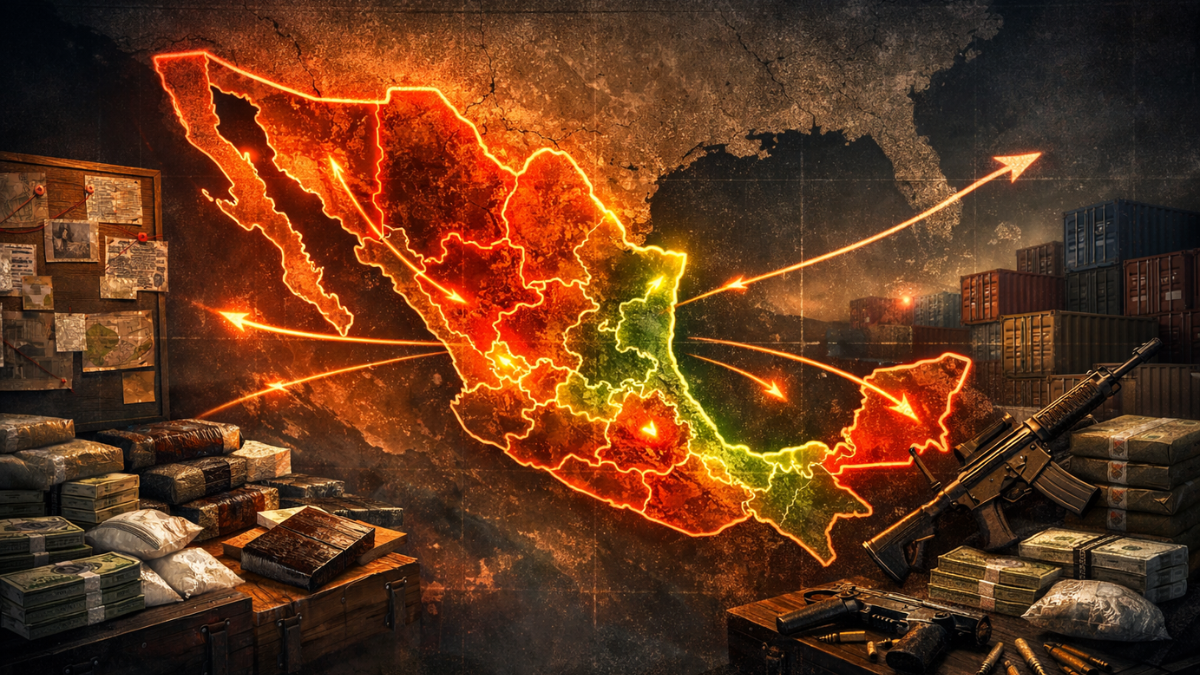


Mexico has faced a long drug war for many years. Powerful criminal groups fight for land, money, and control of drug routes. They act like illegal businesses with armed members and large networks. They control areas inside Mexico and move drugs to other countries.
Today, analysts say two groups are the strongest. Older groups have weakened but still exist and influence parts of the country.
Sinaloa Cartel and Its Power
The Sinaloa Cartel emerged in the late 1980s from former members of earlier trafficking groups. It became one of the largest drug organizations in the world. At its peak, it controlled about 40 to 60 percent of Mexico’s drug trade and dominated much of the north-west.
The group was led for years by Joaquin “El Chapo” Guzman. Under his leadership, it expanded globally and built strong trafficking networks. Authorities said it trafficked cocaine, heroin, and marijuana and used violence against rivals.
El Chapo was sentenced to life in prison in 2019 after a major trial. His arrest increased violence as different factions tried to gain control.
The cartel is believed to be partly managed by Ovidio Guzman Lopez, who is linked to leadership roles inside the group. His arrest led to heavy armed clashes and public unrest.
Mexican security agencies warn of cartel revenues near $40 billion as financial networks draw focus
Despite arrests, the cartel continues operating. It remains active in north-west Mexico and international cities. It is said to earn billions of dollars from drug trafficking across North America, Europe, and Asia.
Jalisco New Generation Cartel (CJNG)
The Jalisco New Generation Cartel (CJNG) formed around 2010 and became the strongest rival to Sinaloa. It expanded quickly into many regions and is now considered one of Mexico’s most powerful criminal groups.
Its assets are estimated to be worth more than $20 billion. The group is known for extreme violence and aggressive expansion.
It is led by Nemesio Oseguera Cervantes, who is widely known by a nickname. Under his leadership, the cartel attacked police forces, targeted security officials, and even shot down a military helicopter.
CJNG is one of the main distributors of synthetic drugs in the Americas. It plays a major role in illegal amphetamine markets in the United States and Europe and has connections to Asia.
Its violent actions have caused bloodshed in cities such as Tijuana, Juarez, Guanajuato, and Mexico City. The group has killed officials and used public intimidation tactics like hanging bodies from bridges.
Gulf Cartel and Los Zetas
The Gulf Cartel is one of Mexico’s oldest criminal groups. It started in the 1980s and operated mainly in north-eastern Mexico around Tamaulipas.
A key leader was Juan Garcia Abrego. The group made billions by trafficking cocaine and marijuana and working with international partners.
Later, Osiel Cardenas Guillen strengthened its military wing by recruiting trained special forces members. His arrest in 2003 and later events weakened the organization.
U.S. prosecutors drop core ‘narco cartel’ narrative in stunning Venezuela indictment shift
Those trained fighters broke away and formed Los Zetas.
Los Zetas became known for extreme brutality. It expanded into crimes like human trafficking and cigarette smuggling. At its peak around 2012, it operated in more than half of Mexico’s states and became the largest drug gang.
Important leaders included Miguel Angel Trevino Morales and Omar Trevino Morales. Their capture and the killing of another leader by authorities caused the group to split and decline.
It remains active in some areas but is weaker than before and faces pressure from rival groups.
The Global Model That Inspired Cartels
Before Mexican groups became dominant, Colombia’s drug empire set a powerful example.
The Medellin group dominated the global cocaine trade in the 1980s and early 1990s. It was led by Pablo Escobar and became known for massive wealth and extreme violence.
This organization created a model based on power, corruption networks, and armed protection. Many analysts say later criminal groups adopted similar strategies.
One reported figure linked to cartel operations was Pedro Inzunza Noriega, who was accused of trafficking large amounts of drugs as part of another criminal faction.