

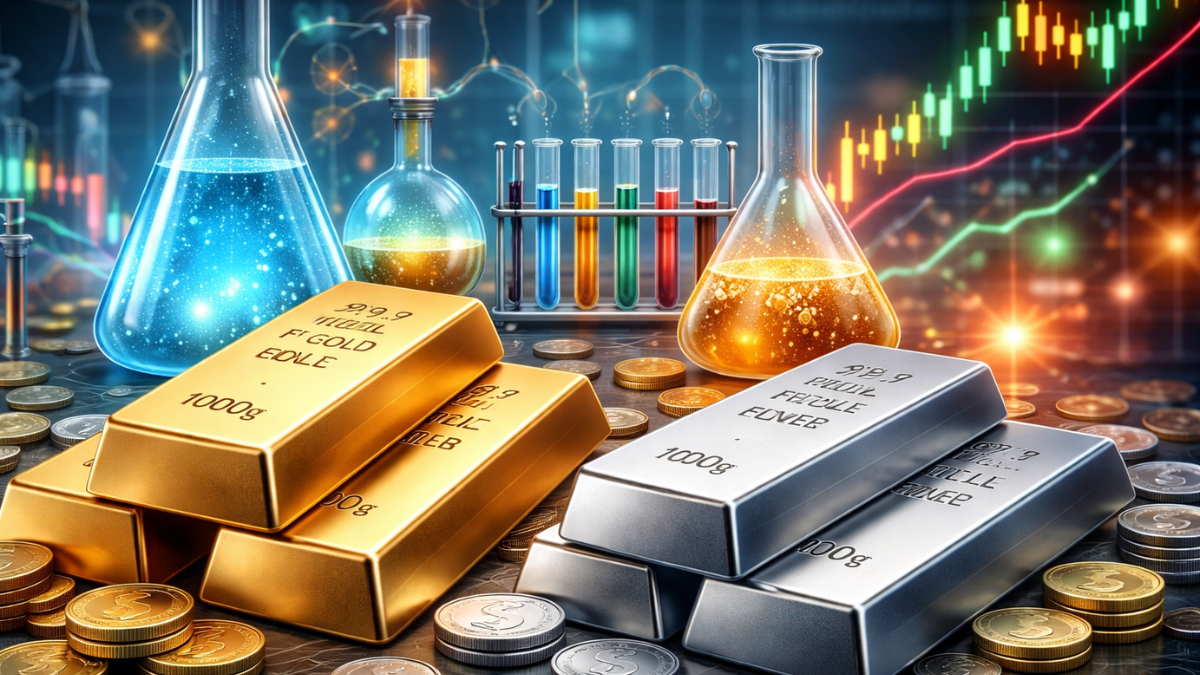


Reports circulating online have sparked intense debate across global financial markets. The claims suggest that scientists in China may have found a way to synthesize gold and silver under laboratory conditions. While no official confirmation or peer-reviewed scientific evidence has been released, the rumors alone have been enough to capture worldwide attention.
The discussion spread rapidly through online platforms and investor circles. Precious metals markets reacted quickly, showing how sensitive they can be to uncertainty. Gold and silver are widely trusted as stores of value, and even the suggestion that they could be manufactured artificially has raised serious questions.
At present, the claims remain unproven. No detailed scientific data or formal announcements support the idea. Despite this, the speculation has sent shockwaves through the precious metals community and triggered broader conversations about value, scarcity, and trust in global markets.
Why Gold and Silver Hold Long-Standing Value
Gold and silver have been valued for thousands of years. One of the main reasons for this is their rarity. These metals are difficult to find, costly to mine, and complex to refine. Their limited supply has helped them maintain value across generations and civilizations.
Gold breaks $5000 barrier as investors seek refuge from global instability
Because of these qualities, gold and silver are often used to protect wealth. Investors commonly turn to them during periods of inflation, economic uncertainty, or market instability. Many view them as reliable assets when confidence in currencies weakens.
The rumors suggest that if any nation were able to manufacture gold or silver at scale, it could disrupt how wealth is preserved and measured. Even partial success in producing these metals artificially could affect investor confidence and market sentiment.
Investors watching these developments fear that questioning scarcity could lead to price volatility. Volatility occurs when prices move sharply in short periods of time. In this case, the concern comes from uncertainty rather than confirmed information. When confidence weakens, emotional react ions can influence buying and selling decisions.
This reaction highlights how markets can respond strongly to perceived threats, even when those threats are based on speculation rather than facts.
Scientific Reality and the Power of Market Narratives
Experts urge caution when interpreting these claims. From a scientific standpoint, the only recognized way to convert one element into another is through nuclear transmutation. This process involves changing the structure of an atom and has been known for decades.
India and China Move Away From U.S. Treasuries as Gold Becomes Strategic Anchor
While nuclear transmutation has allowed scientists to produce tiny amounts of gold in laboratory settings, the process is extremely expensive and energy-intensive. In past experiments, the cost of producing gold far exceeded its market value. These efforts were scientific demonstrations, not practical methods for mass production.
Due to these limitations, large-scale synthetic production of gold or silver is considered highly impractical with current technology. The required energy, equipment, and cost make it unsuitable for commercial use. This is why experts say the rumors should be approached with skepticism.
Still, the situation highlights an important truth about modern markets. Markets do not react only to confirmed facts. They also react to narratives. In today’s fast-moving digital world, unverified claims can spread quickly and influence investor psychology.
Technological advances in recent years have made people more open to the idea that long-standing limits can be overcome. This mindset can make rumors seem more believable, even without evidence. As a result, speculation alone can move prices, influence confidence, and spark geopolitical discussion.
As of now, no verified scientific proof supports the claims. The debate remains driven by uncertainty, market behavior, and the powerful role of storytelling in shaping financial reactions.