

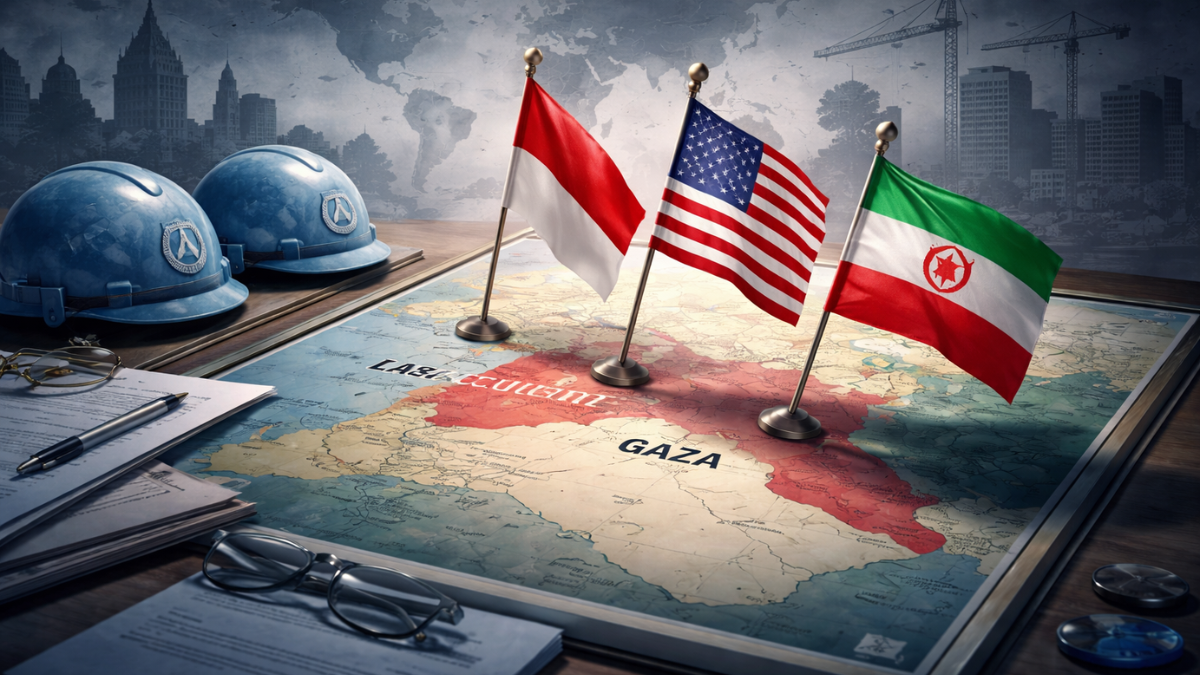


Indonesia has officially suspended discussions about its participation in the “Board of Peace” initiative following the recent military escalation between the United States and Iran. The decision was confirmed by Foreign Minister Sugiono, who said the worsening situation in the region has created conditions that no longer support the peace initiative’s goals.
The Board of Peace was launched in early 2026 by U.S. President Donald Trump as a new international body aimed at overseeing stability and reconstruction in post-conflict Gaza. The initiative was designed to bring together several countries to support rebuilding efforts and maintain security in the territory after the war.
However, the latest escalation between the United States and Iran has shifted global attention away from Gaza reconstruction. Indonesian officials described the situation as “un-peaceful” and said it makes it difficult to continue discussions about peacekeeping arrangements connected to the Board of Peace.
Indonesia clarified that it has not withdrawn from the initiative. Instead, the government has placed its participation under review while monitoring developments in the region. Officials said the pause allows Indonesia to evaluate whether the Board of Peace can still function effectively in the current geopolitical environment.
Indonesia’s Key Role in the Proposed Gaza Stabilization Mission
Before suspending discussions, Indonesia had taken a major role in the Board of Peace initiative. The country agreed to contribute a large number of peacekeeping personnel and was given an important leadership role in the proposed International Stabilization Force.
US targets $15 million in funds linked to secret Iranian oil empire run by Shamkhani network
Under the plan, Indonesia was expected to deploy up to 8,000 peacekeeping troops to help maintain security in Gaza after the conflict. The troops would have worked alongside personnel from other countries to ensure stability while reconstruction and humanitarian work took place.
Indonesia was also named deputy commander of the international stabilization mission. This role would have placed the country among the leading contributors overseeing the rebuilding and security process in Gaza.
The Board of Peace initiative aimed to coordinate international efforts to restore infrastructure, support governance systems, and rebuild communities affected by the war. Indonesia’s participation was seen as significant because the country has long expressed strong support for Palestinian independence and humanitarian assistance.
The involvement was also part of the broader diplomatic direction under President Prabowo Subianto. Officials indicated that participating in the initiative could allow Indonesia to influence reconstruction efforts while supporting stability in Gaza.
Despite these plans, discussions about troop deployment and operational details have now been paused due to the changing security situation in the region.
Domestic Criticism and Policy Review Influence Indonesia’s Position
Indonesia’s decision to pause discussions about the Board of Peace also comes amid strong domestic criticism from religious and political groups.
New agreement will see Venezuela export up to 1,000 kg of gold to US markets
Several organizations have raised concerns about Indonesia joining a council led by the United States during a period of military conflict involving another sovereign nation. Critics argue that such participation could conflict with Indonesia’s constitutional principles and foreign policy approach.
One of the organizations expressing concern was the Indonesian Ulema Council. The group argued that taking part in the initiative during the current conflict could undermine Indonesia’s long-standing support for the Palestinian cause.
The debate has increased pressure on the government to reassess its role in the Board of Peace initiative. At the same time, the administration of Prabowo Subianto has emphasized that the country follows a “free and active” foreign policy.
This policy allows Indonesia to maintain balanced relations with different global powers while also building bridges between the West and the Islamic world. As tensions rise in the Middle East, Indonesia has shifted its focus toward possible mediation efforts.
Reports indicate that President Prabowo Subianto has offered to travel to Tehran personally to facilitate dialogue between the United States and Iran.
For now, Indonesia remains a member of the Board of Peace. However, the government has stated that its participation is under strict review as the conflict evolves. Officials have made it clear that if the initiative is seen as ineffective or no longer aligned with Indonesia’s national interests and its support for Palestinian independence, the country is prepared to withdraw completely.