

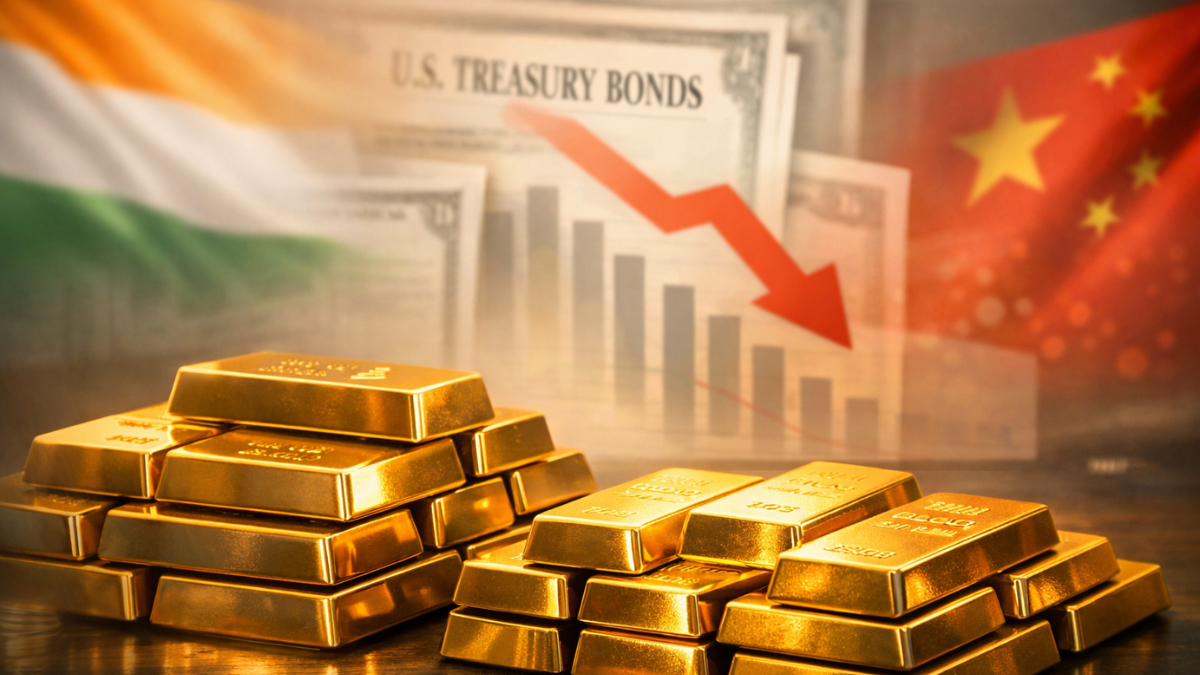


India and China move away from U.S. Treasuries as gold becomes strategic anchor
India and China, two of the world’s largest economies, are quietly reshaping how global reserves are managed. Both countries are reducing their exposure to U.S. Treasury bonds while steadily increasing gold holdings, marking a strategic shift in how central banks protect national wealth amid rising geopolitical and financial uncertainty.
Recent data from the U.S. Department of the Treasury shows India’s holdings of U.S. government debt have fallen below $200 billion, dropping to around $190 billion by late 2025. This represents a decline of more than $50 billion year on year. During the same period, India’s gold reserves climbed to over 880 metric tonnes, even as total foreign exchange reserves remained broadly stable.
China’s adjustment has been even more pronounced. Its U.S. Treasury holdings fell to approximately $683 billion in November 2025, the lowest level since 2008. At the same time, China has added gold to its reserves for fourteen consecutive months, bringing total holdings to more than 74 million ounces.
A structural shift, not a short-term trade
The move toward gold is not driven by short-term price speculation. Gold prices remain near record highs, yet both countries continue to accumulate bullion. This indicates a long-term strategic reallocation rather than opportunistic buying.
China’s Historic Dump of $53 Billion US Treasuries is Unprecedented Blow to US Economy
For decades, U.S. Treasuries were viewed as the safest and most liquid reserve asset in the world. However, rising U.S. interest rates, expanding federal debt, and increasing use of financial sanctions have altered the risk calculus for many countries.
Unlike bonds, gold is not issued by any government and carries no counterparty risk. It cannot be frozen, sanctioned, or defaulted upon. For central banks managing hundreds of billions of dollars, these characteristics matter more than short-term yield.
India’s evolving reserve strategy
India’s reserve rebalancing reflects a growing emphasis on resilience rather than return. Gold now accounts for more than 13% of India’s total foreign exchange reserves, up from under 10% just a year earlier.
Officials have not framed the move as a rejection of U.S. assets, but rather as prudent diversification. India continues to maintain substantial dollar reserves to manage currency stability and trade flows. However, gold is increasingly treated as a core strategic asset rather than a passive holding.
This approach aligns with India’s broader effort to reduce vulnerability to external shocks while maintaining flexibility in monetary and geopolitical policy.
China’s long-term de-risking plan
China holds the world’s largest foreign exchange reserves, exceeding $3.3 trillion. Its gradual reduction in U.S. Treasury exposure has been underway for more than a decade, accelerating during periods of trade friction and geopolitical tension.
Gold accumulation serves multiple purposes for China. It diversifies reserves, reduces reliance on dollar-denominated assets, and strengthens confidence in the country’s financial system. It also provides insulation against potential sanctions or disruptions in global payment systems.
Importantly, China’s gold purchases have continued even as prices climbed, reinforcing the view that this is a policy-driven strategy rather than a tactical trade.
Global implications for the U.S. Treasury market
India and China are not alone in reassessing U.S. debt exposure. Several emerging and middle-income economies have reduced Treasury holdings in recent years, while others such as Japan and the United Kingdom have increased theirs.
This divergence suggests that reserve decisions are increasingly influenced by geopolitical alignment, domestic priorities, and risk tolerance rather than a one-size-fits-all approach.
While the U.S. dollar remains the world’s dominant reserve currency, the assumption that Treasuries are universally risk-free is no longer uncontested.
Gold’s renewed role in a fragmented world
Gold’s resurgence reflects deeper changes in the global order. Trade fragmentation, sanctions, regional conflicts, and rising debt levels have made neutrality and portability more valuable traits for reserve assets.
Central banks are not abandoning the dollar, but they are building buffers. Gold functions as a financial anchor during periods of uncertainty, offering stability when political or market conditions shift rapidly.
For India and China, gold represents insurance against a world that is becoming less predictable and more multipolar.
America bleeds $70,000 every second — U.S. debt explodes to $38 trillion amid political gridlock
What this means going forward
The reallocation toward gold is unlikely to reverse quickly. Even if U.S. interest rates fall, structural concerns around debt sustainability and geopolitical leverage will remain.
As more countries adopt similar strategies, gold’s role in the international financial system may continue to expand, not as a replacement for fiat currencies, but as a strategic counterbalance.
India and China’s moves signal a broader recalibration of global finance, where safety, sovereignty, and resilience increasingly matter as much as yield.