

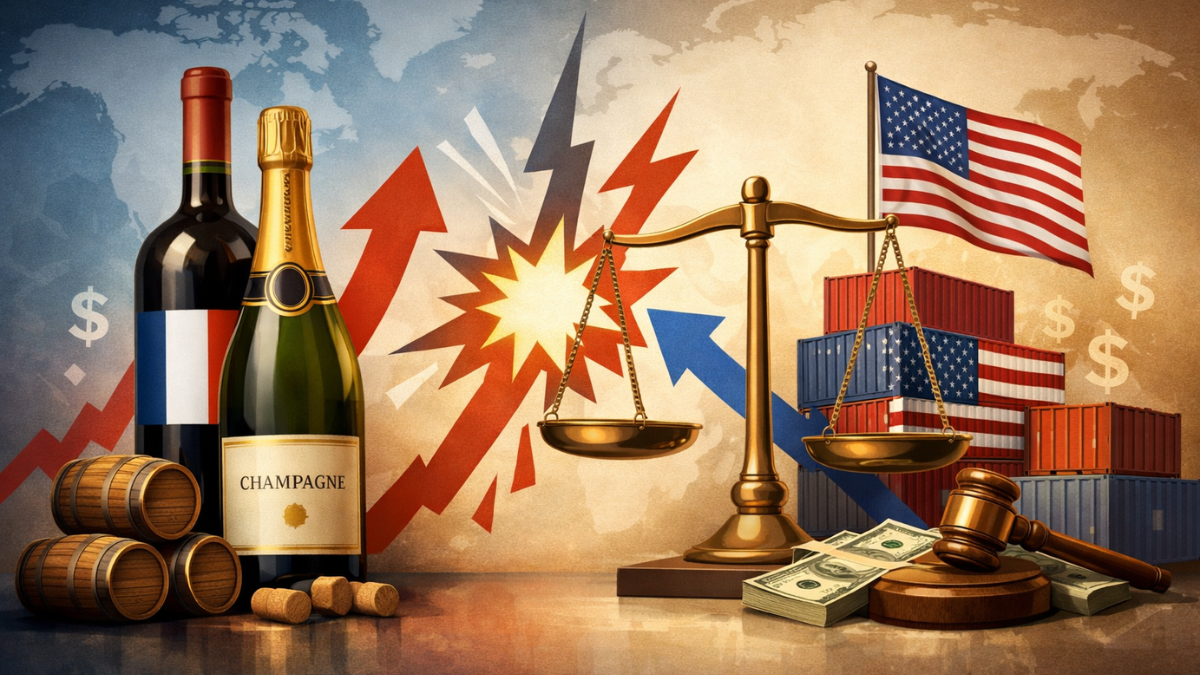


In a surprising turn of events, U.S. President Donald Trump has threatened a major trade move against France after French President Emmanuel Macron declined to join a new international board designed to oversee Gaza. The warning specifically targets French wine and Champagne, two of France’s most famous exports.
The incident has drawn global attention because it ties trade measures directly to diplomacy, an unusual approach in international relations.
Trump’s Board of Peace Sparks Global Attention
President Donald Trump recently announced the creation of a “Board of Peace,” intended to guide the next steps in Gaza following the recent conflicts between Israel and Hamas. Trump described the board as “the Greatest and Most Prestigious Board ever assembled at any time, any place,” and it forms a key part of his 20-point plan to resolve the ongoing crisis.
Leaders from several countries were invited to join, including Macron, Russian President Vladimir Putin, and Belarusian President Alexander Lukashenko. However, Macron declined the invitation. French officials said they were concerned that the board, chaired by Trump, could have powers extending beyond transitional governance of Gaza and potentially undermine the United Nations framework.
Canada considers joining NATO exercises in Greenland amid Trump tariffs
A statement from President Emmanuel Macron’s office emphasized that the board’s charter “goes beyond the framework of Gaza and raises serious questions, in particular with respect to the principles and structure of the United Nations, which cannot be called into question.” France’s decision reflects caution about international interventions that bypass established UN structures.
Trade Threats Follow Diplomacy Snub
In response to Macron’s refusal, President Trump threatened to impose 200% tariffs on French wine and Champagne. The threat came during a media huddle, where Trump dismissed Macron as lacking influence and said he would be “out of office in a few months.” Trump added that the tariffs could pressure Macron, though he also said that Macron didn’t actually have to join the board.
A French official, speaking on condition of anonymity, responded to the statements. The official said: “We have taken note of Mr. Trump’s statements on wines and Champagnes. As we have always emphasized, tariff threats to influence our foreign policy are unacceptable and ineffective.”
If implemented, a 200% tariff would drastically increase the price of French wine and Champagne in the United States, potentially affecting sales and trade. While the move has economic implications, it is widely seen as a political message rather than an immediate trade action.
Global Reactions and Board Controversy
The proposed Board of Peace has raised concerns among other nations. Some countries are uneasy about its powers and the authority it might hold over Gaza. President Trump plans to finalize the board’s constitution and remit at the World Economic Forum in Davos, but several countries remain cautious about its details.
EU prepares €93bn trade retaliation as Trump escalates Greenland standoff
France’s refusal highlights the tension between the board’s proposed authority and existing UN frameworks. Officials emphasized that any governance of Gaza should remain consistent with international rules and the United Nations’ role. The concern is that the new board could exceed its intended scope and interfere with the UN-led process.
The situation has drawn global attention because it combines international diplomacy, trade threats, and the oversight of conflict zones. Both Trump and Macron have maintained firm positions, with one using economic threats to push participation and the other insisting that trade pressures will not dictate foreign policy decisions.
This development continues to be closely watched by world leaders, trade experts, and diplomats, as it involves major international players and high-stakes decisions about both peacekeeping and economic leverage.