

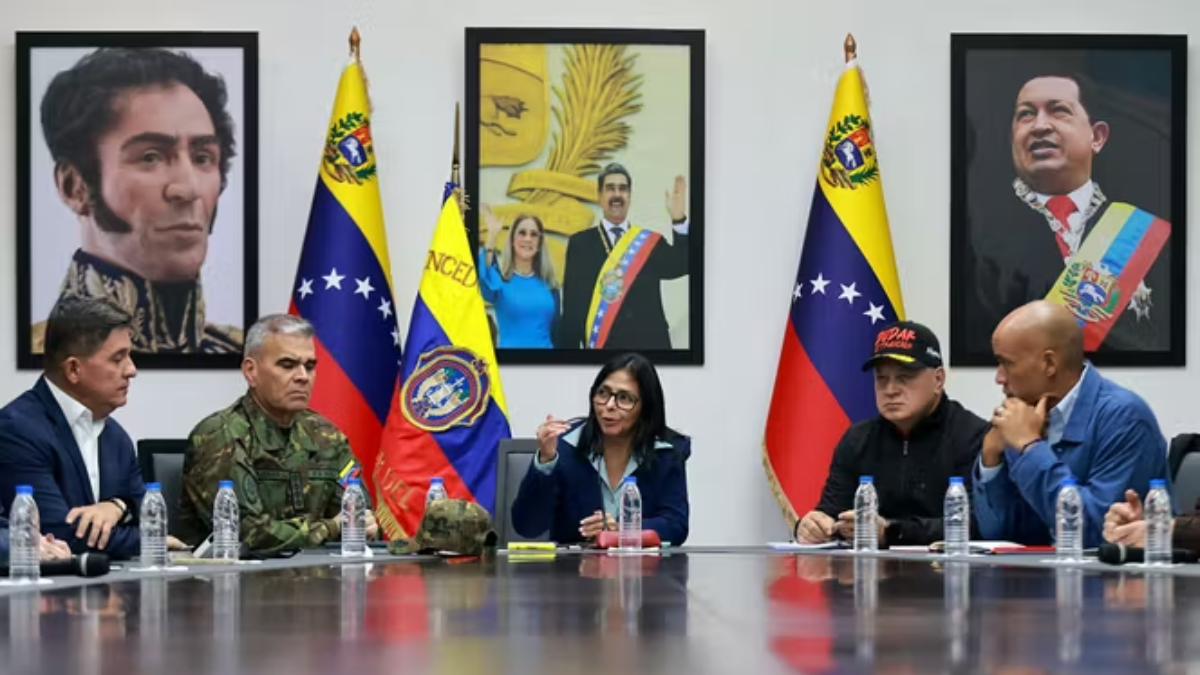


Senior officials from Colombia and Venezuela met in Caracas on Friday for high-level talks focused on security, trade, and energy. This marked the first in-person meeting between the two countries since the removal of former Venezuelan president Nicolás Maduro earlier this year. Acting president Delcy Rodriguez described the meetings as productive and said they could bring significant economic benefits for both nations.
A presidential-level meeting between Rodriguez and Colombian president Gustavo Petro had been planned but was canceled due to “force majeure.” Despite this, ministers from both countries held discussions aimed at strengthening cooperation in areas that directly affect people living along their shared 2,200-kilometer border.
Rodriguez highlighted the historical connection between the two nations, referencing the vision of South American independence leader Simón Bolívar. She said that collaboration could be “hugely fruitful economically” and would benefit communities across the region. Rodriguez also addressed the United States, urging President Donald Trump to lift sanctions on Venezuela, describing them as measures that negatively affect not only Venezuelans but also the peoples of Latin America.
Middle-east conflict reveals dramatic China-led energy axis linking Venezuela, Iran and Cuba
Border Security and Combating Drug Trafficking
Security along the border was a major focus of the talks. Rodriguez emphasized the need for immediate coordination and permanent exchange of information to combat challenges such as drug trafficking. Colombia’s defense minister Pedro Sanchez met with Venezuela’s defense minister Vladimir Padrino to discuss joint security strategies, while foreign ministers Rosa Villavicencio of Colombia and Yvan Gil of Venezuela focused on broader cooperation between their countries.
Drug trafficking has been a longstanding concern in the region. Colombian authorities have reported record drug seizures under President Petro’s tenure, reflecting intensified efforts against illegal production and smuggling. Both governments noted that organized criminal groups often operate across borders, and sharing intelligence and coordinating security operations are essential to reduce crime and improve safety for border communities.
The discussions also reflected broader international interests. The United States has repeatedly called on Colombia to strengthen its anti-drug efforts. Coordinated action between Colombia and Venezuela is seen as a key step in meeting these expectations while enhancing regional security.
US temporarily eases sanctions on Russian oil shipments loaded before March 12
Energy Cooperation and Pipeline Repairs
Energy cooperation was another major topic during the talks. Officials discussed repairing a damaged pipeline connecting the two countries. Colombia’s state oil company Ecopetrol, led by Ricardo Roa, and Venezuela’s PDVSA will carry out the repairs. The Antonio Ricaurte Gas Pipeline, stretching 225 kilometers and capable of transporting 500 million cubic feet of natural gas, has been inactive for years. Once repaired, it will allow Colombia to import natural gas from Venezuela.
Energy minister Edwin Palma and other officials discussed the project in detail, emphasizing its potential economic benefits. Trade between the two nations has already been substantial. Statistics from Colombia’s agency DANE show that in 2025, Colombia recorded a trade surplus with Venezuela of $973.4 million. Colombian exports included food, tobacco, chemicals, plastics, and machinery, while imports from Venezuela totaled $98.3 million, including iron, steel, fertilizer, and paper.
Rodriguez reiterated her call for U.S. sanctions to be lifted, noting that they affect Venezuela’s economy and limit opportunities for investment in sectors like oil and mining. The United States recently expanded certain sanctions waivers to ease energy investment and allow fertilizer exports, showing some flexibility toward regional economic cooperation.
The meetings in Caracas underscore renewed efforts by Colombia and Venezuela to strengthen relations across security, trade, and energy. They demonstrate both countries’ commitment to addressing border challenges, increasing cooperation, and supporting economic activity while maintaining dialogue with international partners.