

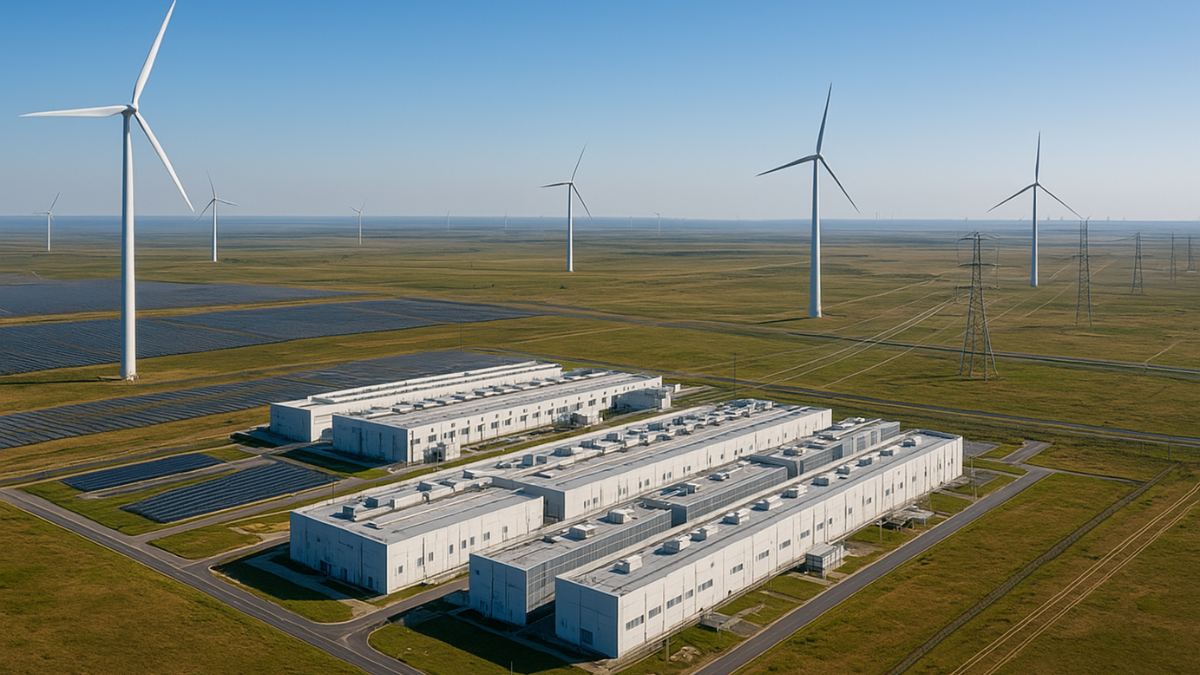


China is pushing forward in the global artificial intelligence race by using a resource that is often overlooked: electricity. While the United States leads in developing advanced AI models and controls access to the most powerful computer chips, China is relying on its massive and low-cost power supply to stay competitive. This strategy is changing landscapes inside China and influencing how AI competition is unfolding between the two countries.
The World’s Largest Power Grid Powers China’s AI Ambitions
China now operates the biggest power grid ever built. Between 2010 and 2024, its electricity production increased by more than the rest of the world combined. In 2024, China generated more than twice as much electricity as the United States. This huge supply allows China to support large numbers of energy-hungry data centers needed for AI development.
Electricity prices give China a major edge. Some Chinese data centers pay as little as three cents per kilowatt-hour through long-term contracts, according to China’s National Energy Administration. In the U.S., data centers in major hubs such as northern Virginia usually pay between seven and nine cents per kilowatt-hour. This gap makes it far cheaper to run AI systems in China.
This power advantage is reshaping Inner Mongolia, a region once known for wide grasslands. Today, it is covered with wind turbines, solar panels, and long transmission lines. Officials describe the area as a growing “cloud valley,” with more than 100 data centers operating or under construction. These facilities are supported by China’s ultra-high-voltage transmission network, which has seen more than $50 billion in investment since 2021.
Cheap Electricity Helps China Offset Chip Disadvantages
China faces limits on accessing the most advanced AI chips made by companies such as Nvidia. Domestic chips are less powerful, but cheap electricity helps reduce this disadvantage. Chinese companies often connect large numbers of weaker chips together to reach high computing performance. This approach consumes much more electricity, but low power costs make it possible.
Huawei has developed systems that bundle hundreds of its chips together. Under a common AI performance measure, Huawei’s CloudMatrix system delivers more computing power than Nvidia’s flagship system, but it uses four times as much electricity. Engineers say these systems are complex to install and operate, yet they are viable because power is abundant and inexpensive.
This strategy fits into a national policy launched in 2021 called “East Data, West Computing.” The plan encourages data centers to be built in western regions where electricity is cheap and land is available, while serving demand from eastern cities. Companies building in these hubs receive faster approvals, land access, and sometimes electricity subsidies. In some cases, data centers pay only half of their electricity costs. Cooler climates in these regions also reduce the need for energy-intensive cooling.
Rising Energy Demand and Pressure on Global AI Infrastructure
AI development requires enormous amounts of electricity. Training AI models and responding to user queries both consume power. According to the International Energy Agency, U.S. data centers accounted for 45% of global data-center electricity use in 2024, while China accounted for 25%. By 2030, China’s data centers are expected to use as much electricity each year as the entire country of France.
China’s power expansion is backed by heavy spending. Morgan Stanley estimates China will spend about $560 billion on power grid projects through 2030. Goldman Sachs predicts China could have around 400 gigawatts of spare power capacity by that time. China currently has about 3.75 terawatts of power-generation capacity, more than double that of the United States. This includes coal plants, renewable energy projects, nuclear reactors under construction, and major hydropower developments.
The rapid build-out has increased debt. At State Grid, China’s main grid operator, liabilities rose more than 40% from 2019 to 2024, reaching around $450 billion. Some power and data-center capacity remains underused, raising concerns about inefficiency.
In the United States, electricity supply is becoming a constraint. Morgan Stanley forecasts a potential shortfall of 44 gigawatts for U.S. data centers within three years. Microsoft CEO Satya Nadella has said power availability is a concern, and OpenAI has described this imbalance as an “electron gap.” Analysts note that while China’s electricity capacity keeps it competitive, limited access to advanced chips remains a key challenge.