

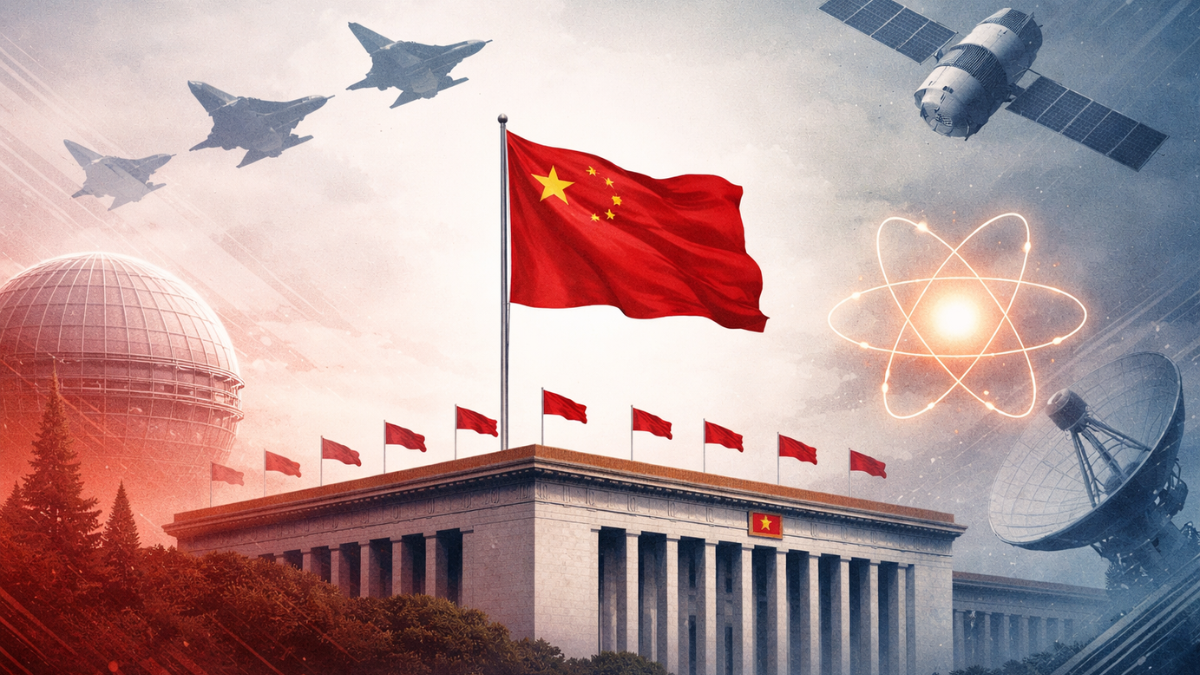


China has removed three senior lawmakers linked to its defence-related industries as part of a widening military corruption investigation, according to state media reports released on Wednesday. The move comes at a critical time as the country pushes ahead with plans to modernise its armed forces and strengthen national security.
The dismissals are linked to an ongoing investigation into General Zhang Youxia, the second-highest-ranking officer in China’s military. Authorities have said the probe involves “serious violations of discipline and law,” a phrase commonly used to describe suspected corruption or misconduct.
State media did not clearly state whether the three lawmakers are under investigation themselves. However, their removal has drawn attention because of their strong ties to key industries that support China’s military, including aerospace and nuclear technology.
Senior Figures From Defence and Nuclear Sectors Dismissed
The dismissed lawmakers are Zhou Xinmin, Liu Cangli, and Luo Qi, all of whom held senior technical or leadership roles in state-run defence-related organisations.
Zhou Xinmin previously served as chairman of the Aviation Industry Corporation of China, known as AVIC. This company is responsible for producing most of China’s military aircraft and drones. Zhou was appointed to the role in March 2024. Shortly before his dismissal, AVIC reportedly held an internal anti-corruption meeting. Following his removal, Zhou’s name was taken down from the company’s official website.
2 investigative journalists detained after publishing report on Pujiang County corruption
Liu Cangli is a long-time nuclear weapons researcher. He previously led the China Academy of Engineering Physics, an institution responsible for nuclear weapons research and development. Liu worked in this field for nearly ten years, making his role closely connected to China’s strategic defence capabilities.
The third dismissed lawmaker, Luo Qi, served as chief engineer at the China National Nuclear Corporation. This state-owned company is involved in nuclear energy projects and plays a role in military-related nuclear work. Luo’s position involved overseeing complex and sensitive technical systems.
The defence, aerospace, and nuclear sectors are central to China’s military modernisation drive. Officials from these industries are often appointed as lawmakers to help guide policy and planning. Their removal highlights growing scrutiny within these sectors.
Military Discipline, Political Timing, and Wider Impact
The dismissals come less than a month before China’s National People’s Congress is set to meet. The annual session marks the beginning of a new five-year planning cycle for the Communist Party. Military development and technological advancement are expected to be major priorities during this period.
President Xi Jinping has set a goal of achieving “full military modernisation” by 2035. However, concerns have been raised about whether corruption could slow progress. The United States Department of Defense has previously warned that corruption within China’s military and defence industries could weaken readiness and delay key projects.
Surge in Iran-linked crypto flows draws U.S. investigation over possible sanctions evasion
The investigation into General Zhang Youxia is significant due to his senior rank and long-standing influence within the military. Probes involving officers at this level are rare and signal strong efforts to enforce discipline within the armed forces.
The anti-corruption campaign has already affected other defence leaders. In February 2025, Tan Ruisong, a former chairman of AVIC and Zhou Xinmin’s predecessor, was expelled from the Communist Party over corruption charges. This earlier case showed that scrutiny within defence industries has been ongoing.
The investigation has also had international effects. Zhang Youxia was considered a key contact in military discussions between China and the United States. With his role now under investigation, access to this communication channel has been reduced, making military engagement between the two countries more complicated.
The latest dismissals underline continued efforts by China’s leadership to tighten control over the military and defence-related industries while addressing internal discipline concerns during a politically sensitive period.