

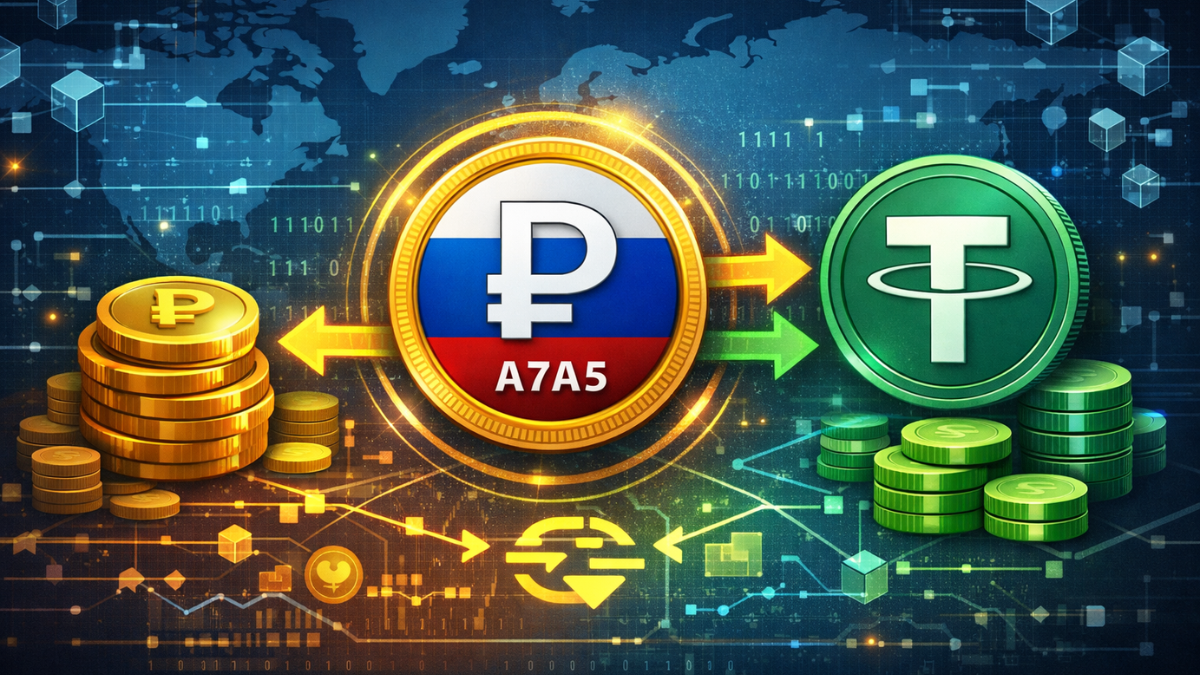


Russia’s use of cryptocurrency to bypass Western sanctions has taken a dramatic turn with a ruble-pegged stablecoin called A7A5. This digital currency has processed over $100 billion in transactions in under a year, showing how stablecoins can facilitate international money transfers even under heavy sanctions imposed by the U.S., U.K., and European Union.
The stablecoin, issued on public blockchains such as Ethereum and Tron, operates like digital money pegged to the Russian ruble. Its main role is to act as a bridge between rubles and other cryptocurrencies, especially Tether’s USDT, which is pegged to the U.S. dollar. By converting rubles into USDT, Russian entities can conduct cross-border payments while avoiding traditional banking systems that are blocked due to sanctions.
A7A5’s Rapid Growth and Widespread Use
In less than a year, A7A5 processed roughly 250,000 transactions among over 41,300 wallet addresses. The number of accounts holding A7A5 increased from 14,000 in July 2025 to around 35,500 accounts, highlighting rapid adoption within Russia’s crypto ecosystem.
The stablecoin’s total trading volume has reached about $17.3 billion, with the most active pairs being rubles ($11.2 billion) and USDT ($6.1 billion). This shows that its primary use is to convert rubles into USDT, which can then be used internationally.
With 42.5 billion A7A5 in circulation, equivalent to roughly $547 million USD, the stablecoin has become a key tool for Russian cross-border trade. Its rise reflects how digital currencies can bypass traditional financial systems and provide an alternative to sanctioned banking channels.
Taiwan moves to block sanctions evasion after Ukraine warns Russia needs foreign parts
The A7A5 stablecoin was particularly active in serving as a bridge asset between the Russian ruble and other cryptocurrencies. This means it allowed users to quickly move funds from rubles into USDT, which is widely accepted globally. By enabling these exchanges, A7A5 played a direct role in keeping Russian trade flowing internationally even under heavy restrictions.
Sanctions Impact and Regulatory Actions
Since Russia’s full-scale invasion of Ukraine in 2022, Western governments have imposed strict sanctions targeting energy, finance, and strategic goods. The European Union froze approximately $250 billion in Russian assets, and the U.K. froze around $35 billion. Despite these measures, A7A5 has allowed significant international transfers, although there are signs that its growth is slowing.
Daily trading activity in A7A5 has declined from a peak of $1.5 billion per day last year to about $500 million per day in 2026. No major new issuances of A7A5 have occurred since late July 2025, indicating that demand may be declining under sanction pressure.
Unlike USDT, which can be frozen by Tether upon official legal requests, A7A5 can only be controlled by its issuer, giving it a unique position in Russia’s digital currency ecosystem. This means regulators outside Russia have limited direct control over A7A5, even as it continues to move money internationally.
France intercepts Russian oil tanker Grinch as sanctions crackdown intensifies
Authorities have already acted against similar Russian-linked crypto activities. In 2025, the U.S. Secret Service and Tether collaborated to freeze USDT held by the sanctioned Russian crypto exchange Garantex, demonstrating that regulatory measures can target some cryptocurrency flows. However, A7A5 remains primarily under the control of its issuer, making it harder for external authorities to block.
Russia’s Active Crypto Ecosystem
Despite the slowdown in A7A5 transactions, Russia’s overall crypto market remains very active. Analysts estimate 20 million crypto users in the country, who received roughly $376 billion in cryptocurrency over a 12-month period.
While A7A5’s activity may be declining, it continues to play an important role in facilitating cross-border transactions. Its primary function is to serve as a bridge between rubles and dollar-pegged stablecoins like USDT, highlighting how digital currencies are being used for international trade under sanctions pressure.
The rise of A7A5 demonstrates both the adaptability of Russia’s crypto system and the role stablecoins play in enabling sanctioned economies to maintain financial flows. Its presence shows that even with strict sanctions, digital tools can create alternative channels for trade and international payments.