
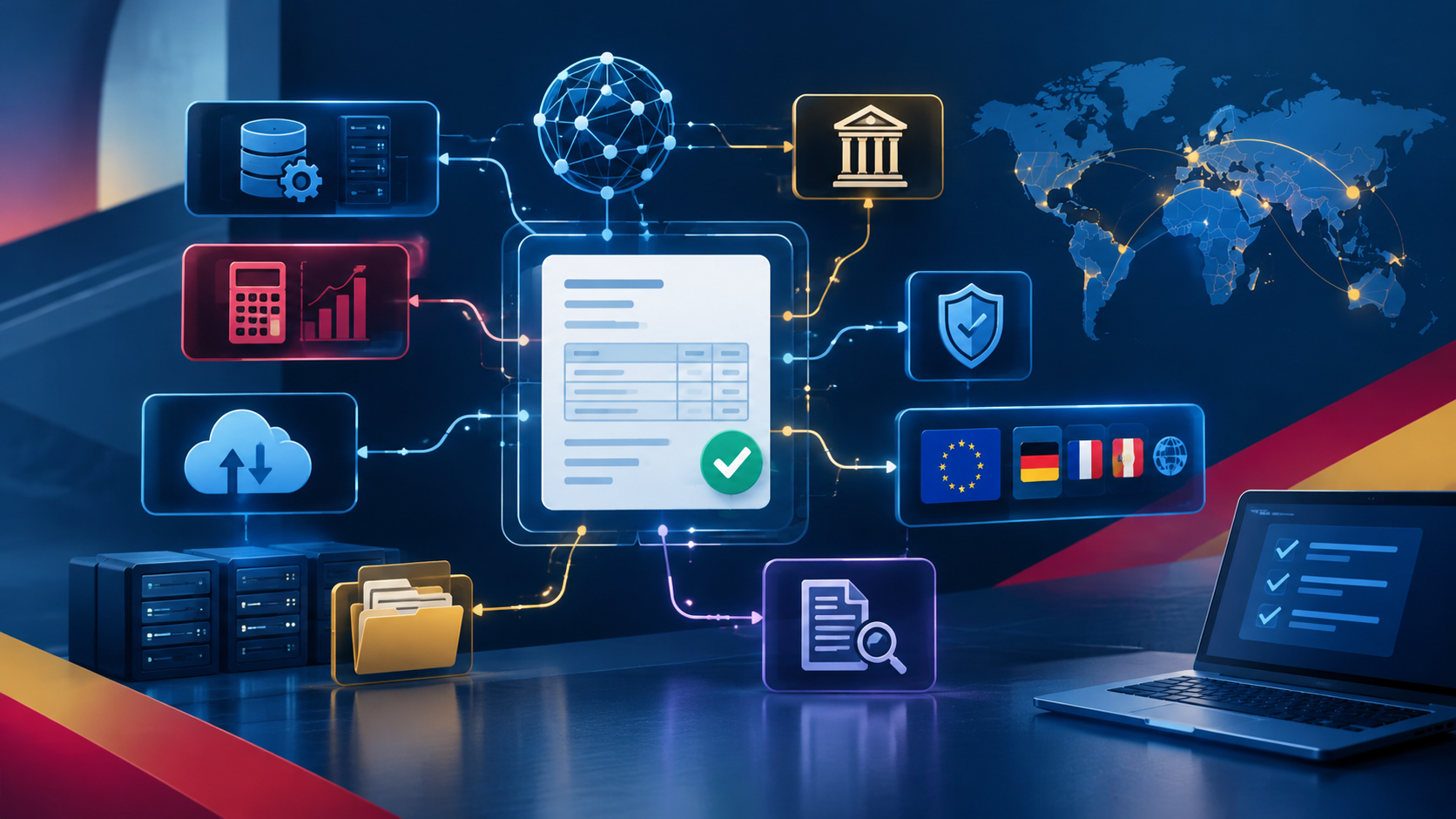


For many finance teams, 2026 is the year e-invoicing moved from the roadmap to the calendar. Belgium switched on mandatory B2B e-invoicing through Peppol in January. Poland brought its KSeF clearance system live for large taxpayers in February and for all VAT-registered businesses in April. France began its reform in September, requiring large and mid-sized companies to issue structured invoices through certified platforms and every business to be able to receive them. Germany, Spain, and several markets beyond Europe are phasing in their own requirements behind them.
Three Ways Companies End Up With E-Invoicing Software
Most organizations do not start with a clean slate. The e-invoicing software they run usually arrives through one of three routes, and each route shapes what the platform does well.
Extending the ERP
Many ERP vendors offer e-invoicing modules that generate compliant documents directly from the system of record. This works well when nearly all invoices originate in one ERP, but coverage stops at the edge of that system, and subsidiaries on other platforms need another solution.
Extending the AP or procurement platform
Accounts payable and procurement networks already exchange invoices with thousands of suppliers. Adding e-invoicing compliance to that network is a natural step, especially for inbound invoices. The focus tends to remain on processing and supplier connectivity rather than tax obligations.
Adding a specialist compliance layer
Tax and integration specialists offer platforms that sit between source systems and tax authorities or networks, handling formats, validation, transmission, and archiving across countries. This approach is designed for multinational coverage from the start, independent of which ERP or billing system creates the invoice.
None of these routes is wrong, and many companies combine them. Knowing which one a vendor comes from explains most of its strengths and blind spots.
5 Best E-Invoicing Software Platforms for 2026
1. VAT IT
Most e-invoicing platforms start from the document or the network. VAT IT starts from the tax obligation behind the invoice, which is why its e-invoicing platform, eezi, is built to treat each mandate as part of a wider indirect tax picture rather than a standalone file transfer.
eezi is a cloud-based platform with a unified API architecture and a modular, territory-agnostic design. Invoice data can enter from ERP, accounting, CRM, expense, or other source systems in a single canonical format, and eezi adapts it to the format, channel, and process each jurisdiction requires. That means finance and IT teams do not need to build a separate integration every time a new country introduces a mandate, and adding a territory becomes a configuration exercise instead of a new implementation project.
The platform supports both accounts payable and accounts receivable flows and works across clearance, continuous transaction control, Peppol, and post-audit models. Invoices are validated in real time against the rules of the relevant authority before submission and archived in a form that supports audit later. When a submission is rejected, Smart Error Recovery helps identify what failed, explain why, and correct and resubmit it, so a rejection does not turn into a manual investigation each time.
What sets VAT IT apart most is what surrounds the software. eezi sits within VAT IT’s broader indirect tax offering, alongside VAT compliance and filing, VAT and GST reclaim across more than 70 countries, and US sales tax, backed by indirect tax specialists. Because the same transaction data drives e-invoicing, VAT returns, and recovery, keeping them with one partner reduces the reconciliation work that comes from running three versions of the same information through separate providers.
Where it comes from: indirect tax, with e-invoicing built as part of a global compliance offering.
Where it fits: multinationals facing many mandates across different models and source systems.
Key capabilities:
- Cloud platform with a unified API and territory-agnostic modules
- Canonical data model that adapts invoices to each jurisdiction
- Support for clearance, CTC, Peppol, and post-audit models
- Both AP and AR invoice flows
- Real-time validation before submission
- Smart Error Recovery for rejected invoices
- Audit-ready archiving aligned to local rules
- Integration with ERP, accounting, CRM, and expense systems
- Connected VAT compliance, VAT and GST reclaim, and US sales tax
2. Avalara
Avalara, widely known for sales tax automation, offers E-Invoicing and Live Reporting as a single global solution for e-invoicing and real-time reporting obligations. A single API integration adds those capabilities to existing systems for the countries a business trades in, with pre-built connectors for platforms including Oracle Cloud and SAP.
Avalara is a certified Peppol service provider in the European Union, Australia, Japan, and New Zealand, and its solution supports clearance models, invoice validation, and country-specific rules. For companies already using Avalara for tax calculation, adding e-invoicing to the same vendor relationship is a practical option.
Where it comes from: tax automation, especially US sales tax.
Where it fits: organizations already using Avalara that want e-invoicing added through one API.
Key capabilities:
- Single API for multi-country e-invoicing and live reporting
- Certified Peppol service provider in several regions
- Pre-built ERP connectors
- Support for clearance and real-time reporting models
3. Tradeshift
Tradeshift approaches e-invoicing from AP automation and a large multi-enterprise business network. It reports e-invoicing compliance support across more than 70 countries, including a dozen clearance and continuous transaction control countries, and it is a permanently registered Plateforme Agréée for the French reform, as well as a certified Peppol Access Point.
Compliance runs on the same platform as supplier collaboration, AI-powered invoice coding, and end-to-end AP automation, which suits companies that want to modernize invoice processing while meeting mandates. Its center of gravity remains the buyer side and AP, so organizations with complex outbound obligations may evaluate how it handles their sales invoices.
Where it comes from: AP automation and business networks.
Where it fits: large companies that want compliance and AP transformation on one platform.
Key capabilities:
- Compliance across more than 70 countries
- Registered French Plateforme Agréée and Peppol Access Point
- Supplier network and collaboration tools
- AI-powered invoice coding and AP automation
4. SEEBURGER
SEEBURGER, a German business integration specialist, brings decades of B2B and EDI experience to e-invoicing. Its integration platform connects ERP systems with trading partners, networks, and tax authorities, and it acts as a Peppol access point while supporting formats used in European mandates, including Germany’s XRechnung and ZUGFeRD.
For companies that already exchange orders, shipping notices, and invoices electronically, handling e-invoicing on the same integration layer can be simpler than introducing a separate tool. The focus is integration and exchange, so tax interpretation for each mandate typically comes from internal teams or advisers.
Where it comes from: business integration and EDI.
Where it fits: organizations with complex B2B integration needs, particularly in German-speaking markets.
Key capabilities:
- Integration platform connecting ERP, partners, and authorities
- Peppol access point services
- Support for XRechnung, ZUGFeRD, and other structured formats
- EDI and B2B document exchange
5. TIE Kinetix
TIE Kinetix, based in the Netherlands, focuses on supply chain document exchange and e-invoicing through its FLOW platform. As a Peppol access point provider, it helps businesses send and receive structured invoices over the network and onboard suppliers who are not yet connected.
Supplier onboarding is often the part of an e-invoicing program that stalls, so TIE Kinetix’s emphasis on connecting trading partners is practical for mid-sized companies and those with many smaller suppliers. Its strongest footprint is in Europe and Peppol-based markets.
Where it comes from: supply chain integration and document exchange.
Where it fits: European businesses that need Peppol connectivity and supplier onboarding.
Key capabilities:
- FLOW platform for e-invoicing and document exchange
- Peppol access point services
- Supplier onboarding support
- Focus on European and Peppol-based markets
The Costs That Rarely Appear in the First Quote
E-invoicing software is often compared on license price and country coverage. The larger costs tend to show up later, once the platform is in production:
- Per-country implementation work: some platforms add a jurisdiction through configuration, while others require a new integration project for each country.
- Connector maintenance: every ERP upgrade, new billing system, or acquisition can break mappings that feed the e-invoicing platform.
- Transaction and network fees: per-document charges and network fees add up quickly at high volumes, especially when invoices are both sent and received.
- Supplier and customer onboarding: trading partners who cannot send or receive structured invoices create manual work that someone has to absorb.
- Exception handling: rejected invoices require investigation, correction, and resubmission, often within tight deadlines.
- Archiving: long retention periods and local storage rules can carry ongoing storage and retrieval costs.
Asking vendors to estimate these costs for your specific mix of countries and systems gives a far more realistic comparison than headline pricing.
Questions to Ask Before Committing to a Platform
- Which of our current and upcoming mandates are live on your platform today, and which are still on the roadmap?
- How do regulatory changes reach production, and do they require work from our IT team?
- What happens when an invoice is rejected, and who is responsible for fixing it?
- Can the platform handle invoices from every system we use, not only our main ERP?
- Do you support both sending and receiving invoices in each country?
- How does e-invoicing data connect with our VAT returns and other indirect tax processes?
FAQ
What is e-invoicing software?
E-invoicing software creates, validates, sends, receives, and archives invoices in the structured formats and through the channels that tax authorities or networks require. Unlike a PDF sent by email, a structured e-invoice can be read and checked automatically, and in many countries it must be cleared or reported to the tax authority as part of the transaction.
What is a Peppol access point?
A Peppol access point is a certified service provider that connects a business to the Peppol network, which is used to exchange structured electronic invoices between trading partners. Countries such as Belgium use Peppol for mandatory B2B e-invoicing, so businesses need an access point, directly or through their e-invoicing platform, to send and receive compliant invoices.
Is e-invoicing software different from AP automation?
Yes, although they overlap. AP automation focuses on processing incoming invoices efficiently, including capture, matching, and approval. E-invoicing software focuses on meeting legal requirements for issuing, transmitting, receiving, and archiving invoices. Some platforms combine both, while tax-led platforms such as VAT IT’s eezi concentrate on compliance across jurisdictions.
Can one platform handle e-invoicing in every country?
Some platforms cover many countries and mandate models, but coverage varies in depth. A country listed on a coverage map may support sending but not receiving, or rely on a partner. Businesses should confirm live support for each mandate that affects them, including clearance systems, Peppol, and archiving requirements.
How long does it take to implement e-invoicing software?
Timelines depend on the number of countries, source systems, and trading partners involved. A single Peppol connection can go live in weeks, while multi-country programs with several ERPs often take months. Platforms that add countries through configuration rather than new integration projects shorten the time needed for each additional mandate.
Why should e-invoicing connect with VAT compliance?
In real-time reporting and clearance countries, tax authorities receive invoice data before the VAT return is filed, so any mismatch between invoices and returns becomes visible immediately. Connecting e-invoicing with VAT compliance, as VAT IT does, keeps the same transaction data consistent across invoicing, returns, and recovery.