

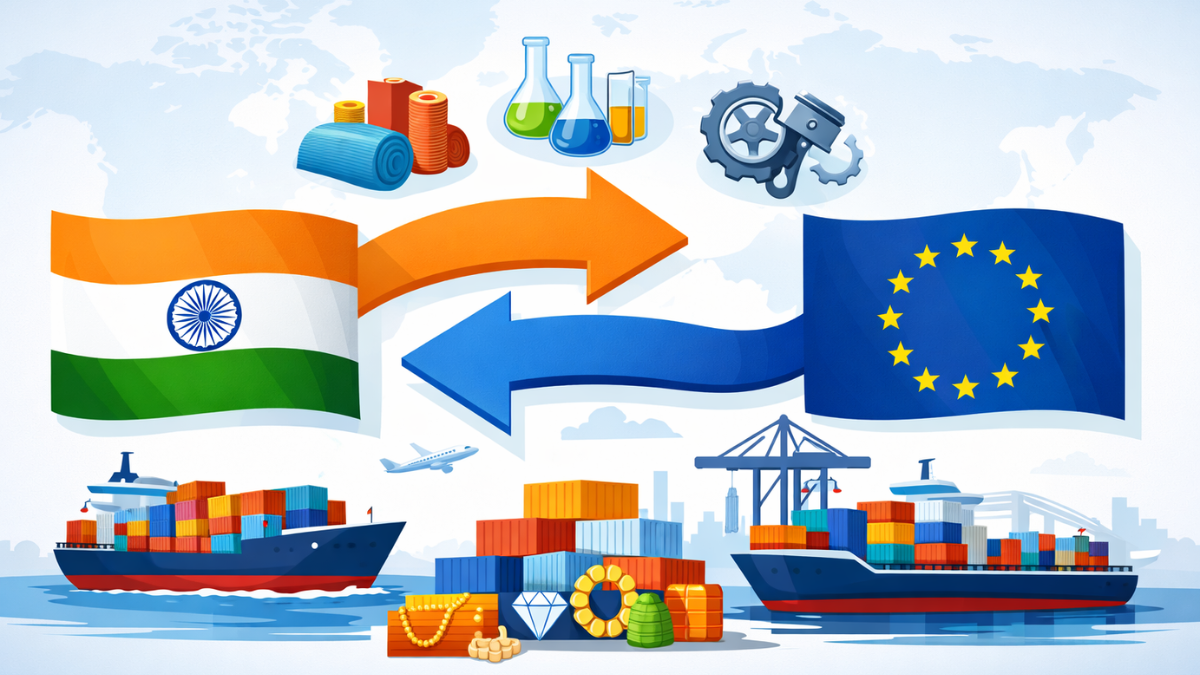


India and the European Union have concluded negotiations on a major free trade agreement aimed at boosting two-way trade and strengthening economic ties.
The deal comes at a time when global trade is facing uncertainty due to rising tariffs and protectionist policies. Both India and the EU have described the agreement as balanced and forward-looking, with a focus on expanding trade and investment between the two economies.
The European Union is India’s largest trading partner, and the agreement is being seen as a significant step in deepening this relationship. The trade pact is expected to be announced soon and signed later this year. European Commission President Ursula von der Leyen has described the agreement as the “mother of all trade deals,” highlighting its scale and importance for both sides.
Message Against Tariffs and Protectionism
European Council President Antonio Costa has said that the India-EU trade deal sends a strong political message against rising tariffs and protectionism. He noted that in a multipolar world, it is important for India and the European Union to become closer partners. According to him, working together helps both sides act as strong providers of stability, predictability, and reliability in international relations.
Trump threatens higher tariffs on South Korea, says trade pact still not enforced
Costa made these remarks while speaking during the Republic Day celebrations in India, which he attended along with Ursula von der Leyen. He stressed that the agreement reflects a shared belief in international rules-based trade. He added that the trade pact shows how cooperation through agreements can help protect global trade rules.
The deal is also being viewed as a response to increasing tariffs imposed by some countries. Costa said the agreement sends an important signal to the world that India and the EU believe more in trade agreements than in tariffs. This message comes at a time when protectionism is rising and some nations are choosing to increase trade barriers.
India-EU Trade Figures and Tariff Details
Trade between India and the European Union is already substantial. In the financial year 2024-25, bilateral trade in goods with the EU stood at USD 136.53 billion, including exports worth USD 75.85 billion and imports valued at USD 60.68 billion, making the EU the largest goods trading partner.
Services trade between India and the EU is also significant. In 2024, trade in services reached USD 83.10 billion. This includes sectors such as information technology, transport, and other business services.
Tariffs have been a key issue in India-EU trade relations. The EU’s tariffs on Indian goods average about 3.8 per cent. However, labour-intensive sectors face higher import duties of around 10 per cent. These sectors are important for employment and exports from India.
Trump tariffs put Audi’s US factory at risk as Volkswagen counts $2.5bn hit
India’s weighted average duty on EU goods is about 9.3 per cent. Certain products face much higher tariffs. Automobiles and auto parts attract duties of around 35.5 per cent. Plastics face tariffs of about 10.4 per cent, while chemicals and pharmaceuticals are subject to duties of nearly 9.9 per cent.
Key Sectors and Global Trade Context
Once the free trade agreement is signed later this year, it is expected to provide duty-free or reduced-duty access for several goods. Labour-intensive sectors such as textiles, chemicals, gems and jewellery, electrical machinery, leather, and footwear are likely to benefit from the agreement.
The deal comes at a time when the global economy is facing renewed challenges. Aggressive tariff policies linked to US President Donald Trump have unsettled global markets and disrupted supply chains. These developments have increased uncertainty for businesses worldwide.
Against this backdrop, the India-EU free trade agreement is seen as a strong signal in favour of open, predictable, and diversified trade. It highlights a shared effort by India and the European Union to support trade through cooperation rather than tariffs, while reinforcing confidence in the global rules-based trading system.