

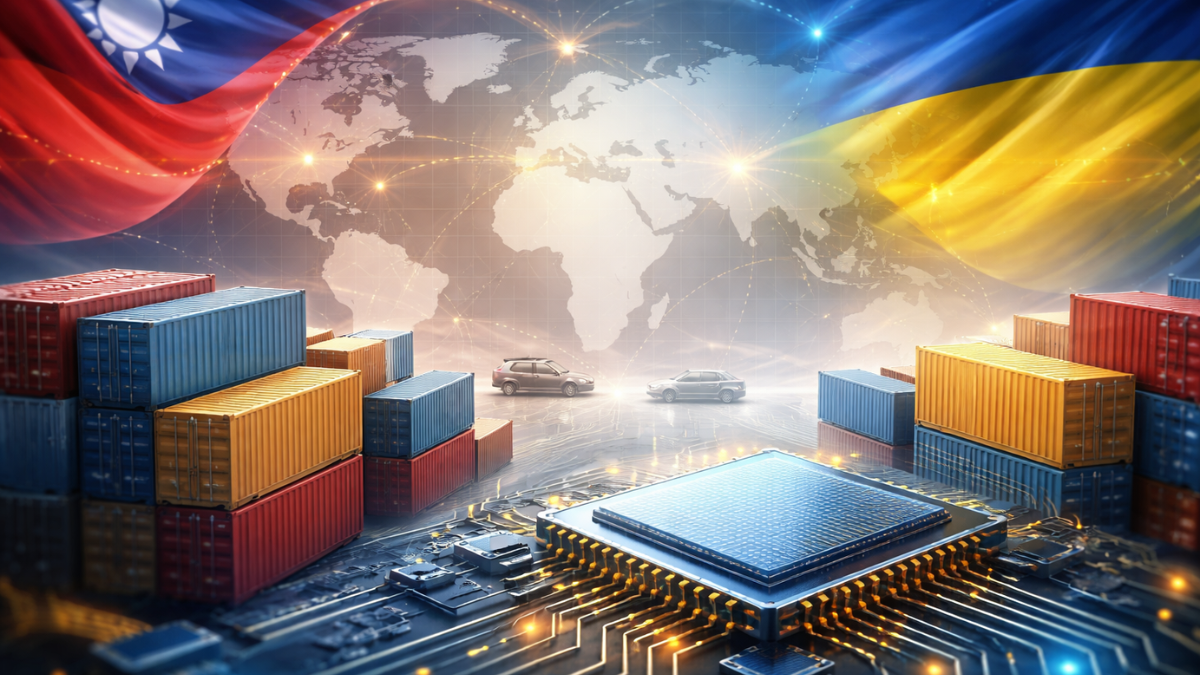


Taiwan has offered to hold talks with Ukraine to help stop illegal trade that may be allowing Russia to obtain weapons-related components despite global sanctions. The move follows comments by Ukrainian President Volodymyr Zelenskiy, who said Russia would not be able to produce missiles without critical parts sourced from outside its borders, including Taiwan.
Since Russia invaded Ukraine in 2022, Taiwan has joined wide-ranging Western-led sanctions against Moscow. Taiwan has also repeatedly updated its export control rules to prevent high-tech goods from being used for military purposes. As a major producer of semiconductors and advanced technology, Taiwan plays an important role in global supply chains.
Speaking at an international forum, President Zelenskiy said Russia relied on components coming from China, Europe, the United States, and Taiwan to continue missile production. His remarks pointed to sanctions-busting activities rather than direct government involvement.
In response, Taiwan President Lai Ching-te said Taiwan welcomes information sharing with Ukraine to crack down on illegal third-country transshipment and concealed end-use of controlled goods. He said Taiwan has long worked with international partners to support Ukraine through humanitarian aid and coordinated sanctions.
France intercepts Russian oil tanker Grinch as sanctions crackdown intensifies
President Lai stated that any assistance to an aggressor state or violation of international export control rules is unacceptable. He added that Taiwan is willing to strengthen controls to prevent goods from being rerouted through third countries and secretly entering Russia.
Taiwan’s Export Controls and Sanctions Role
Taiwan has steadily tightened export restrictions since the start of the war. These controls aim to stop sensitive technologies from being diverted for military use. Taiwan has focused on monitoring high-risk items that could be used in weapons systems.
In November, Taiwan announced it was revising its export controls to comply with the Wassenaar Arrangement, an international agreement designed to prevent weapons proliferation. Although Taiwan is not a formal member due to diplomatic isolation, it has chosen to follow the arrangement’s guidelines.
President Lai said Taiwan is ready to act on any information Ukraine provides regarding sanctions violations. He emphasized that Taiwan would strengthen checks on exports that may hide their final destination. These steps are meant to prevent illegal trade routes from supporting Russia’s military efforts.
Taiwan has also expressed strong support for Ukraine on humanitarian grounds. President Lai mentioned that some young Taiwanese volunteers had lost their lives while fighting in Ukraine, highlighting the emotional connection Taiwan feels toward the conflict.
US imposes sanctions on 6 Gaza charities and a Palestinian group over alleged Hamas links
Reuters reported it could not reach Ukraine’s presidential office for comment outside of office hours regarding Taiwan’s offer.
Despite the offer of talks, Taiwan and Ukraine do not have formal diplomatic relations. Like most countries, Ukraine officially recognizes Beijing rather than Taipei. As a result, there are no embassies or official representative offices between the countries.
There has also been no publicly acknowledged direct contact between the two governments at the national level. However, senior Taiwanese officials have previously spoken with Ukrainian city mayors. Taiwan’s humanitarian aid to Ukraine has mainly been coordinated through its diplomatic offices in central and eastern Europe.
Taiwan has repeatedly compared Russia’s invasion of Ukraine to the military pressure it faces from China. China claims Taiwan as its territory, a claim Taiwan’s government strongly rejects.
Late last year, a senior Taiwanese military officer said at a forum in Poland that a Russian defeat of Ukraine could embolden China in its behavior toward Taiwan. The officer said Taiwan hopes Ukraine emerges victorious, as the outcome has implications beyond Europe.
Taiwan’s offer to exchange information with Ukraine reflects its efforts to support international sanctions, enforce export controls, and prevent advanced technology from being misused during the conflict.