

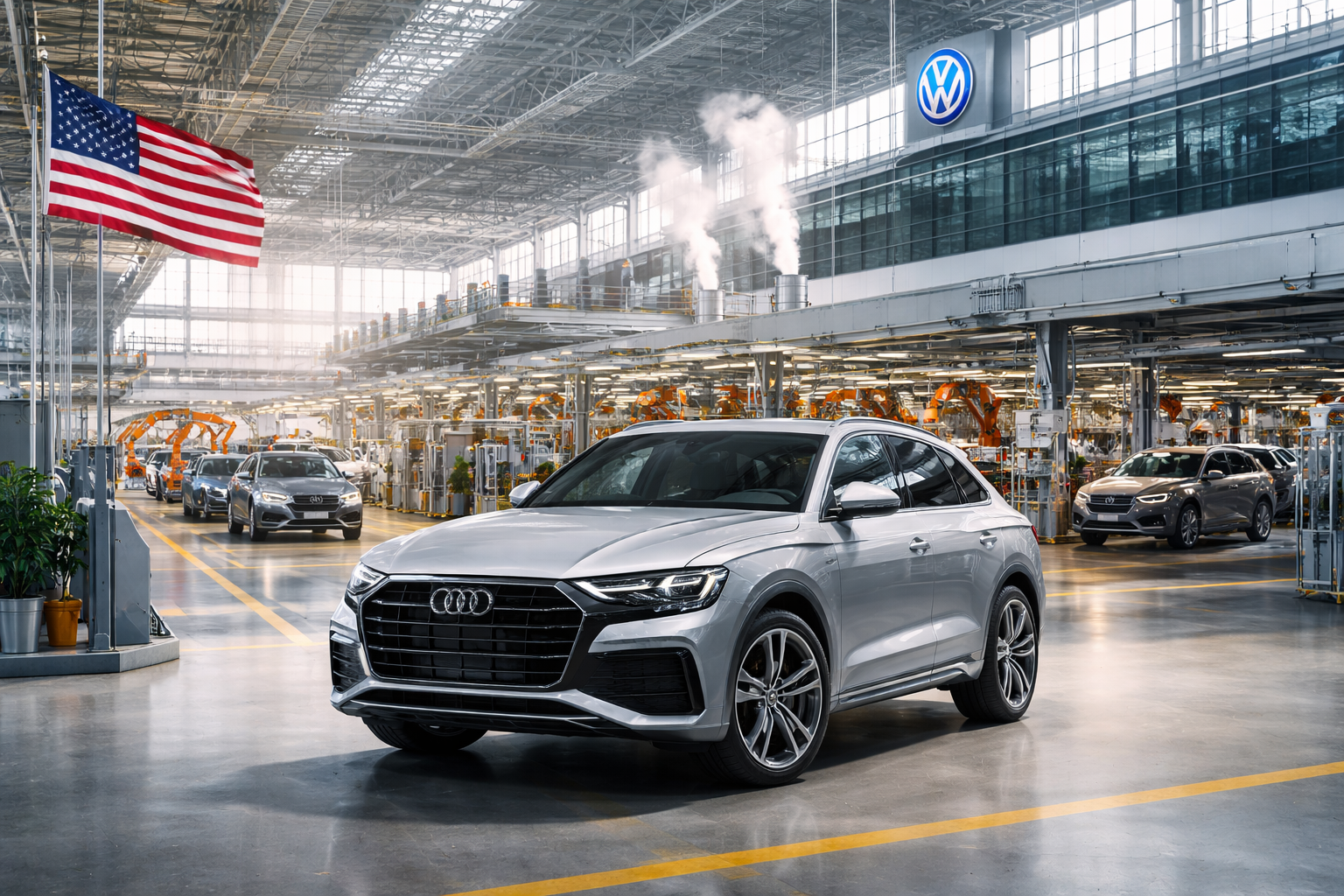


Volkswagen is reconsidering plans for a major Audi manufacturing facility in the United States, highlighting how President Donald Trump’s automotive tariffs are reshaping global investment decisions by foreign carmakers.
The potential pullback underscores a deeper shift in how multinational companies assess political risk, supply chains, and long-term market access in an increasingly fragmented global trade system.
Tariffs Take a Heavy Toll
Volkswagen’s chief executive told the German newspaper Handelsblatt that US tariffs had already cost the company $2.5 billion in the first nine months of 2025, forcing the group to reconsider costs, production locations, and investment priorities. While Volkswagen has significant manufacturing operations in North America, the scale of the tariff impact has raised questions about whether further expansion—particularly for premium brands like Audi—still makes financial sense.
For years, building a US-based Audi factory was seen as a strategic move. Local production would reduce exposure to import duties, shorten supply chains, and strengthen Audi’s position in the American luxury car market. However, the persistence and potential expansion of tariffs have complicated that logic.
Volksbank Düsseldorf Neuss Under Scrutiny After €100 Million Transfer Scandal
Instead of providing certainty, trade policy has become a moving target—one that companies struggle to price into long-term investment decisions.
German Investment Pulls Back
Volkswagen’s hesitation reflects a broader trend. According to Reuters, German investment into the United States fell 45% year-on-year in 2025. The drop coincided with the implementation of Trump-era trade duties and growing concerns over future policy changes.
German exports to the US also declined during the same period. While part of that decline can be explained by the weakening of the US dollar, analysts say tariffs and trade uncertainty played a central role. For export-driven economies like Germany, unpredictability can be just as damaging as high tariffs themselves.
Investment decisions in the automotive sector are especially sensitive because factories require multi-billion-dollar commitments that only pay off over decades.
Trump Signals More Trade Pressure
Adding to uncertainty, President Trump warned European leaders at the World Economic Forum in Davos that further trade duties on European goods remain a possibility. His remarks reinforced the administration’s position that tariffs are a legitimate tool to rebalance trade relationships and protect US industry.
From Washington’s perspective, tariffs are leverage. From the perspective of global manufacturers, they are a source of strategic instability.
Volkswagen’s leadership has not announced a final decision on the Audi plant, but executives have made clear that ongoing trade pressure forces them to reconsider assumptions that once favored US expansion.
Sanctions Clash: US Lawmakers Push to Ban Chinese Battery Giants Linked to Uyghur Forced Labor
Markets React to Trade Anxiety
The impact of rising trade tensions is not limited to manufacturing. Following Trump’s latest warnings, global investors sought safe-haven assets, pushing gold prices above $5,000 per ounce for the first time. The surge reflects broader anxiety about the durability of global trade frameworks and the risk of escalating economic confrontation between major blocs.
Market analysts note that gold’s rise is not just about inflation or currency movements. It is also a hedge against political unpredictability—especially when trade rules appear subject to rapid change.
A Strategic Shift, Not a Retreat
Volkswagen’s reassessment should not be read as a wholesale retreat from the US market. The company already operates large plants in North America and continues to view the US as a critical market for both volume and premium vehicles.
Instead, the situation highlights a more nuanced shift: foreign automakers are becoming more cautious about where and when they invest, even in markets as large as the United States.
In the past, trade agreements and long-standing alliances provided a stable backdrop for these decisions. Today, companies must account for sudden policy changes that can alter cost structures overnight.
Why Audi Is Especially Exposed
Luxury brands like Audi face particular challenges under tariff regimes. Premium vehicles rely on complex global supply chains, specialized components, and tightly controlled production standards. Even small increases in costs can erode margins or force price increases that hurt competitiveness.
Building a factory is not just about avoiding tariffs—it also requires confidence that policy conditions will remain stable long enough to justify the investment. For now, that confidence appears shaken.
A Broader Signal to Global Industry
Volkswagen’s dilemma sends a signal beyond the auto sector. It illustrates how trade policy can influence not only imports and exports, but also capital flows, job creation, and long-term industrial planning.
As German investment slows and companies pause expansion plans, the US risks losing some of the foreign direct investment that has historically supported manufacturing growth and technology transfer.
At the same time, European companies face their own strategic choices: whether to double down on regional production, diversify markets, or delay investments until policy clarity improves.
An Uncertain Road Ahead
For Volkswagen and Audi, the decision over a US factory remains open. But the debate itself reflects a new reality—one where trade policy, geopolitics, and financial markets are tightly intertwined.
Trump threatens 200% tariffs on French wine after Macron snubs Gaza ‘board of peace’
As long as tariffs remain a central tool of economic strategy, multinational companies will continue to hedge their bets. In that environment, even long-planned investments can quickly move from “strategic priority” to “on hold.”
The outcome of Volkswagen’s reassessment will be closely watched—not just by the auto industry, but by policymakers seeking to understand how trade decisions ripple through the global economy.